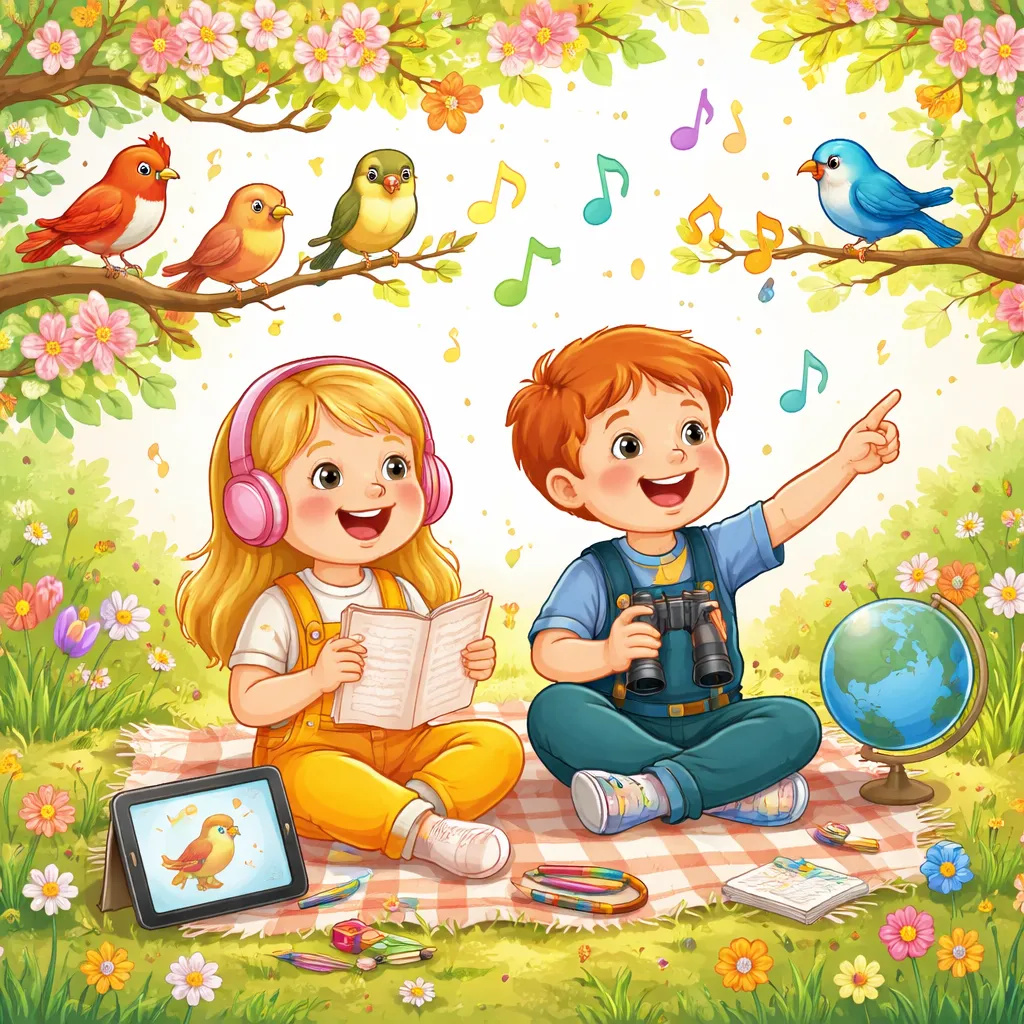

Spring arrives with a chorus of birdsong. The world wakes up. Colors return. A children’s song can capture that same sense of joyful arrival in language learning. Today, we explore a beloved German nursery rhyme called “Alle Vögel sind schon da,” which translates to “All Birds Are Already Here.” This cheerful song celebrates the return of birds in springtime. We will use this melody as a bright, welcoming path into English. Together, we will learn new words, explore important sounds, and discover how a simple song can make language learning feel like opening the window to a new season. The birds return with their songs. Your child can welcome new English words with that same joyful anticipation.
What is the rhyme? “Alle Vögel sind schon da” is a traditional German children’s song that celebrates the arrival of spring. It has been sung for generations as a way to welcome the changing season. The song names different birds and describes their happy songs. It has a bright, cheerful rhythm. Children often use hand movements. They flap their arms like wings. They make bird calls. They point to the sky. The song creates a feeling of joy and anticipation. It invites children to notice the natural world around them. When we bring this song to English learning, we keep its bright, welcoming spirit. We use the familiar melody to introduce English words in a way that feels like celebrating the return of something wonderful.
The lyrics of nursery rhymes To appreciate this song, we first look at the original German words. Then we see how they translate into English. This shows children that the same joyful welcome to spring can be expressed in different languages. You do not need to know German to enjoy the bright, cheerful rhythm of the words.
Original Version (German)
Alle Vögel sind schon da Alle Vögel, alle Welch ein Singen, Musizieren Pfeifen, Zwitschern, Tirilieren Frühling will nun einmarschieren Kommt mit Sang und Schall
English Version
All birds are already here All birds, all What a singing, music-making Whistling, chirping, trilling Spring wants to march in now Comes with song and sound
A second verse often continues, naming specific birds:
Original Version (German)
Wie sie alle lustig sind Flink und froh sich schwingen Amsel, Drossel, Fink und Star Und die ganze Vogelschar Wünschen dir ein frohes Jahr Laut mit hellem Klang
English Version
How they are all so merry Nimble and joyful they soar Blackbird, thrush, finch and starling And the whole flock of birds Wish you a happy year Loud with bright sound
As you read these words, notice the bright repetition. The rhythm moves like birds flitting from branch to branch. The story is simple and joyful. All the birds are here. They sing, whistle, chirp, and trill. Spring marches in with song and sound. The birds are merry. They wish us a happy year. This narrative invites children to celebrate the arrival of spring.
Vocabulary learning This song offers a wonderful set of words that connect to birds, spring, and joyful sounds. We can explore these words through conversation, observation, and outdoor exploration.
Start with the main idea: all the birds are here. In German, it is Vögel. In English, we say “birds.” Spring is the time when many birds return after winter.
Here are the key words to focus on from the song:
Birds: Animals with feathers that can fly. Look out the window. What birds do you see?
Already here: They have arrived. The birds have returned.
Singing: Making music with the voice. The birds sing.
Music-making: Creating music. The birds make music together.
Whistling: A high, clear sound. Birds whistle.
Chirping: A short, sharp sound. Small birds chirp.
Trilling: A rapid, warbling sound. Some birds trill.
Spring: The season after winter. This is when birds return.
March in: To enter in a steady way. Spring marches in.
Merry: Happy and cheerful. The birds are merry.
Nimble: Quick and light in movement. Birds are nimble.
Soar: To fly high. The birds soar in the sky.
Flock: A group of birds. A flock of birds together.
Happy year: A good year ahead. The birds wish us happiness.
Use these words in natural moments. When you see birds, say “look, the birds are here! They are singing.” When spring comes, say “spring is marching in!” These connections make the vocabulary meaningful.
Phonics points Phonics helps children understand the sounds that build English words. This song gives us several clear sounds to explore in a bright, springtime way.
First, focus on the ‘b’ sound at the beginning of “birds.” This is a voiced sound made with the lips together. Say “b b b.” Practice with “ball,” “big,” and “birds.” This sound is crisp and bright.
Next, notice the ‘ir’ sound in “birds” and “chirping.” Say “ir” like in “girl.” Practice with “first,” “stir,” and “birds.” This sound is made with the tongue curled back.
The word “spring” contains the ‘spr’ blend. This is three consonants together. Say “s,” then quickly add “p,” then “r.” Then add “ing.” Practice with “spring,” “sprinkle,” and “sprint.” This blend is challenging but fun.
Finally, look at the ‘fl’ blend in “flock.” Say “f” and then quickly add “l.” Then add “ock.” Practice with “flower,” “fly,” and “flock.” The song also has “thrush,” which contains the ‘th’ sound and the ‘r’ sound. Say “th” like in “think.” Then add “rush.”
Grammar patterns Even a simple song contains grammar that we can introduce gently. We do not need to use technical terms. Instead, we show how words work together through examples and play.
The song uses the present tense to describe what is happening now. “Are,” “sing,” “whistle,” and “soar” describe the present moment. You can practice by describing what you see outside. “The birds are singing.” “Spring is coming.” This builds understanding of present tense.
Notice the word “all” in “all birds.” This shows the whole group. You can practice with other “all” phrases. “All the flowers.” “All the colors.” This builds quantity vocabulary.
The phrase “wants to march in” uses the verb “wants” to show intention. Spring wants to arrive. You can practice with other “wants to” phrases. “The bird wants to sing.” “You want to play.” This builds language about desires.
Also, look at the list of bird names: blackbird, thrush, finch, starling. Listing is a common way to give information. You can practice listing things. “Birds: robin, sparrow, blue jay.” This builds organizational skills.
Learning activities Activities bring the song into the body and the imagination. They transform listening into active participation. These ideas are simple and require little preparation.
Bird Song Walk Play the song and go for a walk outside. Listen for bird songs. When you hear a bird, point and say “a bird is singing!” Try to identify the sounds. Is it whistling? Chirping? Trilling? This activity builds listening skills and connects the song to real life.
Bird Watching Sit by a window or in a garden. Watch for birds. Count how many you see. Name the birds if you know them. Say “the birds are here! They are singing.” This builds observation and vocabulary.
Spring Celebration Create a simple spring celebration. Draw or cut out pictures of birds. Hang them on a window. Sing the song together. Say “spring is marching in!” This celebrates the season with language.
Printable materials Printable resources offer a quiet way to reinforce the song’s vocabulary. They are perfect for moments when children want to create or focus calmly.
Flashcards Create a set of flashcards. One card shows a bird. One shows a musical note for “singing.” One shows a flower for “spring.” One shows a bird whistling. One shows a flock of birds. One shows the word “merry.” Use these cards for a matching game. Sing a line from the song and ask your child to find the matching card. This builds word recognition.
Coloring Page Draw a simple scene from the song. Show trees with many birds sitting on branches. Add musical notes floating in the air. Children can color the birds in bright colors. As they color, talk about the scene. “What birds do you see?” “What sounds are they making?” This keeps the language flowing naturally.
Bird Spotting Chart Create a simple chart to record birds you see. Draw columns for different birds. Sparrow. Robin. Blue jay. Pigeon. Each time you see a bird, add a mark. This builds observation and counting skills.
Educational games Games encourage repetition without boredom. They invite children to use the language in new and creative ways.
Bird Says Play a game similar to “Simon Says.” Give commands using the song’s vocabulary. “The bird says sing a song.” “The bird says whistle.” “The bird says flap your wings.” If you give a command without saying “the bird says,” the child does not move. This game builds listening skills.
What Bird Do You Hear? Play recordings of different bird songs. Ask your child to guess the bird. Start with easy ones. Cuckoo. Sparrow. Robin. This builds listening discrimination skills.
Bird Name Hunt Look at books or pictures of birds. Find a blackbird. Find a thrush. Find a finch. Find a starling. Say the names together. This builds bird vocabulary.
As you share “Alle Vögel sind schon da” with your child, remember that you are celebrating the joy of arrival and new beginnings. The birds come back in spring. They sing. They whistle. They chirp. They bring happiness. Learning a new language is also a kind of arrival. New words come into your child’s world. New sounds appear. And with them comes the joy of expression. Let the singing birds be your guide. Sing the song when you notice the changing seasons. Let the bright spirit of spring remind you both that every new word is like a bird returning home, and when they all gather together, they make a beautiful song.