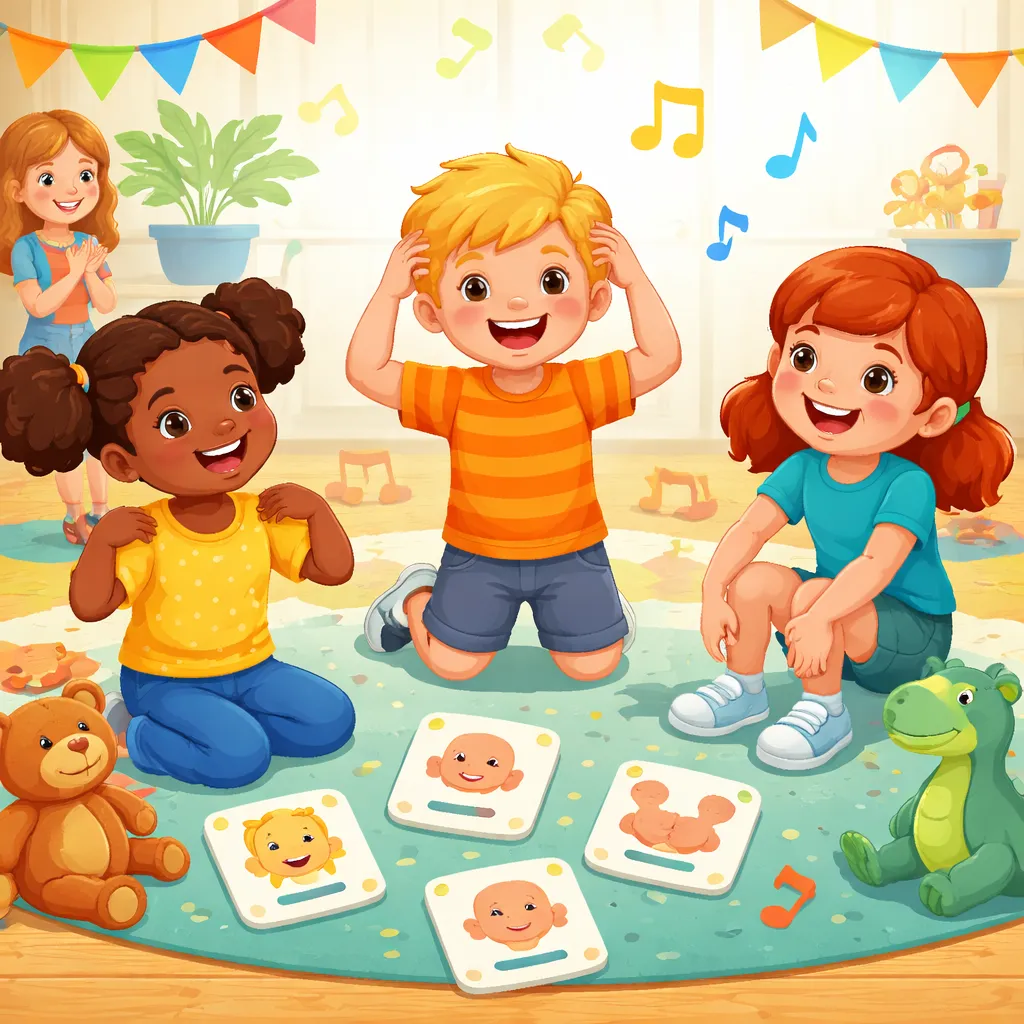

A child touches their head. Then their shoulders. Then their knees. Then their toes. This simple action becomes a joyful game when set to music. A children’s song can turn learning body parts into a playful, moving experience. Today, we explore a German version of the beloved nursery rhyme “Head, Shoulders, Knees and Toes,” known as “Kopf, Schulter, Knie und Fuß.” This energetic song invites children to touch and name parts of their body. We will use this melody as a lively, kinesthetic path into English. Together, we will learn new words, explore important sounds, and discover how a simple song can make language learning feel like a game you play with your whole body. The song gets faster and faster. Your child can learn English words with that same joyful energy.
What is the rhyme? “Head, Shoulders, Knees and Toes” is one of the most beloved action songs in the English-speaking world. The German version, “Kopf, Schulter, Knie und Fuß,” follows the same pattern. The song names parts of the body in order. Children touch each part as they sing. The song starts slowly and often gets faster with each repetition. It has a lively, accelerating rhythm. Children love the challenge of keeping up as the speed increases. The song creates a joyful, active atmosphere. It invites children to learn through movement. When we bring this song to English learning, we keep its lively, kinesthetic spirit. We use the familiar melody to introduce English words in a way that feels like playing with your own body.
The lyrics of nursery rhymes To appreciate this song, we first look at the original German words. Then we see how they translate into English. This shows children that the same playful body game exists in different languages. You do not need to know German to enjoy the lively, building rhythm of the words.
Original Version (German)
Kopf, Schulter, Knie und Fuß Knie und Fuß Kopf, Schulter, Knie und Fuß Knie und Fuß Und Augen, Ohren, Nase, Mund Kopf, Schulter, Knie und Fuß Knie und Fuß
English Version
Head, shoulders, knees and toes Knees and toes Head, shoulders, knees and toes Knees and toes And eyes, ears, nose, mouth Head, shoulders, knees and toes Knees and toes
As you read these words, notice the building repetition. The rhythm moves like a playful challenge. The song names the body parts in order. First the head, shoulders, knees, and toes. Then it adds eyes, ears, nose, and mouth. This narrative invites children to learn and move at the same time.
Vocabulary learning This song offers a wonderful set of words that connect to body parts. We can explore these words through conversation, movement, and playful touching.
Start with the main subject: body parts. In German, they are Kopf, Schulter, Knie, Fuß. In English, we say head, shoulders, knees, toes. These are parts of our body we can see and touch.
Here are the key words to focus on from the song:
Head: The top part of your body. Touch your head.
Shoulders: The parts between your neck and arms. Touch your shoulders.
Knees: The middle parts of your legs. Touch your knees.
Toes: The ends of your feet. Wiggle your toes.
Eyes: The parts you see with. Point to your eyes.
Ears: The parts you hear with. Point to your ears.
Nose: The part you smell with. Point to your nose.
Mouth: The part you speak and eat with. Point to your mouth.
Use these words in natural moments. When you get dressed, name the body parts. “Put your shirt over your head.” “Pull up your pants over your knees.” When you wash, name the parts. “Wash your face. Wash your ears.” These connections make the vocabulary meaningful.
Phonics points Phonics helps children understand the sounds that build English words. This song gives us several clear sounds to explore in a lively, moving way.
First, focus on the ‘h’ sound at the beginning of “head.” This is a soft, breathy sound. Say “h h h” like a gentle sigh. Practice with “hello,” “home,” and “head.” This sound is light and clear.
Next, notice the ‘sh’ sound in “shoulders.” This is a quiet, airy sound. Put your finger to your lips and say “shhh.” Then say “shoulders.” Practice with “ship,” “fish,” and “shoulders.” This sound is soft.
The word “knees” contains the ‘kn’ blend. The ‘k’ is silent. Say “n” like in “no.” Then add “eez.” Practice with “knee,” “knife,” and “knees.” The silent ‘k’ is a special pattern in English.
Finally, look at the ‘t’ sound in “toes.” This is a sharp, unvoiced sound. Put your hand in front of your mouth and say “t t t.” You will feel air. Practice with “top,” “toy,” and “toes.” The song also has “nose,” which contains the long ‘o’ sound. Say “oh” like in “go.”
Grammar patterns Even a simple song contains grammar that we can introduce gently. We do not need to use technical terms. Instead, we show how words work together through examples and play.
The song uses nouns to name body parts. “Head,” “shoulders,” “knees,” and “toes” are all nouns. You can practice naming body parts on yourself and on a doll. “This is my head.” “This is my nose.” This builds noun vocabulary.
Notice the use of “and” to connect words. “Head, shoulders, knees and toes.” “And” joins the last item. You can practice making lists with “and.” “I have eyes, ears, a nose and a mouth.” This builds sentence structure.
The repetition of the list helps with memorization. Repeating words helps them stick. You can practice repeating lists. “Head, shoulders, knees, toes.” “Eyes, ears, nose, mouth.” This builds memory and fluency.
Also, look at how the song builds. First the four main parts. Then it adds four more. This is a cumulative structure. You can practice adding new items to a list. “Head, shoulders, knees, toes, and eyes.” This builds sequencing skills.
Learning activities Activities bring the song into the body and the imagination. They transform listening into active participation. These ideas are simple and require little preparation.
Body Part Touch Play the song and touch each body part as you sing. Start slowly. Then sing faster and faster. See how fast you can go. This activity builds listening skills, coordination, and vocabulary.
Mirror Game Stand facing each other. Sing the song and touch your body parts. Your child mirrors your actions. Then switch roles. Your child leads, and you follow. This builds observation and turn-taking.
Body Part Drawing Draw an outline of a body on a large paper. Your child can draw the parts or point to them. Label them with the English words. This builds literacy and vocabulary.
Printable materials Printable resources offer a quiet way to reinforce the song’s vocabulary. They are perfect for moments when children want to create or focus calmly.
Flashcards Create a set of flashcards. One card shows a head. One shows shoulders. One shows knees. One shows toes. One shows eyes. One shows ears. One shows a nose. One shows a mouth. Use these cards for a matching game. Sing a line from the song and ask your child to find the matching card. This builds word recognition.
Coloring Page Draw a simple body outline. Label the parts: head, shoulders, knees, toes, eyes, ears, nose, mouth. Children can color the picture and trace the words. As they color, talk about the parts. “Where are your knees?” “Point to your nose.” This keeps the language flowing naturally.
Body Part Puzzle Create a simple puzzle by drawing a body on paper and cutting it into pieces. Head, shoulders, arms, legs, feet. Your child puts the puzzle together while naming the parts. This builds fine motor skills and vocabulary.
Educational games Games encourage repetition without boredom. They invite children to use the language in new and creative ways.
Body Part Says Play a game similar to “Simon Says.” Give commands using the song’s vocabulary. “Head says touch your head.” “Shoulders says touch your shoulders.” “Knees says touch your knees.” “Toes says wiggle your toes.” If you give a command without naming a body part, the child does not move. This game builds listening skills.
Point and Name Point to a body part on yourself or a doll. Ask your child to name it. Then switch roles. Your child points, and you name. This builds recognition and vocabulary.
Speed Challenge Sing the song slowly. Then sing it faster. Then faster. See who can keep up. This builds coordination and makes learning fun.
As you share this song with your child, remember that you are building a connection between words and the body. Head, shoulders, knees, toes. Eyes, ears, nose, mouth. These are the parts that make us who we are. Learning a new language is also about connection. Words connect to objects. Sounds connect to meaning. And when you move your body while you learn, the words become part of you. Let the lively song be your guide. Sing it when you need to move. Sing it when you need to wake up. Let the joyful rhythm remind you both that every new word is a part of you now, and you can reach out and touch it anytime you want.