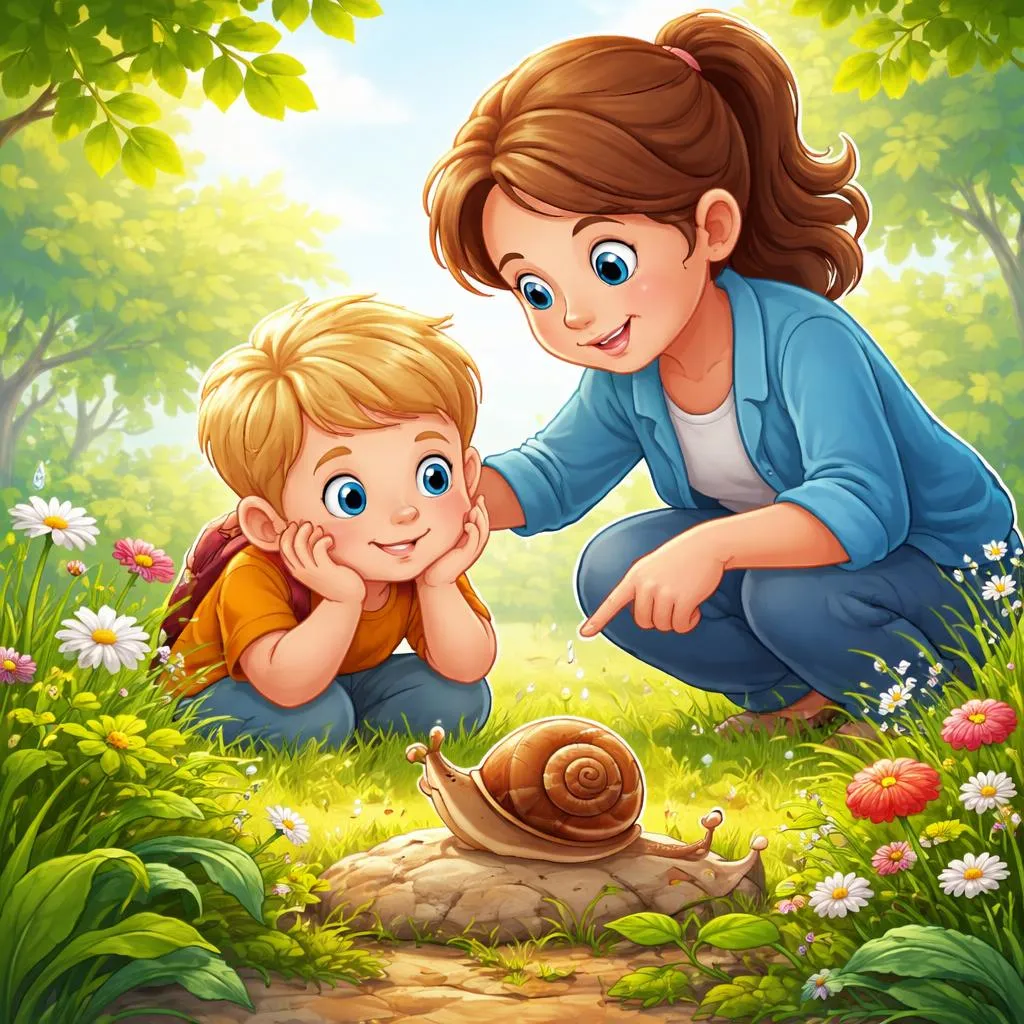

A snail moves slowly across a leaf. It carries its house on its back. It takes its time. A children’s song can capture that gentle pace and bring it into language learning. Today, we explore a traditional German nursery rhyme called “Schnecke, Schnecke,” which translates to “Little Snail.” This gentle song follows a snail as it slowly moves along. We will use this melody as a calm, patient path into English. Together, we will learn new words, explore important sounds, and discover how a simple song can make language learning feel like taking one small, steady step at a time. The snail does not hurry. Your child can learn English with that same patient, steady pace.
What is the rhyme? “Schnecke, Schnecke” is a gentle German nursery rhyme that celebrates the slow, steady movement of a snail. It is often sung as a finger play. Children use their fingers to make snail antennae. They move their hands slowly. The song has a slow, steady rhythm that mimics a snail’s pace. Children love the gentle repetition and the playful invitation to come out of the shell. The song creates a calm, patient atmosphere. When we bring this song to English learning, we keep its slow, steady spirit. We use the familiar melody to introduce English words in a way that feels like watching a snail make its way across a leaf, one small step at a time.
The lyrics of nursery rhymes To appreciate this song, we first look at the original German words. Then we see how they translate into English. This shows children that the same gentle invitation to move slowly can be expressed in different languages. You do not need to know German to enjoy the slow, patient rhythm of the words.
Original Version (German)
Schnecke, Schnecke Krieche, krieche Zeig mir deine zwei Fühler Streck sie raus, streck sie raus Dann kriechst du wieder in dein Haus
English Version
Little snail, little snail Crawl, crawl Show me your two feelers Stretch them out, stretch them out Then you crawl back into your house
A shorter version is also common:
Schnecke, Schnecke Komm heraus Zeig mir dein kleines Haus
English Version
Little snail, little snail Come on out Show me your little house
As you read these words, notice the slow, gentle repetition. The rhythm moves like a snail gliding. The story is simple and patient. A snail is asked to crawl. It is asked to show its feelers. Then it goes back into its shell. This narrative invites children to observe nature slowly and patiently.
Vocabulary learning This song offers a lovely set of words that connect to nature, slow movement, and patience. We can explore these words through conversation, pictures, and gentle observation.
Start with the main character: the snail. In German, it is Schnecke. In English, we say “little snail.” Snails are small creatures that carry their homes on their backs. They move very slowly.
Here are the key words to focus on from the song:
Snail: A small creature with a shell on its back. Look at pictures of snails together.
Crawl: To move slowly on the ground. The snail crawls.
Feelers: The two antennae on a snail’s head. Snails use them to feel around.
Stretch: To extend. The snail stretches out its feelers.
House: The snail’s shell. The snail carries its house on its back.
Come out: To leave the shell. We ask the snail to come out.
Show: To let someone see. Show me your house.
Use these words in natural moments. When you see a snail, say “look, a little snail! It is crawling slowly.” When your child is taking their time, say “you are like a little snail, taking your time.” These connections make the vocabulary meaningful.
Phonics points Phonics helps children understand the sounds that build English words. This song gives us several clear sounds to explore in a slow, gentle way.
First, focus on the ‘sn’ blend at the beginning of “snail.” This is two consonants together. Say “s” like a snake, then quickly add “n.” Then add “ail.” Practice with “snow,” “snake,” and “snail.” This blend is soft and smooth.
Next, notice the long ‘a’ sound in “snail” and “crawl.” Actually, “crawl” has the ‘aw’ sound. Let us focus on the long ‘a’ in “snail.” Say “ay” like in “day.” Practice with “mail,” “pail,” and “snail.” This sound is bright.
The word “crawl” contains the ‘aw’ sound. Say “aw” like in “saw.” Practice with “paw,” “straw,” and “crawl.” This sound is open and low.
Finally, look at the ‘sh’ sound in “show” and “stretch.” The ‘sh’ is a quiet, airy sound. Put your finger to your lips and say “shhh.” Then say “show.” Practice with “ship,” “fish,” and “stretch.” The song also has “feelers,” which contains the long ‘e’ sound. Say “ee” like in “see.”
Grammar patterns Even a simple song contains grammar that we can introduce gently. We do not need to use technical terms. Instead, we show how words work together through examples and play.
The song uses the imperative mood. “Crawl,” “show,” “stretch,” and “come” are commands. You can practice giving gentle commands. “Crawl slowly.” “Show me your toy.” This builds understanding of how to give instructions.
Notice the repetition of words. “Crawl, crawl” and “stretch them out, stretch them out” repeat for emphasis. You can practice repeating for gentle emphasis. “Slowly, slowly.” “Gently, gently.” This adds a calm, patient tone.
The phrase “show me” is a request. You can practice using “show me” to ask to see things. “Show me your drawing.” “Show me your snail.” This builds conversational language.
Also, look at the preposition “into” in “crawl back into your house.” This shows movement to the inside. You can practice with other “into” phrases. “Go into the room.” “Put the toy into the box.” This teaches spatial language.
Learning activities Activities bring the song into the body and the imagination. They transform listening into active participation. These ideas are simple and require little preparation.
Snail Crawl Play the song and pretend to be a snail. Crawl slowly on the floor. When the song says “show me your feelers,” put your fingers up like antennae. When it says “stretch them out,” stretch your arms. When it says “crawl back into your house,” curl up into a ball. This activity builds listening skills and slow, patient movement.
Snail Observation If you can find a snail outside, watch it together. Observe how slowly it moves. Notice its feelers. Talk about its shell. Sing the song softly while watching. This connects the song to real nature observation.
Snail Craft Create a simple snail using a paper plate or a circle of paper for the shell. Add a strip of paper for the body. Draw eyes and feelers. Talk about the snail as you create. This combines fine motor skills with language practice.
Printable materials Printable resources offer a quiet way to reinforce the song’s vocabulary. They are perfect for moments when children want to create or focus calmly.
Flashcards Create a set of flashcards. One card shows a snail. One shows a snail crawling. One shows antennae for “feelers.” One shows a shell for “house.” One shows a hand stretching for “stretch.” One shows a snail coming out of its shell for “come out.” Use these cards for a matching game. Sing a line from the song and ask your child to find the matching card. This builds word recognition.
Coloring Page Draw a simple scene from the song. Show a snail crawling on a leaf. Draw its shell and its feelers. Children can color the snail and the leaf. As they color, talk about the scene. “Where is the snail going?” “What does it carry on its back?” This keeps the language flowing naturally.
Snail Trail Page Create a page with a winding path. Draw a snail at the start. Your child can trace the path with their finger, pretending to be the snail crawling slowly. Say “crawl, crawl, little snail.” This builds fine motor skills and patience.
Educational games Games encourage repetition without boredom. They invite children to use the language in new and creative ways.
Snail Says Play a game similar to “Simon Says.” Give commands using the song’s vocabulary. “The snail says crawl slowly.” “The snail says show your feelers.” “The snail says go into your house.” If you give a command without saying “the snail says,” the child does not move. This game builds listening skills.
Slow Race Have a crawling race. See who can crawl the slowest. The winner is the one who takes the longest. This builds patience and makes “slow” a positive word.
Find the Snail Hide a picture of a snail or a toy snail around the room. Say “where is the little snail?” Crawl slowly to find it. When found, say “the snail is in its house!” This builds vocabulary and patience.
As you share this song with your child, remember that you are celebrating patience and slow, steady progress. The little snail crawls slowly. It shows its feelers. It goes back into its house. There is no rush. Learning a new language also takes time. Some days, progress feels fast. Other days, it feels slow. Both are important. Let the gentle snail be your guide. Move at your child’s pace. Celebrate each small step. Let the patient spirit of the snail remind you both that every word learned is a step forward, and even the slowest crawl brings you closer to where you want to go.