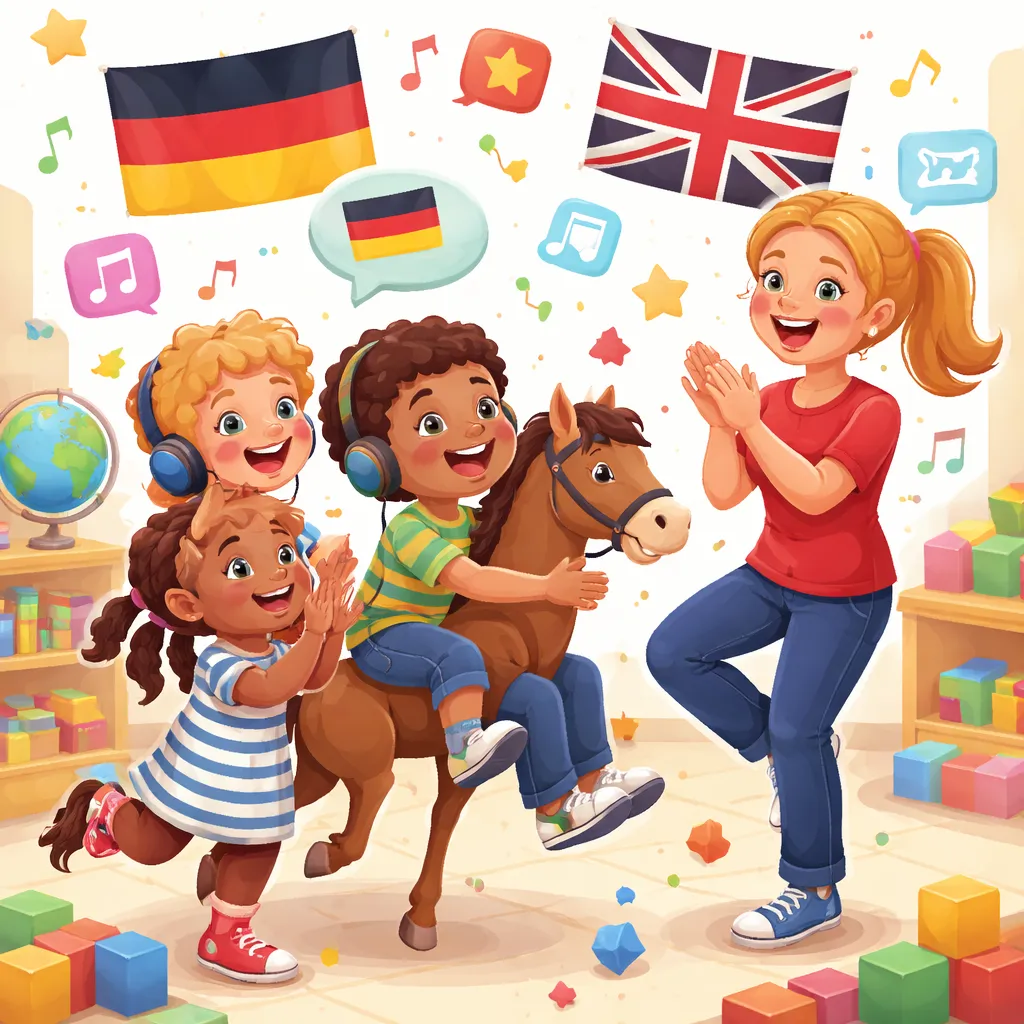

A child bounces on a parent’s knee. The horse gallops, then stumbles. The child laughs. This simple game has brought joy to families for generations. A children’s song can capture that same playful rhythm and bring it into language learning. Today, we explore a traditional German nursery rhyme called “Hoppe, hoppe Reiter,” which translates to “Spotted, Spotted” or “Giddy-up, Horseman.” This lively song mimics the bouncing rhythm of a horse ride. We will use this melody as a rhythmic, playful path into English. Together, we will learn new words, explore important sounds, and discover how a simple song can make language learning feel like a joyful bounce on a parent’s knee. The horse goes up and down. Your child can learn English with that same joyful rhythm.
What is the rhyme? “Hoppe, hoppe Reiter” is a beloved German nursery rhyme that is often sung as a knee-bouncing game. A parent sits a child on their knee and bounces them gently while singing. The song tells the story of a horseman who rides his horse. When the horse falls, the child slides off the knee. It is a moment of playful surprise. The song has a steady, bouncing rhythm that mimics a horse’s trot. Children love the anticipation of the fall. The song creates a feeling of closeness, rhythm, and playful anticipation. When we bring this song to English learning, we keep its rhythmic, playful spirit. We use the familiar melody to introduce English words in a way that feels like a game of ups and downs.
The lyrics of nursery rhymes To appreciate this song, we first look at the original German words. Then we see how they translate into English. This shows children that the same playful bouncing game can be expressed in different languages. You do not need to know German to enjoy the steady, bouncing rhythm of the words.
Original Version (German)
Hoppe, hoppe Reiter Wenn er fällt, dann schreit er Fällt er in den Graben Fressen ihn die Raben Fällt er in den Sumpf Dann macht der Reiter Plumps!
English Version
Giddy-up, giddy-up, horseman If he falls, he screams If he falls into the ditch The ravens will eat him If he falls into the swamp Then the horseman goes plop!
A gentler English version often used for bouncing games:
Giddy-up, giddy-up, horseman Riding down the lane If he falls, he calls out “I’ll get up again!”
Giddy-up, giddy-up, horseman Riding up the hill If he tumbles, grumbles But he’s riding still!
As you read these words, notice the steady, bouncing repetition. The rhythm moves like a horse’s hooves. The story is simple and playful. The horseman rides. If he falls, something happens. But in the gentler version, he gets up again. This narrative invites children to enjoy rhythm, anticipation, and resilience.
Vocabulary learning This song offers a wonderful set of words that connect to movement, animals, and playful repetition. We can explore these words through conversation, actions, and bouncing games.
Start with the main action: riding. In German, it is Reiter. In English, we say “horseman” or “rider.” The song is about a person riding a horse.
Here are the key words to focus on from the song:
Giddy-up: A word used to tell a horse to go. Say it with energy. Giddy-up!
Horseman: A person riding a horse. The horseman rides down the lane.
Falls: Drops to the ground. The horseman might fall.
Screams: Cries out loudly. If he falls, he screams.
Ditch: A small trench by the road. The horseman could fall into a ditch.
Ravens: Large black birds. In the song, ravens might come.
Swamp: Wet, muddy land. The horseman could fall into a swamp.
Plop: The sound of falling into water or mud. The horseman goes plop!
Lane: A narrow road. The horseman rides down the lane.
Hill: A raised area of land. The horseman rides up the hill.
Tumbles: Falls suddenly. The horseman tumbles.
Grumble: Complain quietly. The horseman grumbles but keeps riding.
Riding still: Continuing to ride. The horseman does not give up.
Use these words in natural moments. When you bounce your child on your knee, say “giddy-up, giddy-up!” When someone falls, say “plop!” These connections make the vocabulary meaningful and playful.
Phonics points Phonics helps children understand the sounds that build English words. This song gives us several clear sounds to explore in a rhythmic, playful way.
First, focus on the ‘g’ sound at the beginning of “giddy-up.” This is a voiced sound made with the back of the tongue. Say “g g g.” Practice with “go,” “garden,” and “giddy.” The ‘g’ is followed by a short ‘i’ sound.
Next, notice the short ‘i’ sound in “giddy,” “hill,” and “still.” Say “i” like in “igloo.” Practice with “sit,” “big,” and “giddy.” This is a very common vowel sound.
The word “plop” contains the ‘pl’ blend and the short ‘o’ sound. Say “p,” then quickly add “l.” Then add “op.” Practice with “play,” “plant,” and “plop.” The ‘pl’ blend is bright and bouncy.
Finally, look at the ‘r’ sound in “rider” and “ride.” This is a voiced sound made with the tongue. Say “rrrr.” Practice with “run,” “red,” and “rider.” The song also has “tumble,” which contains the ‘t’ sound and the ‘um’ sound. Say “t” like in “top.” Then “umble” like in “humble.”
Grammar patterns Even a simple song contains grammar that we can introduce gently. We do not need to use technical terms. Instead, we show how words work together through examples and play.
The song uses the present tense to describe what happens. “Rides,” “falls,” “screams,” and “tumbles” describe actions that happen regularly or in the story. You can practice by describing the bouncing game. “You bounce. You fall. You laugh.” This builds understanding of present tense.
Notice the conditional “if” in the song. “If he falls, he screams.” This shows what happens in a certain situation. You can practice with other “if” phrases. “If you bounce, you go up and down.” “If you fall, you get up.” This builds understanding of cause and effect.
The word “still” means “continuing.” “Riding still” means continuing to ride even after falling. You can practice with other “still” phrases. “Still playing.” “Still singing.” This adds a useful adverb.
Also, look at the exclamation “plop!” This is onomatopoeia. It is a word that sounds like the action. You can practice other sound words. “Boom!” “Splash!” “Bounce!” This adds playful language.
Learning activities Activities bring the song into the body and the imagination. They transform listening into active participation. These ideas are simple and require little preparation.
Knee Bouncing Sit with your child on your lap. Bounce them gently in rhythm with the song. On the word “falls” or “plop,” let them slide gently down your knees. This activity builds rhythm, anticipation, and connection.
Horse Ride Game Pretend to be horses. Get on all fours or use a riding toy. Walk around the room. When the song says “giddy-up,” go faster. When it says “falls,” pretend to tumble. Then get up and ride again. This builds listening skills and physical play.
Up and Down Practice the words “up” and “down” while bouncing. “Up we go! Down we go!” Connect this to the horse’s movements. This builds understanding of opposites.
Printable materials Printable resources offer a quiet way to reinforce the song’s vocabulary. They are perfect for moments when children want to create or focus calmly.
Flashcards Create a set of flashcards. One card shows a horseman. One shows a horse galloping for “giddy-up.” One shows a person falling for “falls.” One shows a ditch. One shows a swamp. One shows the word “plop.” Use these cards for a matching game. Sing a line from the song and ask your child to find the matching card. This builds word recognition.
Coloring Page Draw a simple scene from the song. Show a horseman riding down a lane. Draw a hill in the distance. Children can color the horse and rider. As they color, talk about the scene. “Where is the horseman riding?” “What happens if he falls?” This keeps the language flowing naturally.
Horse Puppet Create a simple horse puppet using a paper bag or sock. Decorate it with a mane and eyes. Use the puppet to act out the song while bouncing it on your hand. This combines fine motor skills with language practice.
Educational games Games encourage repetition without boredom. They invite children to use the language in new and creative ways.
Horseman Says Play a game similar to “Simon Says.” Give commands using the song’s vocabulary. “The horseman says giddy-up!” “The horseman says ride up the hill.” “The horseman says tumble down.” If you give a command without saying “the horseman says,” the child does not move. This game builds listening skills.
Obstacle Course Create a simple obstacle course. Use cushions as hills. A blanket as a swamp. Jump over a “ditch” made of tape. Ride (walk) through the course. When you fall, say “plop!” Then get up and continue. This builds movement and vocabulary.
Sound Effects Take turns making sound effects for the song. Clop, clop for horse hooves. Plop for falling. Giddy-up for going faster. This builds sound vocabulary and creativity.
As you share “Hoppe, hoppe Reiter” with your child, remember that you are building rhythm, resilience, and joy. The horseman rides. Sometimes he falls. But he gets up again. He keeps riding. Learning a new language has its ups and downs too. Some words come easily. Some words make you stumble. But with practice, you get up again. You keep riding. Let the playful horseman be your guide. Bounce together. Fall together. Get up together. Let the steady rhythm of the song remind you both that every “plop” is just part of the ride, and the joy is in the journey, up and down, all the way.