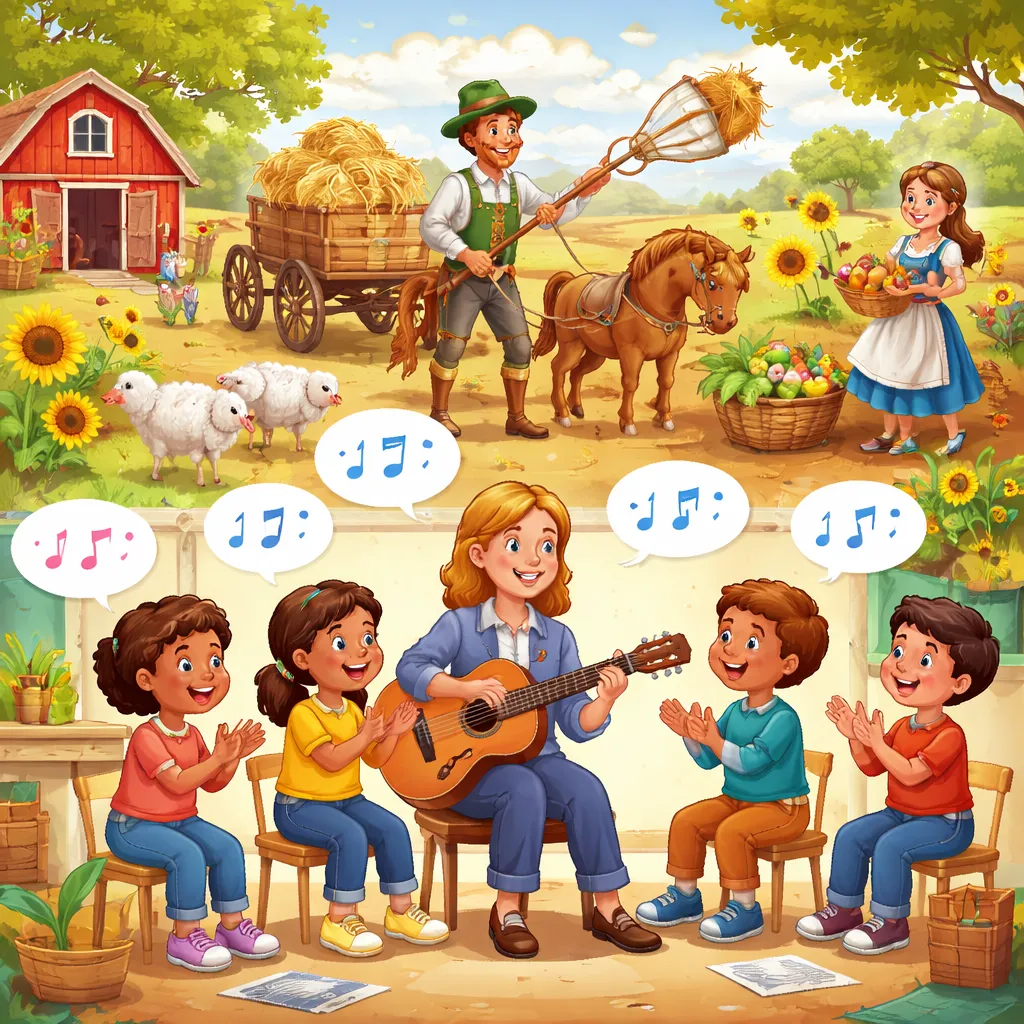

A mill wheel turns. A river flows. A farmer works in the fields. These are the sounds and sights of everyday life. A children’s song can capture these moments and turn them into a language lesson. Today, we explore a traditional German folk song called “Es klappert die Mühle,” which translates to “The Mill Is Clattering.” This cheerful song celebrates the sounds of a working mill and the joy of the farmer and peasant. We will use this melody as a rhythmic, sound-filled path into English. Together, we will learn new words, explore important sounds, and discover how a simple song can make language learning feel like listening to the world around you. The mill clatters. The river splashes. Your child can discover English words in those everyday sounds.
What is the rhyme? “Es klappert die Mühle” is a traditional German folk song that has been sung for generations. It describes a mill by a river, the sound of the mill wheel turning, and the joy of the farmer and peasant. The song has a steady, rhythmic beat that mimics the turning of a mill wheel. Children often use hand movements. They turn their hands like a mill wheel. They make clattering sounds. They sway like wheat in the wind. The song creates a feeling of steady work and simple joy. When we bring this song to English learning, we keep its rhythmic, sound-filled spirit. We use the familiar melody to introduce English words in a way that feels like hearing the steady rhythm of life.
The lyrics of nursery rhymes To appreciate this song, we first look at the original German words. Then we see how they translate into English. This shows children that the same sounds of work and nature can be expressed in different languages. You do not need to know German to enjoy the steady, rhythmic beat of the words.
Original Version (German)
Es klappert die Mühle am rauschenden Bach Klipp klapp, klipp klapp, klipp klapp Bei Tag und bei Nacht ist der Müller wach Klipp klapp, klipp klapp, klipp klapp
Er mahlt uns das Korn zu dem kräftigen Brot Klipp klapp, klipp klapp, klipp klapp Und hätten wir dieses nicht, hätten wir Not Klipp klapp, klipp klapp, klipp klapp
English Version
The mill clatters by the rushing brook Clippity-clap, clippity-clap, clippity-clap By day and by night the miller is awake Clippity-clap, clippity-clap, clippity-clap
He grinds the grain into hearty bread Clippity-clap, clippity-clap, clippity-clap And if we did not have this, we would be in need Clippity-clap, clippity-clap, clippity-clap
A second verse often continues with the farmer and peasant:
Original Version (German)
Der Bauer und Müller sind gute Kamerad Klipp klapp, klipp klapp, klipp klapp Denn keiner von beiden kann leben ohn’ das Klipp klapp, klipp klapp, klipp klapp
English Version
The farmer and miller are good companions Clippity-clap, clippity-clap, clippity-clap Because neither of them can live without the other Clippity-clap, clippity-clap, clippity-clap
As you read these words, notice the steady repetition. The rhythm moves like a mill wheel turning. The story is simple and grounded. The mill clatters by the rushing brook. The miller works day and night. He grinds grain into bread. Without him, we would be in need. The farmer and miller are good companions. This narrative invites children to appreciate where food comes from and the people who work to provide it.
Vocabulary learning This song offers a wonderful set of words that connect to nature, work, and community. We can explore these words through conversation, pictures, and hands-on activities.
Start with the main images: the mill and the farmer. In German, they are Mühle and Bauer. In English, we say “mill” and “farmer.” The mill grinds grain into flour. The farmer grows the grain.
Here are the key words to focus on from the song:
Mill: A building where grain is ground into flour. Look at pictures of mills.
Clatters: Makes a loud, rattling sound. The mill wheel clatters.
Rushing: Moving quickly. The brook is rushing.
Brook: A small stream. Show pictures of brooks and rivers.
Miller: The person who works at the mill. The miller works day and night.
Awake: Not sleeping. The miller is awake.
Grinds: Crushes into small pieces. The miller grinds grain.
Grain: Seeds used for food, like wheat. Show different grains.
Hearty bread: Strong, nourishing bread. Explain that bread gives us energy.
In need: Without something important. Without bread, we would be in need.
Farmer: A person who grows crops. The farmer grows the grain.
Companions: Friends who work together. The farmer and miller are companions.
Use these words in natural moments. When you eat bread, say “the miller grinds the grain to make bread.” When you see a stream, say “listen, the water is rushing.” These connections make the vocabulary meaningful.
Phonics points Phonics helps children understand the sounds that build English words. This song gives us several clear sounds to explore in a rhythmic, steady way.
First, focus on the ‘m’ sound at the beginning of “mill” and “miller.” This is a voiced sound made with the lips together. Say “m m m” like a hum. Practice with “mother,” “moon,” and “mill.” This sound is steady and warm.
Next, notice the ‘cl’ blend in “clatters” and “clippity-clap.” Say “c,” then quickly add “l.” Then add “atters.” Practice with “clap,” “climb,” and “clatters.” This blend mimics the sound of the mill.
The word “rushing” contains the ‘sh’ sound. This is a quiet, airy sound. Put your finger to your lips and say “shhh.” Then say “rushing.” Practice with “ship,” “fish,” and “rushing.” This sound is like the water flowing.
Finally, look at the ‘gr’ blend in “grinds” and “grain.” Say “g,” then quickly add “r.” Then add “inds” or “ain.” Practice with “green,” “grass,” and “grinds.” The song also has “brook,” which contains the ‘oo’ sound. Say “oo” like in “book.”
Grammar patterns Even a simple song contains grammar that we can introduce gently. We do not need to use technical terms. Instead, we show how words work together through examples and play.
The song uses the present tense to describe what happens. “Clatters,” “is,” “grinds,” and “are” describe ongoing actions and states. You can practice by describing what you see. “The water rushes.” “The bread is good.” This builds understanding of present tense.
Notice the conditional “if” in “if we did not have this, we would be in need.” This shows a hypothetical situation. You can practice with simple conditionals. “If it rains, we stay inside.” “If you are hungry, you eat.” This builds understanding of cause and effect.
The phrase “day and night” shows continuous time. The miller works all the time. You can practice with other time phrases. “Morning and night.” “Winter and summer.” This builds vocabulary about time.
Also, look at the onomatopoeia “klipp klapp” (clippity-clap). These words sound like the mill wheel. You can practice making sound words for different things. “Tick tock” for a clock. “Drip drop” for water. This adds playful language.
Learning activities Activities bring the song into the body and the imagination. They transform listening into active participation. These ideas are simple and require little preparation.
Mill Wheel Turning Play the song and pretend to be a mill wheel. Turn your arms in a circle. When the song says “klipp klapp,” clap your hands or tap a rhythm. This activity builds listening skills and physical rhythm.
Bread Making If possible, bake bread together. Talk about the steps. The farmer grows the grain. The miller grinds it into flour. You mix it and bake it into bread. This connects the song to a real, hands-on experience.
Sound Walk Go for a walk and listen for sounds. A rushing stream. A clattering machine. A bird singing. Talk about the sounds you hear. This builds listening skills and sound vocabulary.
Printable materials Printable resources offer a quiet way to reinforce the song’s vocabulary. They are perfect for moments when children want to create or focus calmly.
Flashcards Create a set of flashcards. One card shows a mill by a stream. One shows a miller working. One shows grain. One shows bread. One shows a farmer. One shows the mill wheel turning. Use these cards for a matching game. Sing a line from the song and ask your child to find the matching card. This builds word recognition.
Coloring Page Draw a simple scene from the song. Show a mill by a rushing stream. Show the mill wheel turning. Add a farmer in the field. Children can color the scene. As they color, talk about the scene. “What is the mill doing?” “Who works here?” This keeps the language flowing naturally.
From Grain to Bread Chart Create a simple chart showing the steps. Grain grows in the field. The farmer harvests it. The miller grinds it into flour. You bake bread. Your child can draw or glue pictures for each step. This builds sequencing and understanding.
Educational games Games encourage repetition without boredom. They invite children to use the language in new and creative ways.
Miller Says Play a game similar to “Simon Says.” Give commands using the song’s vocabulary. “The miller says grind the grain.” “The miller says turn the mill wheel.” “The farmer says grow the wheat.” If you give a command without saying who, the child does not move. This game builds listening skills.
Sound Match Make different sound words. Clippity-clap. Tick tock. Drip drop. Splish splash. Ask your child to guess what is making the sound. This builds sound vocabulary and listening skills.
Companion Match Match pairs of people who work together. Farmer and miller. Baker and farmer. Teacher and student. Talk about how they help each other. This builds vocabulary about community and cooperation.
As you share this song with your child, remember that you are celebrating the rhythms of work and community. The mill clatters by the stream. The miller works day and night. The farmer and miller are good companions. They need each other. Learning a new language is also about rhythms and connections. Words have rhythm. Sounds connect to meaning. People work together to communicate. Let the steady mill wheel be your guide. Listen to the sounds around you. Notice how people help each other. Let the rhythmic spirit of the song remind you both that every word you learn is part of a larger community, and every sound you make connects you to the world.