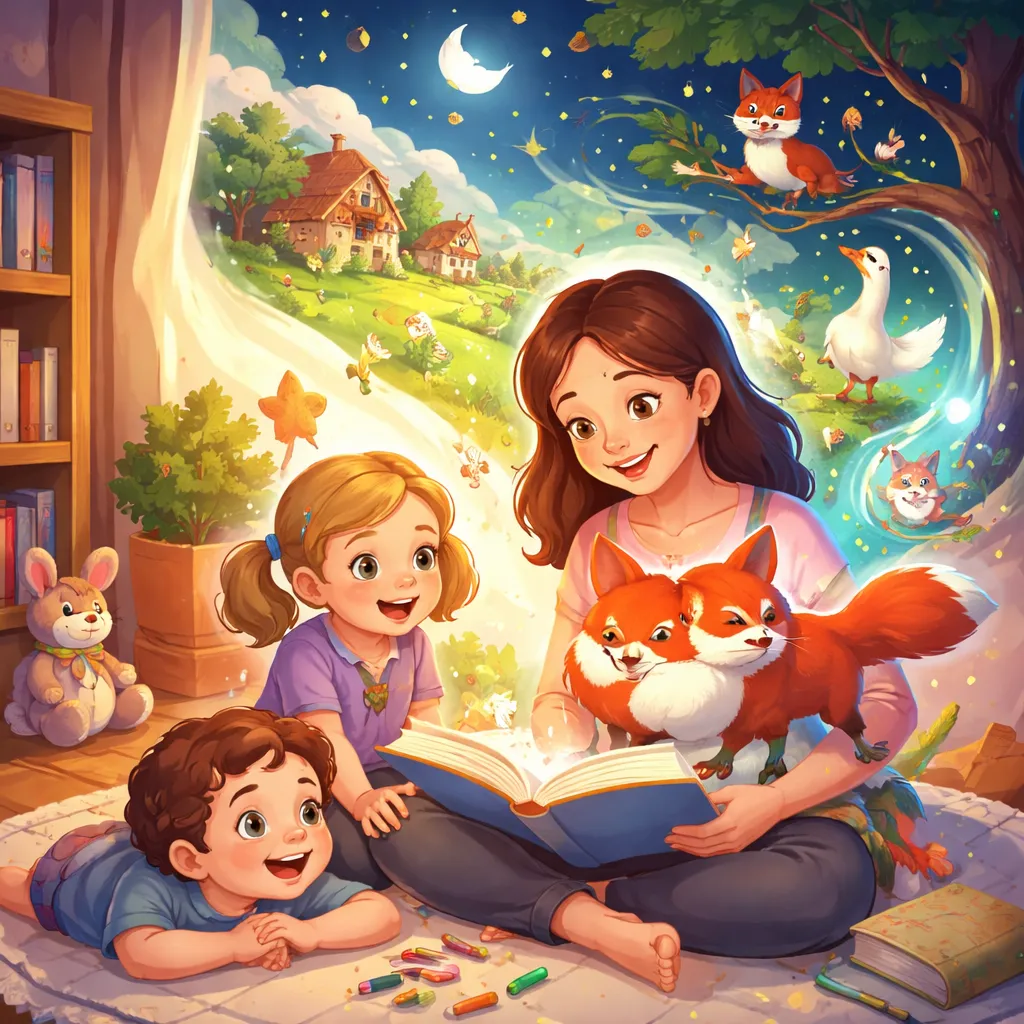

A sly fox. A stolen goose. A call for help. A story unfolds in just a few lines. Children love stories with animals, mystery, and a touch of mischief. A song can bring that story to life while teaching new words. Today, we explore a traditional German folk song called “Fuchs, du hast die Gans gestohlen,” which translates to “The Fox, He Stole the Goose.” This playful song tells a simple story about a fox who takes a goose and the call to return it. We will use this melody as a storytelling path into English. Together, we will learn new words, explore important sounds, and discover how a simple song can make language learning feel like opening a storybook. The fox took something. Your child can take new words and make them their own.
What is the rhyme? “Fuchs, du hast die Gans gestohlen” is a traditional German children’s song that has been sung for generations. It tells the story of a fox who steals a goose from the farm. The song calls out to the fox, asking him to return the goose. It promises that if he does, the hunter will not shoot him. The song has a gentle, slightly mischievous rhythm. Children often use hand movements. They make a fox’s ears with their fingers. They pretend to sneak like a fox. They shake their fingers in a playful scolding. The song creates a sense of playful tension and resolution. When we bring this song to English learning, we keep its storytelling spirit. We use the familiar melody to introduce English words in a way that feels like following a little story with a beginning, middle, and end.
The lyrics of nursery rhymes To appreciate this song, we first look at the original German words. Then we see how they translate into English. This shows children that the same little story can be told in different languages. You do not need to know German to enjoy the gentle, storytelling rhythm of the words.
Original Version (German)
Fuchs, du hast die Gans gestohlen Gib sie wieder, gib sie wieder Sonst wird dich der Schütze holen Mit dem Schießgewehr
English Version
Fox, you have stolen the goose Give it back, give it back Otherwise the hunter will get you With his rifle
A second verse continues the story with a promise:
Original Version (German)
Große Jammerei, große Jammerei Frisst er alle Hühner auf Lässt kein Ei zurück, lässt kein Ei zurück Bis der Jäger kommt, bis der Jäger kommt Und ihn niederschießt
English Version
Great lament, great lament He eats all the chickens Leaves no egg behind, leaves no egg behind Until the hunter comes, until the hunter comes And shoots him down
As you read these words, notice the gentle repetition. The rhythm moves like someone telling a cautionary tale. The story is simple and engaging. A fox stole a goose. Give it back, or the hunter will come. The fox causes trouble. The hunter is the solution. This narrative invites children to think about right and wrong, and the consequences of actions.
Vocabulary learning This song offers a wonderful set of words that connect to animals, actions, and storytelling. We can explore these words through conversation, pictures, and simple storytelling.
Start with the main characters: the fox and the goose. In German, they are Fuchs and Gans. In English, we say “fox” and “goose.” The fox is clever and sneaky. The goose is the victim.
Here are the key words to focus on from the song:
Fox: An animal with reddish fur and a bushy tail. Foxes are known for being clever.
Stole: Took something that does not belong to you (past tense of steal). The fox stole the goose.
Goose: A water bird with a long neck. The goose was taken.
Give it back: Return what was taken. The song asks the fox to give the goose back.
Hunter: A person who hunts animals. The hunter will come if the fox does not return the goose.
Rifle: A gun. The hunter has a rifle.
Lament: A cry of sorrow or complaint. There is great lament because the fox eats the chickens.
Chickens: Farm birds. The fox eats chickens too.
Egg: What chickens lay. The fox leaves no egg behind.
Shoots: Fires a gun. The hunter shoots the fox.
Use these words in natural moments. When you read a story about a fox, say “look, a fox! Is he stealing something?” When your child takes a toy, say “give it back, please.” These connections make the vocabulary meaningful.
Phonics points Phonics helps children understand the sounds that build English words. This song gives us several clear sounds to explore in a storytelling way.
First, focus on the ‘f’ sound at the beginning of “fox.” This is a soft, airy sound. Put your hand in front of your mouth and say “f f f.” You will feel air. Practice with “fish,” “fun,” and “fox.” This sound is light and sneaky, like a fox.
Next, notice the ‘g’ sound at the beginning of “goose” and “give.” This is a voiced sound made with the back of the tongue. Say “g g g.” Practice with “go,” “garden,” and “goose.” The ‘g’ is strong and clear.
The word “stole” contains the ‘st’ blend and the long ‘o’ sound. Say “s,” then quickly add “t.” Then add “ole.” Practice with “stop,” “stone,” and “stole.” The long ‘o’ is like “go.”
Finally, look at the ‘th’ sound in “the” and “otherwise.” This is a soft sound made with the tongue between the teeth. Say “th th th.” Practice with “this,” “that,” and “the.” The song also has “hunter,” which contains the short ‘u’ sound. Say “u” like in “up.”
Grammar patterns Even a simple song contains grammar that we can introduce gently. We do not need to use technical terms. Instead, we show how words work together through examples and play.
The song uses the present perfect tense in “you have stolen.” This tense connects the past action to the present. You stole, and now the goose is missing. You can practice with simple examples. “You have taken the toy.” “You have eaten the snack.” This builds understanding of this important tense.
Notice the command “give it back.” This is the imperative mood. It is a direct request. You can practice giving simple commands. “Give it back.” “Come here.” This builds understanding of how to make requests.
The word “otherwise” shows what will happen if the fox does not act. It introduces a consequence. You can practice with “otherwise” or “or else.” “Give it back, or the hunter will come.” “Eat your dinner, or you will be hungry.” This builds understanding of cause and effect.
Also, look at the repetition in the song. “Give it back, give it back” repeats for emphasis. Children can use repetition to show importance. “Come here, come here!” “Look, look!” This adds expressive language.
Learning activities Activities bring the song into the body and the imagination. They transform listening into active participation. These ideas are simple and require little preparation.
Fox and Goose Game Play the song and act out the story. One person is the fox. One person is the goose. The fox “steals” the goose (a stuffed animal or a toy). The other players call out “give it back!” The fox returns it. This activity builds listening skills and understanding of the story.
Story Sequencing Draw or print pictures of the story. The fox stealing the goose. The hunter with a rifle. The fox eating chickens. Put them in order. Talk about what happens first, next, last. This builds sequencing and storytelling skills.
Farm Animal Visit If possible, visit a farm or look at pictures of farm animals. Find a goose. Find chickens. Find eggs. Talk about what the fox might do on a farm. This connects the song to real knowledge about animals.
Printable materials Printable resources offer a quiet way to reinforce the song’s vocabulary. They are perfect for moments when children want to create or focus calmly.
Flashcards Create a set of flashcards. One card shows a fox. One shows a goose. One shows a hand giving something for “give it back.” One shows a hunter with a rifle. One shows a chicken. One shows an egg. Use these cards for a matching game. Sing a line from the song and ask your child to find the matching card. This builds word recognition.
Coloring Page Draw a simple scene from the song. Show the fox with the goose in his mouth. Draw the hunter in the distance. Children can color the fox orange, the goose white, and the hunter’s clothes. As they color, talk about the scene. “What did the fox do?” “Who is coming?” This keeps the language flowing naturally.
Story Wheel Create a story wheel with four scenes. The fox steals the goose. People call “give it back!” The hunter comes. The fox returns the goose. Turn the wheel to tell the story. This builds sequencing and storytelling.
Educational games Games encourage repetition without boredom. They invite children to use the language in new and creative ways.
Fox Says Play a game similar to “Simon Says.” Give commands using the song’s vocabulary. “The fox says steal the goose.” “The people say give it back.” “The hunter says come with the rifle.” If you give a command without saying who speaks, the child does not move. This game builds listening skills and understanding of characters.
What’s Missing? Place toy farm animals on a tray. Let your child look. Then cover the tray and take one animal away. Ask “what is missing?” The goose is missing! The fox stole it! This builds memory and vocabulary.
Hunter and Fox Play a simple chase game. One person is the fox. One is the hunter. The fox runs. The hunter tries to catch the fox. When caught, the fox says “I will give it back!” This builds movement and language.
As you share this song with your child, remember that you are exploring stories and consequences. The fox stole the goose. He is asked to give it back. There is a warning about the hunter. Learning a new language also involves actions and consequences. You practice, and you learn. You make mistakes, and you try again. You take new words, and you make them your own. Let the clever fox be your guide. Tell stories together. Act out the scenes. Let the storytelling spirit of the song remind you both that every new word is part of a larger story, and you are the one who gets to tell it.