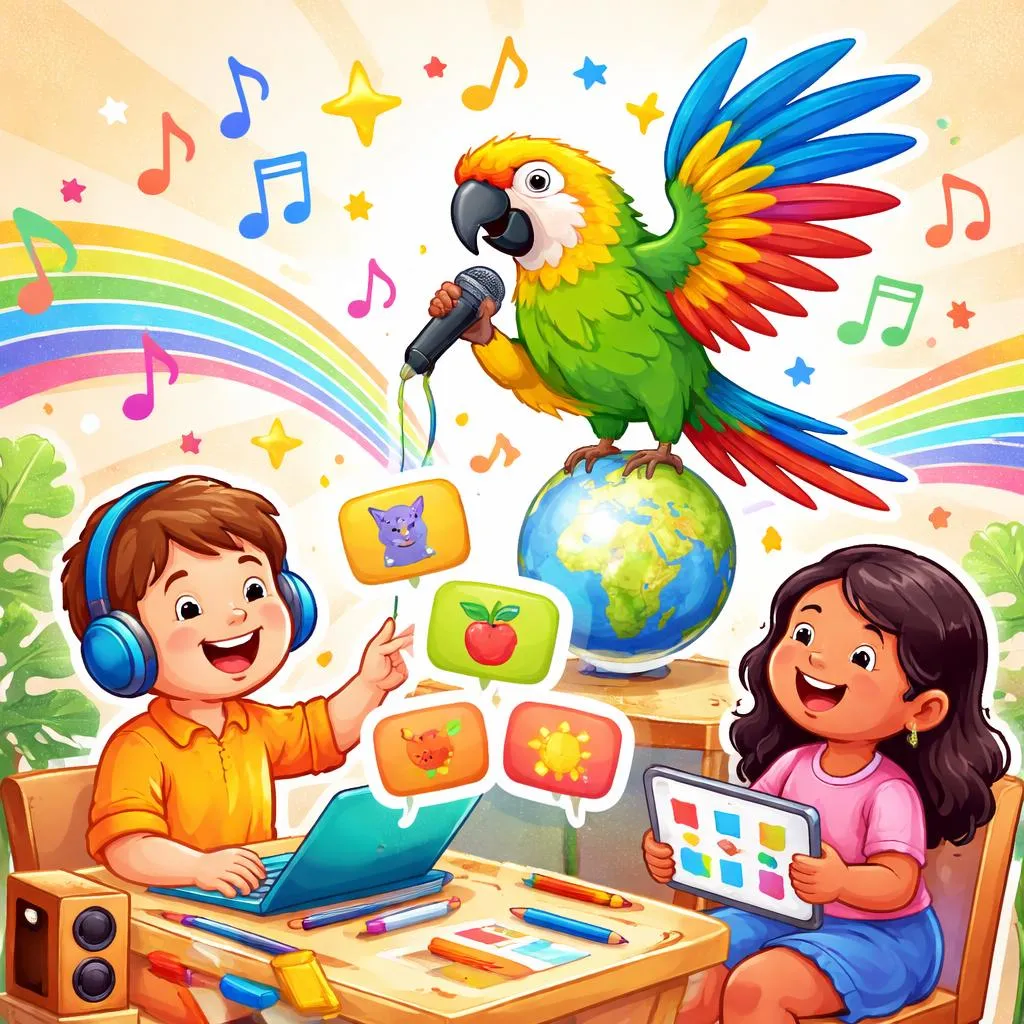

A parrot is a bird that loves to repeat sounds. A children’s song can do something very similar for language learning. It can invite children to repeat new words with joy. Today, we explore a traditional Portuguese rhyme called “O Papagaio,” which means “The Little Parrot.” This playful song celebrates the parrot who loves to talk and repeat what he hears. We will use this melody as a colorful path into English. Together, we will learn new words, explore important sounds, and discover how a simple song can make language learning feel like a friendly parrot perched on your shoulder, ready to repeat and play.
What is the rhyme? “O Papagaio” is a joyful nursery rhyme in Portuguese-speaking cultures. It tells the story of a little parrot who loves to talk and repeat words. The song has a bouncy, talkative rhythm. Children often use hand movements. They make a beak with their fingers. They bob their heads like a parrot. They repeat the words with enthusiasm. The song celebrates the joy of talking and repeating sounds. It invites children to be playful with language. When we bring this song to English learning, we keep its talkative spirit. We use the familiar melody to introduce English words in a way that feels like a friendly conversation with a colorful bird.
The lyrics of nursery rhymes To appreciate this song, we first look at the original Portuguese words. Then we see how they translate into English. This shows children that the same playful idea of repeating sounds exists in different languages. You do not need to know Portuguese to enjoy the bouncy, talkative rhythm of the words.
Original Version (Portuguese)
O papagaio, o papagaio Vai falar, vai falar Tudo o que ouve, tudo o que ouve Vai repetir, vai repetir
English Version
The little parrot, the little parrot Will talk, will talk Everything he hears, everything he hears Will repeat, will repeat
A second verse often continues the story, showing what the parrot might say.
Original Version (Portuguese)
Que bonito, que bonito Diz o papagaio, diz o papagaio Bom dia, bom dia Vamos brincar, vamos brincar
English Version
How pretty, how pretty Says the parrot, says the parrot Good morning, good morning Let us play, let us play
As you read these words, notice the lively repetition. The rhythm moves like a parrot bobbing on a branch. The story is simple and engaging. A parrot talks and repeats what he hears. He says “good morning” and “let us play.” This narrative invites children to join in the repetition.
Vocabulary learning This song offers a wonderful set of words that connect to talking, listening, and playful interaction. We can explore these words through conversation, repetition, and fun.
Start with the main character: the parrot. In Portuguese, it is papagaio. In English, we say “little parrot.” Parrots are known for their bright feathers and their ability to copy sounds. You can look at pictures of parrots together. Notice their colors. Talk about how they repeat what people say.
Here are the key words to focus on from the song:
Parrot: A colorful bird that can copy sounds. Explain that parrots are good at repeating words.
Talk: To speak. This is what the parrot loves to do. Ask your child what they like to talk about.
Everything: All things. The parrot repeats everything he hears. This word means “all.”
Hears: Listens to and perceives sound. Cup your ear and say “I hear.” Then say “the parrot hears.”
Repeat: To say again. This is the key action of the song. Practice repeating sounds together.
Pretty: Nice to look at or hear. The parrot says “how pretty.” Use this word when you see something lovely.
Good morning: A greeting. Use this every morning to make it familiar.
Let us play: An invitation to play. Use this phrase when starting playtime.
Use these words in natural moments. When your child repeats something you said, say “you are repeating like a parrot!” When you start playing, say “let us play.” These connections make the vocabulary meaningful and memorable.
Phonics points Phonics helps children understand the sounds that build English words. This song gives us several clear sounds to explore in a playful, talkative way.
First, focus on the ‘p’ sound at the beginning of “parrot” and “pretty.” This is a sharp, popping sound. Put your hand in front of your mouth and say “p p p.” Practice with “panda,” “paint,” and “parrot.” This sound is crisp and clear.
Next, notice the ‘r’ sound in “parrot” and “repeat.” This is a voiced sound made with the tongue. Say “rrrr” like a rolling sound. Practice with “run,” “red,” and “repeat.” This sound appears in many English words.
The word “hear” contains the ‘ear’ sound. This is a combination of vowel sounds. Say “ear” like in “near.” Then say “hear.” Practice with “dear,” “fear,” and “hear.” This is a common sound pattern.
Finally, look at the ‘pl’ blend in “play.” This is two consonants together. Say “p” and then quickly add “l.” Then add “ay.” Practice with “please,” “plane,” and “play.” This blend appears in many playful words. The song also has “good morning,” which contains the ‘ng’ sound at the end of “morning.” Say “ing” like in “ring.”
Grammar patterns Even a simple song contains grammar that we can introduce gently. We do not need to use technical terms. Instead, we show how words work together through examples and play.
The song uses the future tense with the word “will.” “Will talk” means the parrot plans to talk. You can explain this simply. “Will” is a helper word that tells us something is going to happen. Practice by talking about your day. “You will talk to Grandma.” “We will repeat the song.” This gives children a tool to talk about future events.
The second verse introduces the present tense. “Says the parrot” describes what the parrot does now. You can point out that we use this form when something is happening in the present. Practice by saying what you are doing now. “You say good morning.” “I sing a song.”
Notice the command form in “let us play.” This is an invitation that includes the speaker. “Let us” means “we should.” This is a friendly way to suggest an activity. Practice by saying “let us read,” “let us sing,” “let us repeat.” This gives children a polite way to make suggestions.
Also, look at the question of repetition. The song asks us to notice what the parrot repeats. You can ask your own questions. “What does the parrot say?” “What do you hear?” This builds conversational skills.
Learning activities Activities bring the song into the body and the imagination. They transform listening into active participation. These ideas are simple and require little preparation.
Parrot Repeat Play the song and pretend to be parrots. When the song says “will repeat,” echo what you hear. Say the last word of each line. Say “parrot,” “talk,” “hears,” “repeat.” Then repeat the whole phrases. “Everything he hears.” “Good morning.” This activity builds listening skills and repetition.
Sound Echo Game Say a word or sound. Ask your child to repeat it like a parrot. Start with simple sounds. “Quack.” Then move to words. “Parrot.” Then move to phrases. “Good morning.” Take turns being the parrot. This builds pronunciation and listening skills.
Morning Greeting Use the song’s greeting each morning. Say “good morning” together. Then add “let us play.” Sing the part of the song that says these words. This connects the song to the daily routine.
Printable materials Printable resources offer a quiet way to reinforce the song’s vocabulary. They are perfect for moments when children want to create or focus calmly.
Flashcards Create a set of flashcards. One card shows the parrot. One shows a mouth speaking for “talk.” One shows an ear for “hears.” One shows two arrows circling for “repeat.” One shows a sun for “good morning.” One shows two children playing for “let us play.” Use these cards for a matching game. Sing a line from the song and ask your child to find the matching card. This builds word recognition.
Coloring Page Draw a simple scene from the song. Show the little parrot perched on a branch. Add a speech bubble coming from his beak. Write “good morning” or “let us play” in the bubble. Children can color the parrot in bright colors. As they color, talk about the scene. “What is the parrot saying?” “What colors will you use?” This keeps the language flowing naturally.
Repeat and Draw Print the lyrics with space for drawings. For each phrase, your child can draw what the parrot says. “Good morning” could have a sun. “Let us play” could have two friends. This builds comprehension and creativity.
Educational games Games encourage repetition without boredom. They invite children to use the language in new and creative ways.
Parrot Says Play a game similar to “Simon Says.” Give commands using the song’s vocabulary. “The parrot says repeat after me.” “The parrot says say good morning.” “The parrot says talk loudly.” If you give a command without saying “the parrot says,” the child does not move. This game builds listening skills.
Echo Chain Start with a word. “Parrot.” Your child repeats it. Then add a word. “Little parrot.” Your child repeats the two words. Keep adding words from the song. “The little parrot will talk.” See how long the chain can get. This builds memory and repetition skills.
Greeting Circle Practice different greetings. Good morning. Good afternoon. Hello. Hi. Take turns greeting each other like parrots. Then sing the part of the song that says “good morning.” This extends the vocabulary beyond the song.
As you share “O Papagaio” with your child, remember that you are celebrating the joy of repetition and conversation. The little parrot loves to talk. He loves to repeat what he hears. Your child can learn English in that same playful way. Repetition is not boring when it is a game. Repeating words is how we make them our own. Let the talkative parrot be your guide. Sing the song when you want to practice new words. Repeat sounds together. Say good morning with enthusiasm. Let the colorful parrot remind you both that every word repeated is a word learned, and every sound echoed is a step toward confident conversation.