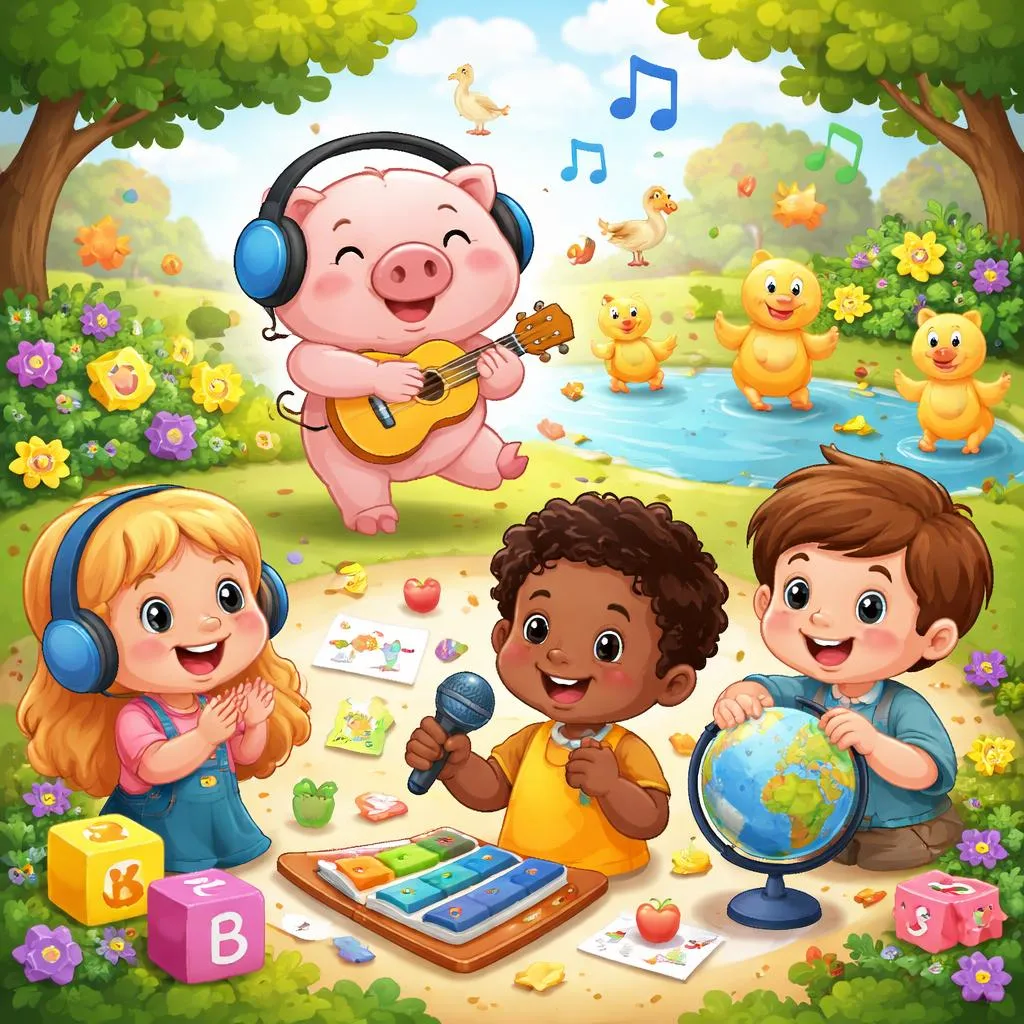

Music has a way of reaching children that ordinary conversation sometimes cannot. A simple melody can carry words into a child’s memory with ease. Today, we explore a traditional Portuguese song called “O Porquinho,” which means “The Little Pig.” This playful rhyme invites children to move, make sounds, and join in a story. We will use this cheerful song as a gentle path into English. Together, we will discover new words, practice important sounds, and see how a little pig can teach us so much about language. The journey is one of joy, not pressure. Let us step into the world of this happy little pig.
What is the rhyme? “O Porquinho” is a beloved children’s rhyme in Portuguese-speaking homes. It tells the story of a small, happy pig who loves to eat and play. The song is often sung with playful actions. Children pretend to be the pig. They wiggle their noses, rub their bellies, and make happy snorting sounds. The rhythm is light and bouncy, matching the playful nature of the character. This rhyme creates a moment of pure fun. It invites children to be silly and expressive. There is no right or wrong way to join in. When we bring this song to English learning, we keep that spirit of playfulness. We use the familiar tune to introduce English words in a way that feels like a game, not a lesson.
The lyrics of nursery rhymes To truly appreciate this song, we first look at the original Portuguese words. Then we see how they translate into English. This shows children that the same playful idea can live in different languages. You do not need to know Portuguese to enjoy the rhythm. Simply listen to the bouncy, happy flow of the words.
Original Version (Portuguese)
O porquinho, o porquinho Vai comer, vai comer Sua comida, sua comida Vai crescer, vai crescer
English Version
The little pig, the little pig Will eat, will eat His food, his food Will grow, will grow
A second verse often continues the story, showing the pig’s playful side.
Original Version (Portuguese)
O porquinho, o porquinho Vai brincar, vai brincar No jardim, no jardim Vai pular, vai pular
English Version
The little pig, the little pig Will play, will play In the garden, in the garden Will jump, will jump
As you read these words, notice the repetition. Each line repeats, giving children time to absorb the sound and meaning. The story is simple and joyful. A little pig eats his food, grows strong, then plays and jumps in the garden. This sequence is easy for a child to follow and act out.
Vocabulary learning This song offers a wonderful collection of words that connect to a child’s daily experiences. We can explore these words through conversation, play, and simple actions.
Start with the main character: the pig. In Portuguese, it is porquinho. In English, we say “little pig.” The word “little” adds warmth and affection. Children often love pigs from stories and farm visits. You can look at pictures together. Make the pig sound, “oink oink.”
Here are the key words to focus on from the song:
Pig: A farm animal that loves to eat. Ask your child what sound a pig makes. Let them try it.
Eat: What we do when we are hungry. This is a word children use every day. Connect it to mealtime.
Food: What the pig eats. Talk about the foods your child likes. Compare them to what the pig might eat.
Grow: How living things get bigger. Show a photo of your child as a baby. Talk about how they have grown.
Play: What children do for fun. This is a joyful word. Use it often during free time.
Garden: A place where plants grow. If you have a garden or park nearby, visit it together.
Jump: A lively action. This word invites movement. Jump together when you sing.
Use these words in natural moments. At mealtime, say “the little pig eats his food, and you are eating your food too.” When playing outside, say “let us jump in the garden, just like the little pig.” These connections make the vocabulary meaningful and memorable.
Phonics points Phonics helps children understand the sounds that build English words. This song gives us several clear sounds to explore in a relaxed, playful way.
First, focus on the ‘p’ sound at the beginning of “pig.” This is a sharp, popping sound. Put your hand in front of your mouth and say “p p p.” You will feel a small puff of air. This sound appears in many words children love, like “pop,” “puppy,” and “play.” Practice by saying “p-p-p-pig” together.
Next, notice the short ‘i’ sound in “pig” and “little.” This is a quick, bright vowel sound. Say “ig” like in “igloo.” Then say “pig” slowly. You can compare it to the long ‘e’ sound in “eat.” This helps children hear the difference between vowel sounds.
The word “grow” contains the ‘gr’ blend. This is two consonants together. Say “g” and then quickly add “r.” Then add “ow.” Practice with “green,” “grass,” and “grow.” This blend is common in English. It builds confidence with consonant combinations.
Finally, look at the ‘j’ sound in “jump.” This is a voiced sound made with the tongue and lips. Say “j j j” like a bouncing ball. Then say “jump.” Practice with “joy,” “jelly,” and “jump.” The song also has “garden,” which contains the ‘ar’ sound. Say “car,” “star,” and “garden.” Notice how the mouth opens wide.
Grammar patterns Even a simple song contains grammar that we can introduce gently. We do not need to use technical terms. Instead, we show how words work together through examples and play.
The song uses the future tense with the word “will.” “Will eat” means the pig plans to eat. You can explain this simply. “Will” is a helper word that tells us something is going to happen. You can practice by talking about your day. “We will play after snack.” “We will read a book.” This gives children a tool to talk about future events.
Notice the repetition of phrases. “The little pig, the little pig” repeats the noun. This repetition is a common feature of English songs and stories. It adds rhythm and makes the phrase easy to remember. Children can use this pattern themselves. They might say “my toy, my toy” to show something important.
Also, look at the preposition “in” in “in the garden.” This shows location. You can practice by placing toys in different places. Put a toy pig in a box. Say “the pig is in the box.” Put it under a blanket. Say “the pig is under the blanket.” This teaches spatial concepts in a concrete way.
Learning activities Activities bring the song into the body and the imagination. They transform listening into active participation. These ideas are simple and require little preparation.
The Little Pig Game Play the song and pretend to be little pigs. When the song says “will eat,” rub your belly and make happy eating sounds. When it says “will grow,” stretch up tall. When it says “will play,” wiggle your whole body. When it says “will jump,” jump up and down. This activity builds listening comprehension. It also connects words to physical actions.
Garden Play Create a simple garden space indoors or outdoors. Use a blanket as the garden. Place toy flowers or leaves around. Pretend to be the little pig. Walk through the garden. Jump over small cushions. Talk about what you are doing. “I am playing in the garden.” “I am jumping.” This connects the song to imaginative play.
Food and Growth Conversation Talk about how food helps us grow. After singing the song, have a snack together. Say “the little pig ate his food to grow. You are eating your food to grow too.” This connects the song to a real-life concept. It also reinforces the word “grow” in a meaningful context.
Printable materials Printable resources offer a quiet way to reinforce the song’s vocabulary. They are perfect for moments when children want to create or focus calmly.
Flashcards Create a set of flashcards. One card shows the pig. One shows the action “eat.” One shows a bowl of food. One shows a child growing taller. One shows a garden with flowers. One shows a child jumping. Use these cards for a matching game. Sing a line from the song and ask your child to find the matching card. This builds word recognition.
Coloring Page Draw a simple scene from the song. Show the little pig in a garden. Draw a bowl of food nearby. Add some flowers and sunshine. Children can color while listening to the song. As they color, talk about the scene. “What is the little pig doing?” “What color is his food?” This keeps the language flowing naturally.
Song Mini-Book Print the lyrics on several small pages. Leave space for drawings. On the page for “will eat,” your child can draw the pig with food. On the page for “will jump,” they can draw the pig jumping. Fold the pages together to make a book. Read and sing the book together. This gives children ownership of the song and its words.
Educational games Games encourage repetition without boredom. They invite children to use the language in new and creative ways.
Pig Says Play a game similar to “Simon Says.” Give commands using the song’s vocabulary. “The pig says eat your pretend food.” “The pig says jump in the garden.” “The pig says grow tall.” If you give a command without saying “the pig says,” the child does not move. This game builds listening skills and makes the vocabulary active.
Action Dice Create a simple dice with pictures on each side. Draw a pig face, a bowl of food, a growing plant, a garden, and a jumping figure. Take turns rolling the dice. Whatever picture appears, do that action and say the related word. “I eat.” “I jump.” This combines movement with vocabulary practice.
Hide and Seek Pig Hide a small toy pig around the room. Sing the song together while searching. When someone finds the pig, they say “I found the little pig!” Then hide it again. This game builds anticipation and makes the song’s vocabulary part of a fun, active experience.
As you share “O Porquinho” with your child, remember that you are building a positive relationship with language. The little pig eats, grows, plays, and jumps with joy. Your child can approach English learning with that same joyful spirit. Let the song be a soundtrack for play. Sing it during snack time. Hum it during outdoor play. Let the cheerful little pig remind you both that language learning can be full of laughter, movement, and simple happiness.