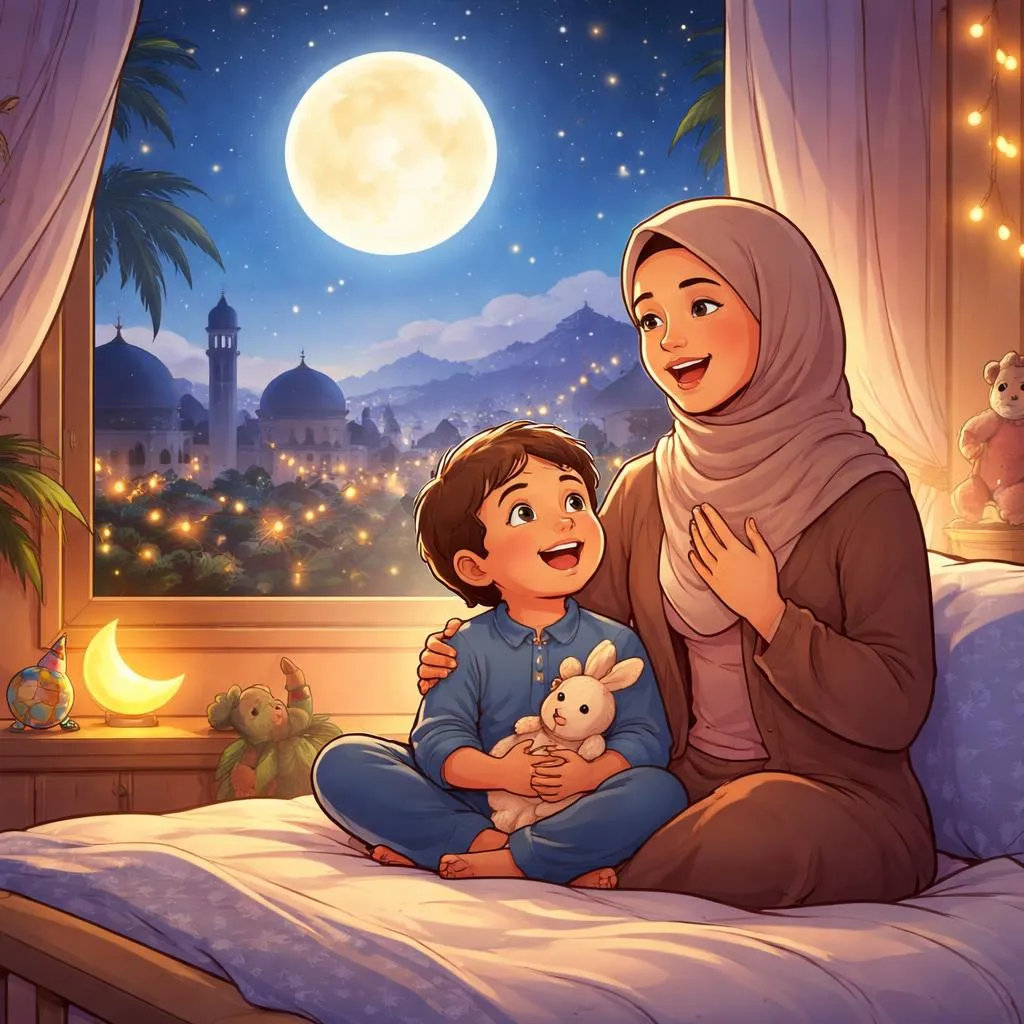

A full moon rises in the night sky. It shines with gentle light. It brings peace and joy. A children’s song can capture that moment of wonder and bring it into language learning. Today, we explore a beloved Arabic song called “طلع البدر علينا” (Tala‘ al-badru ‘alayna), which translates to “The Moon Has Risen Upon Us.” This beautiful melody has been sung for generations as a greeting of joy and celebration. We will use this song as a gentle, peaceful path into English. Together, we will learn new words, explore important sounds, and discover how a simple song can make language learning feel as comforting as moonlight. The moon has risen. Your child can learn English with that same quiet, shining joy.
What is the rhyme? “The Moon Has Risen Upon Us” (طلع البدر علينا) is one of the most cherished songs in the Arabic-speaking world. It was originally sung to welcome the Prophet Muhammad to Medina. Today, it is sung during celebrations, especially during Ramadan and Eid. The song has a slow, peaceful rhythm. Children often use hand movements. They make a moon shape with their hands. They look up at the sky. They sway gently. The song creates a calm, joyful atmosphere. It celebrates the beauty of the moon and the joy of gathering together. When we bring this song to English learning, we keep its peaceful, celebratory spirit. We use the familiar melody to introduce English words in a way that feels like watching the moon rise on a quiet night.
The lyrics of nursery rhymes To appreciate this song, we first look at the original Arabic words. Then we see how they translate into English. This shows children that the same peaceful song about the moon can be told in different languages. You do not need to know Arabic to enjoy the slow, gentle rhythm of the words.
Original Version (Arabic)
طلع البدر علينا من ثنيات الوداع وجب الشكر علينا ما دعا لله داع
English Version
The moon has risen upon us From the mountain pass of farewell Gratitude is due to us As long as there is a caller calling to God
A simpler version for children focuses on the beauty of the moon:
طلع البدر علينا في سماء المدينة نشكر الله شكرًا في ليلة العيد
English Version
The moon has risen upon us In the sky of the city We thank God with gratitude On the night of celebration
As you read these words, notice the gentle, flowing repetition. The rhythm moves like moonlight. The story is simple and joyful. The moon has risen. We give thanks. We celebrate together. This narrative invites children to appreciate the beauty of the night sky and the joy of being together.
Vocabulary learning This song offers a lovely set of words that connect to nature, celebration, and gratitude. We can explore these words through conversation, pictures, and quiet moments.
Start with the main image: the moon. In Arabic, it is بدر (badr). In English, we say “moon.” A full moon is bright and beautiful.
Here are the key words to focus on from the song:
Moon: The bright round object in the night sky. Look at the moon together.
Risen: Has come up. The moon has risen.
Upon: On or over. The moon has risen upon us.
Mountain pass: A path between mountains. The moon rose from the mountain pass.
Farewell: Goodbye. The moon rises from the place of farewell.
Gratitude: Thankfulness. We give gratitude.
Caller: Someone who calls. A caller calling to God.
Sky: The space above us. The moon is in the sky.
City: A large town. The moon shines over the city.
Thank: To express gratitude. We thank God.
Celebration: A joyful gathering. We celebrate on the night of celebration.
Use these words in natural moments. At night, look at the moon and say “the moon has risen!” When you are thankful, say “I feel gratitude.” These connections make the vocabulary meaningful.
Phonics points Phonics helps children understand the sounds that build English words. This song gives us several clear sounds to explore in a gentle, peaceful way.
First, focus on the ‘m’ sound at the beginning of “moon.” This is a voiced sound made with the lips together. Say “m m m” like a hum. Practice with “mother,” “moon,” and “mountain.” This sound is soft and round.
Next, notice the long ‘oo’ sound in “moon” and “soon.” Say “oo” like in “moon.” Practice with “zoo,” “soon,” and “moon.” This sound is full and gentle.
The word “gratitude” contains the ‘t’ sound and the ‘d’ sound. Say “gra-ti-tude.” Practice slowly. “Gratitude.” This is a longer word that teaches patience.
Finally, look at the ‘th’ sound in “thank” and “gratitude.” This is a soft sound made with the tongue between the teeth. Say “th th th.” Practice with “think,” “thank,” and “gratitude.” The song also has “sky,” which contains the ‘sk’ blend. Say “s,” then quickly add “k.” Then add “y.”
Grammar patterns Even a simple song contains grammar that we can introduce gently. We do not need to use technical terms. Instead, we show how words work together through examples and play.
The song uses the present perfect tense in “has risen.” This tense connects the past to the present. The moon rose, and now it is in the sky. You can practice with other present perfect phrases. “The sun has set.” “The stars have appeared.” This builds understanding of this tense.
Notice the phrase “upon us” shows location. You can practice with other “upon” phrases. “Upon the hill.” “Upon the table.” This teaches spatial language.
The word “as long as” shows duration. “As long as there is a caller.” You can practice with other duration phrases. “As long as the sun shines.” “As long as we are together.” This builds understanding of time.
Also, look at the repetition of gratitude. You can practice expressing gratitude. “I am grateful.” “Thank you.” This builds social language.
Learning activities Activities bring the song into the body and the imagination. They transform listening into active participation. These ideas are simple and require little preparation.
Moon Watching At night, go outside or look out the window. Find the moon. Say “the moon has risen!” Sing the song softly. This connects the song to the real night sky.
Moon Craft Create a moon using a paper plate. Color it yellow or white. Add glitter for stars. Hang it in a window. This combines fine motor skills with language practice.
Gratitude Game Take turns saying something you are grateful for. “I am grateful for the moon.” “I am grateful for my family.” “I am grateful for this song.” This builds emotional vocabulary and connection.
Printable materials Printable resources offer a quiet way to reinforce the song’s vocabulary. They are perfect for moments when children want to create or focus calmly.
Flashcards Create a set of flashcards. One card shows a moon for “moon.” One shows a mountain pass. One shows a sky with a city. One shows hands raised in gratitude. One shows a celebration scene. One shows the word “thank.” Use these cards for a matching game. Sing a line from the song and ask your child to find the matching card. This builds word recognition.
Coloring Page Draw a simple night scene. Show a full moon in the sky. Draw a city below. Draw stars around. Children can color the moon yellow, the sky dark blue, and the city with little lights. As they color, talk about the scene. “What is in the sky?” “How do we feel when we see the moon?” This keeps the language flowing naturally.
Moon Journal Create a simple moon journal. Each night, look at the moon. Draw what you see. Write the date. This builds observation and literacy skills.
Educational games Games encourage repetition without boredom. They invite children to use the language in new and creative ways.
Moon Says Play a game similar to “Simon Says.” Give commands using the song’s vocabulary. “The moon says rise.” “The moon says shine bright.” “The moon says give gratitude.” If you give a command without saying “the moon says,” the child does not move. This game builds listening skills.
Gratitude Circle Sit in a circle. Take turns saying one thing you are thankful for. Use the word “gratitude.” “I have gratitude for my friend.” This builds social language and emotional awareness.
Moon Phases Learn about the moon’s phases. Draw a new moon, crescent, half, and full moon. Say “the moon grows. The moon becomes full.” This builds science and language together.
As you share “طلع البدر علينا” with your child, remember that you are celebrating beauty, gratitude, and togetherness. The moon has risen upon us. It shines in the sky. We give thanks. We celebrate. Learning a new language can be like watching the moon rise. It comes gently. It brings light. It fills us with wonder. Let the peaceful moon be your guide. Look up. Be grateful. Let the gentle spirit of the song remind you both that every new word is like a moonbeam, shining softly into your heart, and every moment of learning is something to celebrate.