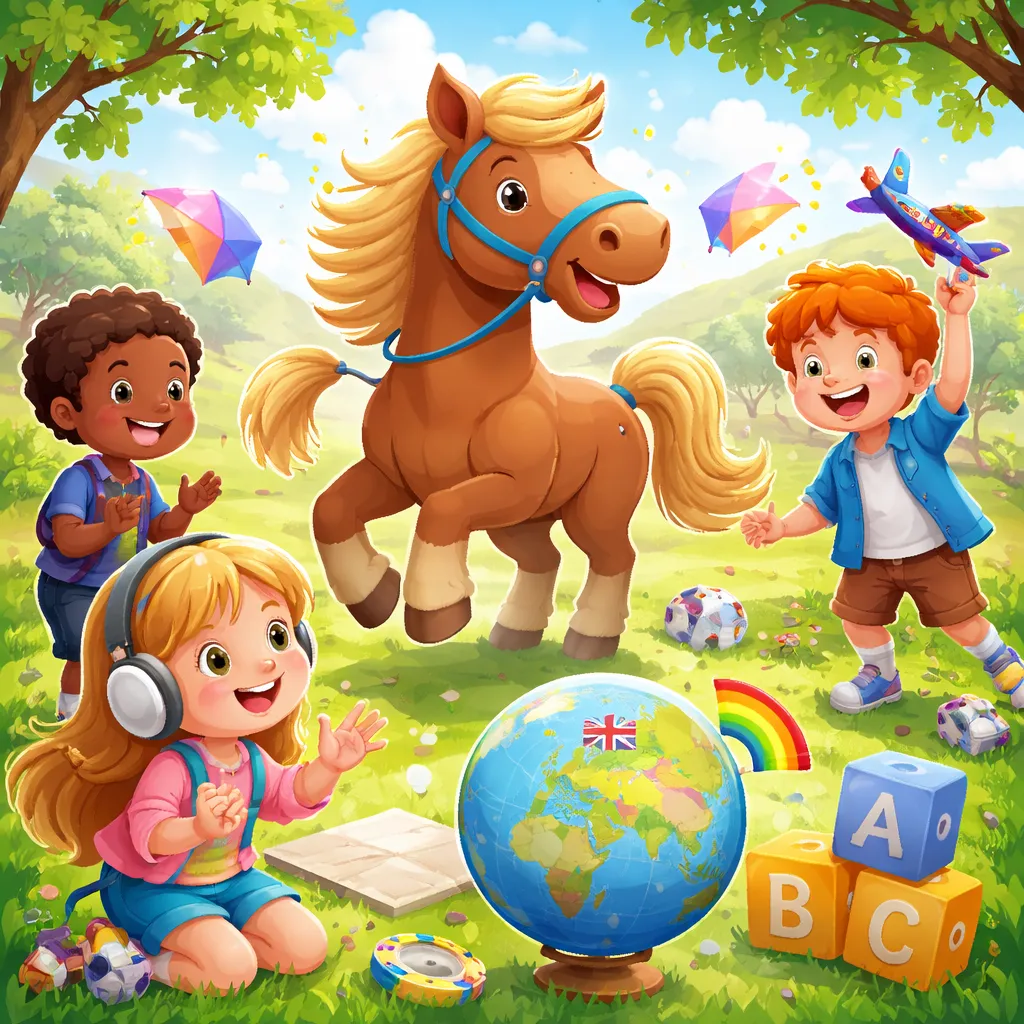

Learning a new language opens doors to new worlds. For children, music is one of the most joyful keys to unlock that door. Today, we will explore a delightful Portuguese children’s song called “O Cavalinho,” which translates to “The Little Horse.” We will use this charming melody as a bridge to learn English. We will discover the rhythm, the words, and the playful spirit of the song. Together, we can turn a simple tune into a powerful, fun-filled language lesson.
What is the rhyme? “O Cavalinho” is a beloved traditional rhyme in Portuguese-speaking cultures. It is a simple, repetitive song that children love to sing while pretending to ride a horse. The song creates a sense of movement and joy. It often involves bouncing on a parent’s knee or galloping around the room. The simplicity of the lyrics makes it perfect for young learners. It invites participation without any pressure. For a child, this rhyme is not just about words. It is about the feeling of play and connection. When we introduce it to English learners, we keep that playful spirit alive. We use the familiar melody to introduce new vocabulary. The song becomes a safe space where children feel confident to make sounds, repeat words, and join in the fun.
The lyrics of nursery rhymes To fully appreciate this song, we first look at the original Portuguese words. Then, we see how they translate into English. This helps children understand the meaning while enjoying the sound of a new language. You do not need to speak Portuguese to enjoy this. Just listen to the rhythm. You will notice how the English version can fit the same playful melody.
Original Version (Portuguese)
O cavalinho, o cavalinho Vai correr, vai correr Pelas montanhas, pelas montanhas Vai chover, vai chover
English Version
The little horse, the little horse Will run, will run Through the mountains, through the mountains It will rain, it will rain
Another common verse adds a layer of action. Here is the second part of the song.
Original Version (Portuguese)
O cavalinho, o cavalinho Vai parar, vai parar Na estradinha, na estradinha Vai descansar, vai descansar
English Version
The little horse, the little horse Will stop, will stop On the little road, on the little road Will rest, will rest
As you read these lines, imagine the gentle bounce of a horse’s trot. The repetition is key. It makes the words easy to remember. Children can focus on the action words: run, stop, rest. They can also picture the places: mountains, road.
Vocabulary learning This song offers a wonderful collection of new words. We can focus on nouns and verbs that are easy to act out. Start with the main character: the horse. In Portuguese, it is cavalinho. In English, we say “little horse.” Using the word “little” adds a feeling of tenderness. It makes the character relatable to a child.
Here are the key words to highlight from the song:
Horse: The animal. You can ask your child to show you a picture of a horse or make the horse sound, “neigh.”
Run: A fast movement. Children know this word from play. Run in place together.
Mountains: Large, tall landforms. You can make a mountain shape with your hands or look at pictures of nature.
Rain: Water falling from the sky. Pat your legs to make the sound of rain.
Stop: To cease moving. This is an important action word. Play a game where you run and then freeze when you say “stop.”
Rest: To relax, to take a break. Yawn and stretch to show the meaning.
Road: The path where the horse walks. You can draw a winding road on paper.
Use these words in daily life. When you see a horse in a book, say “Look, the little horse!” When it starts to rain, sing the line “it will rain.” This connects the song to the real world. It makes the vocabulary stick.
Phonics points Phonics is about understanding the sounds that make up words. This song is perfect for practicing specific sounds. The repetition helps children hear the sounds clearly.
First, focus on the short ‘o’ sound. Listen to the word “horse.” The ‘or’ sound is a unique one. You can practice it by saying “more,” “door,” and “horse.” Make a circle with your mouth and push the sound out.
Next, look at the ‘r’ sound in “run” and “rain.” This is a strong, voiced sound. Have your child pretend to be a race car. Say “rrrrrun” and “rrrrain” with energy. Feel the vibration in your throat.
The word “stop” introduces the ‘st’ blend. This is two consonants together. Say “s” like a snake, then quickly add “top.” It is a sharp, clear sound. Practice by pretending to put your hand up like a stop sign.
Finally, the word “little” has the double ‘t’ sound, which in American English often sounds like a soft ‘d’. Say “little” slowly. Feel how your tongue taps the roof of your mouth. This is a common pattern in English, found in words like “bottle” and “kettle.”
Grammar patterns Even simple songs contain grammar. We can introduce these patterns in a gentle way. Do not use technical terms if they confuse the child. Instead, show how the words work together.
The song uses the future tense with “will.” “Will run” means it is going to happen. You can explain this simply. “Will” is a helper word. It tells us the horse plans to do something soon. You can practice by making predictions. “I will eat my snack.” “We will read a book.” This gives children a tool to talk about future actions.
Notice the repetition of phrases. “The little horse, the little horse” repeats the noun. This is a common pattern in songs and stories. It adds emphasis. It makes the phrase memorable. In English, we use repetition to make a point stronger or more musical.
Also, look at the preposition “through.” The horse runs through the mountains. “Through” means going from one side to the other. You can show this with a tunnel. Push a toy car through a cardboard tube. Say “the car goes through the tunnel.” This teaches spatial relationships in a concrete way.
Learning activities Songs become powerful when we add movement and play. These activities transform listening into active learning. They are simple to do at home or in a small group.
The Galloping Game Play the song and pretend to be the little horse. Gallop around the room. When the song says “will run,” run faster. When it says “will stop,” freeze immediately. When it says “will rest,” lie down on the floor. This activity teaches listening comprehension. It also connects verbs to physical action. Children learn by doing.
Story Stones Create story stones to retell the song. Find smooth stones or use circles of cardboard. Draw a horse, a mountain, a rain cloud, a road, and a resting place. As you sing, place the stones in order. This builds sequencing skills. Children can hold the stones and sing along. It gives them a visual anchor for the words.
Weather and Movement Connection Discuss the weather in the song. It will rain. Ask your child what we need when it rains. An umbrella, a raincoat. Then, connect this to the horse. Where does the horse go when it rains? Perhaps he stops to rest. This encourages critical thinking. It also introduces cause and effect.
Printable materials Printable materials offer a quiet, focused extension of the song. They are wonderful for building fine motor skills and reinforcing vocabulary.
Create a set of flashcards. One card shows the horse. One shows the action “run.” One shows the mountain. One shows the rain. Use these cards for a matching game. Sing a line from the song, and have your child hold up the correct card.
Design a simple coloring page. Draw the little horse standing on a road, with mountains in the background and rain falling from the sky. Children can color while listening to the song. As they color, talk about the scene. “What color is the little horse?” “Is the rain heavy or light?”
Another great printable is a “Song Map.” Print the lyrics with space for drawings. Next to the line “through the mountains,” your child can draw a mountain. Next to “it will rain,” they can draw raindrops. This turns the song into a personal storybook.
Educational games Games turn language learning into a joyful challenge. They encourage participation and repetition without boredom.
Action Charades Write the action words on slips of paper: run, stop, rest. Place them in a bowl. Take turns picking a word and acting it out. The other person guesses the action. When they guess, sing the part of the song that uses that word. This builds vocabulary and confidence.
Musical Obstacle Course Set up a simple obstacle course. Place a picture of a mountain on a chair. Put a blue blanket on the floor to represent rain. Make a path of paper “roads” leading to a cozy pillow for resting. Play the song and guide your little horse through the course. As you go, say the words. “We are going through the mountains!” “Oh, it is raining!” “Now we will rest.” This integrates the vocabulary into a physical narrative.
The Parrot Game This game focuses on pronunciation and memory. One person sings a line, like “The little horse, the little horse.” The other person repeats it like a parrot. Then, switch roles. Add silly voices. Sing fast. Sing slow. The goal is playful repetition. This helps children internalize the melody and the sentence structure without feeling like they are studying.
As you explore “O Cavalinho,” remember that the goal is not perfect pronunciation or memorization. The goal is connection. You are sharing a moment of joy. You are showing your child that language is music. It is movement. It is a story we tell together. Every time you sing about the little horse running through the mountains, you are building a foundation of confidence and curiosity. Let the song be a gentle friend on your language journey. Sing it in the car. Hum it during a walk. Let it rain English words into your daily play.