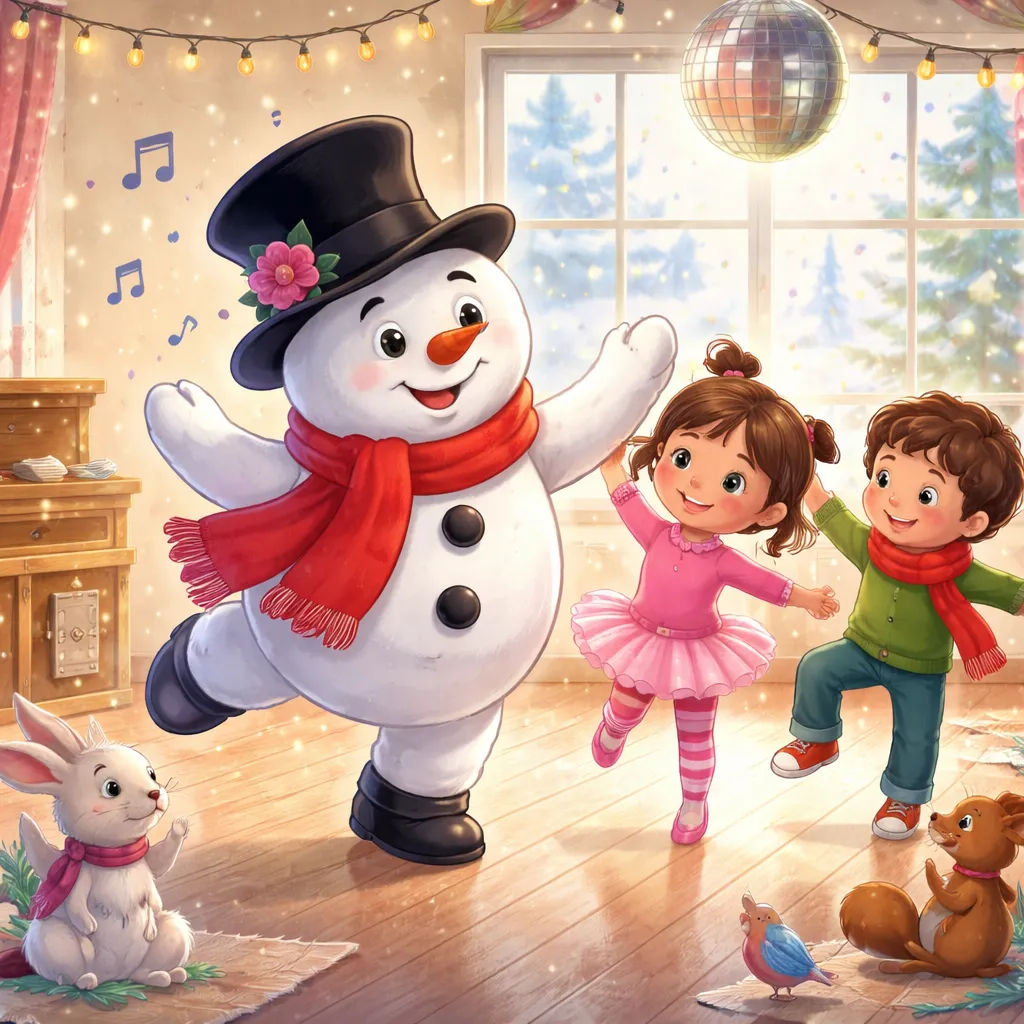

Have you ever built a snowman? You roll the balls, find stones for eyes, and hope it lasts. But what if one day, your snowman winked, tipped his hat, and started to dance? There is a famous song about exactly that magical surprise. It tells the story of a snowman who comes to life for a wonderful, fleeting adventure. Let’s learn about the song “Frosty the Snowman.”
About the Song
Let’s read the magical story told in the song’s words.
Frosty the Snowman was a jolly happy soul, With a corncob pipe and a button nose And two eyes made out of coal. Frosty the Snowman is a fairy tale, they say, He was made of snow but the children Know how he came to life one day. There must have been some magic in that Old silk hat they found. For when they placed it on his head He began to dance around.
Frosty the Snowman was alive as he could be, And the children say he could laugh and play Just the same as you and me. Thumpety thump thump, Thumpety thump thump, Look at Frosty go. Thumpety thump thump, Thumpety thump thump, Over the hills of snow.
Frosty the Snowman knew The sun was hot that day, So he said, "Let's run and We'll have some fun Now before I melt away." Down to the village, With a broomstick in his hand, Running here and there all Around the square saying, Catch me if you can. He led them down the streets of town Right to the traffic cop. And he only paused a moment when He heard him holler "Stop!" For Frosty the Snowman had to hurry on his way, But he waved goodbye saying, "Don't you cry, I'll be back again some day."
This song is a classic American winter song and children’s story. It is a musical tale about a magical snowman who comes to life, plays with children, and then must leave before the sun melts him, promising to return. The song was written by Walter "Jack" Rollins and Steve Nelson in 1950, following the huge success of "Rudolph the Red-Nosed Reindeer." It was first recorded by Gene Autry and the Cass County Boys. The song tells a complete, whimsical story that captures the joy and temporary nature of winter play, blending the real fun of building a snowman with a delightful fantasy of magic and friendship.
What the Song is About
The song paints a vivid, joyful, and bittersweet picture. First, we meet Frosty. He is a wonderfully built snowman, not just any snowman. He has a corncob pipe, a button nose, and coal eyes. Most importantly, he is a “jolly happy soul,” full of cheer. The song explains that his story is like a fairy tale.
The magic happens when the children find an old silk hat. They place it on Frosty’s head. Suddenly, the magic in the hat works! Frosty comes to life! He begins to dance and move. He is as alive as any person, laughing and playing with the children. He dances with a “thumpety thump thump” sound through the snow.
But Frosty is smart. He knows he is made of snow. He feels the hot sun and knows he will melt. So, he decides to make the most of his time. He leads the children on a grand, playful chase through the town square, broomstick in hand, telling everyone to “catch me if you can.” He even runs past a surprised traffic cop. Finally, knowing he cannot stay, he says a cheerful goodbye. He promises the children he will return, then hurries away, leaving behind the magical hat and a wonderful memory.
Who Made It & Its Story
The song “Frosty the Snowman” was written by songwriters Walter “Jack” Rollins and Steve Nelson. They wrote it in 1950, hoping to create another seasonal hit like “Rudolph.” They succeeded brilliantly. The singing cowboy Gene Autry, who had a huge hit with “Rudolph,” recorded it that same year. The song was an instant success and has been a winter standard ever since.
This song became a timeless favorite for three magical reasons. First, it tells a perfect, self-contained story. It has a clear beginning (building Frosty), middle (the magic hat and play), and end (the goodbye and promise), which is satisfying and memorable. Second, it is incredibly fun and active. The “thumpety thump thump” refrain is energetic and mimics the sound of running, encouraging children to move and dance. Third, it touches on a deep truth in a gentle way: the idea that joyful moments are precious and sometimes temporary, but the memory and promise of their return (like winter) brings hope.
When to Sing It
This song is perfect for active, wintery play. You can sing it at the top of your lungs while building your own snowman, hoping for a little magic. You can sing it during a family dance party in the living room, doing the “thumpety thump thump” dance. You can also sing it on a cold car ride, watching the snowy scenery go by and imagining Frosty running over the hills.
What Children Can Learn
This joyful, magical story is packed with wonderful things to discover. Let’s explore the learning hidden in the snow.
Vocabulary
The song teaches us delightful descriptive words. A “snowman” is a figure made of packed snow, shaped to look like a person. “Jolly” means very cheerful and happy. A “soul” can mean a person’s spirit or inner self; calling Frosty a “happy soul” makes him seem alive inside. A “corncob pipe” is a smoking pipe made from the hard core of an ear of corn. A “fairy tale” is a magical story for children. “Magic” is the power to make impossible things happen. A “broomstick” is the handle of a broom. A “village” is a small town. A “traffic cop” is a police officer who directs traffic. To “holler” means to shout loudly.
Let’s use these words! You can say, “The clown was a jolly person.” Or, “We read a fairy tale about a dragon.” You might explain, “The traffic cop hollered, ‘Stop!’ to the car.” New word: Ephemeral. This means lasting for a very short time. Frosty’s life was ephemeral, but his memory lasted.
Language Skills
This song is a wonderful lesson in using the past tense to tell a narrative and the present tense to state a general truth. The story of Frosty is told in the past tense: “Frosty the Snowman was a jolly happy soul… He was made of snow… He began to dance.” This sets the story in a completed time.
However, the song also uses the present tense to tell us what people say or believe now: “Frosty the Snowman is a fairy tale, they say.” This mixes the legendary past with the ongoing present. The song also uses direct speech to bring the characters to life: “So he said, ‘Let’s run and we’ll have some fun…’” and “He waved goodbye saying, ‘Don’t you cry…’” This is a key tool for making stories dynamic and engaging.
Sounds & Rhythm Fun
Listen to the bouncy, playful rhythm of the song. The lyrics use a clear and catchy rhyme scheme: “soul” and “coal,” “say” and “day,” “found” and “around,” “be” and “me.” The most famous part is the onomatopoeic “Thumpety thump thump,” which sounds like the rhythm of running feet in the snow.
The rhythm is upbeat, marching, and full of energy, perfectly capturing a playful chase. Try clapping or stomping: THUMPety THUMP THUMP, THUMPety THUMP THUMP. The melody is simple, repetitive, and incredibly easy to remember and sing along to. This energetic, galloping rhythm makes the story exciting and the song impossible to forget. You can write your own magical friend song! Use the same bouncy rhythm. Try: “Polly the Puddle was a splishy splashy friend, with a surface like a mirror that would ripple without end. Polly the Puddle was a story, they insist, she came to life one morning in the morning mist. There must have been some magic in that morning sun so bright, for when it touched her surface she began to dance with light!”
Culture & Big Ideas
“Frosty the Snowman” is a classic piece of mid-20th century American holiday culture. It emerged during a time when festive songs for children were becoming a major part of the winter season. The song reflects the universal childhood experience of building a snowman and using imagination to bring inanimate objects to life. It also touches on a gentle cycle of life and renewal, tied to the seasons, which is a common theme in winter folklore.
The song conveys three important ideas. First, it’s about the power of imagination and play. The children’s belief and the magical hat turn ordinary snow into a friend, showing how creativity can transform the world. Second, it teaches about enjoying the present moment. Frosty knows his time is limited, so he chooses to have as much fun as possible, teaching us to appreciate joyful times while they last. Third, it’s about graceful goodbyes and hopeful promises. Instead of a sad ending, Frosty leaves with a cheerful wave and a promise to return, which is a gentle way to handle change and loss, much like the cycle of the seasons.
Values & Imagination
Imagine you are one of the children in the song. What does Frosty’s hat look like? Old, silvery, maybe with a slightly bent brim? How does the magic feel? A tingle in the air? What does Frosty’s laugh sound like? A deep, rumbly “Ho Ho Ho!”? Imagine the chase through the town square. What shops do you run past? The bakery? The post office? How does the snow feel under your boots? Draw a map of Frosty’s adventure from the yard, through the square, past the traffic cop, and to the edge of town where he says goodbye.
The song inspires us to cherish play, friendship, and the magic we create ourselves. A wonderful idea is to have a “Frosty’ Day.” The next time it snows, build your own snowman. Give it a special hat (with permission!) and imagine what it would say if it came to life. What adventure would you have? If there’s no snow, draw or craft a Frosty from cotton balls, paper, and buttons. Create a short, happy story about your Frosty’s one day of fun. This celebrates imagination and the joy of creation, just like the song.
So, as we come to the end of Frosty’s running, laughing day, think about the magic of the story. It is a vocabulary lesson in winter whimsy. It is a grammar lesson in storytelling tenses. It is a music lesson in rhythm and sound words. From the first description of a “jolly happy soul” to the final, hopeful wave goodbye, it wraps a deep lesson in a package of pure, playful fun. “Frosty the Snowman” teaches us that magic can be found in an old hat and a child’s belief, that every moment of joy is a treasure, and that goodbyes are not always forever—sometimes, they are just a “see you later,” waiting for the next winter’s snow.
Your Core Takeaways
You are now an expert on the song “Frosty the Snowman.” You know it was written in 1950 by Jack Rollins and Steve Nelson. You’ve learned words like “jolly,” “corncob pipe,” and “thumpety,” and you’ve seen how stories use past and present tense. You’ve felt its galloping, playful rhythm and created your own magical character song. You’ve also discovered the song’s celebration of imagination, living in the moment, and the hopeful, cyclical nature of joy and the seasons.
Your Practice Missions
First, stage the “Great Frosty Chase.” In your backyard or living room, set up a simple obstacle course (chairs, pillows, etc.). One person wears a special hat and is “Frosty.” The others are the children. Play the song or sing it. “Frosty” leads the chase through the course, pausing only when someone playing the traffic cop (maybe a parent) shouts “Stop!” At the end, Frosty waves goodbye and promises to return. This active play brings the song to life.
Second, write and draw “Frosty’s Return.” The song ends with Frosty promising to come back. Create a one-page comic or a short story about his return. What new adventure does he have? Does he visit in a blizzard? Does he have a new magical item? Use at least five words from the song in your story (like jolly, magic, village, etc.). Share your story with your family, keeping the magic of Frosty alive until next winter.