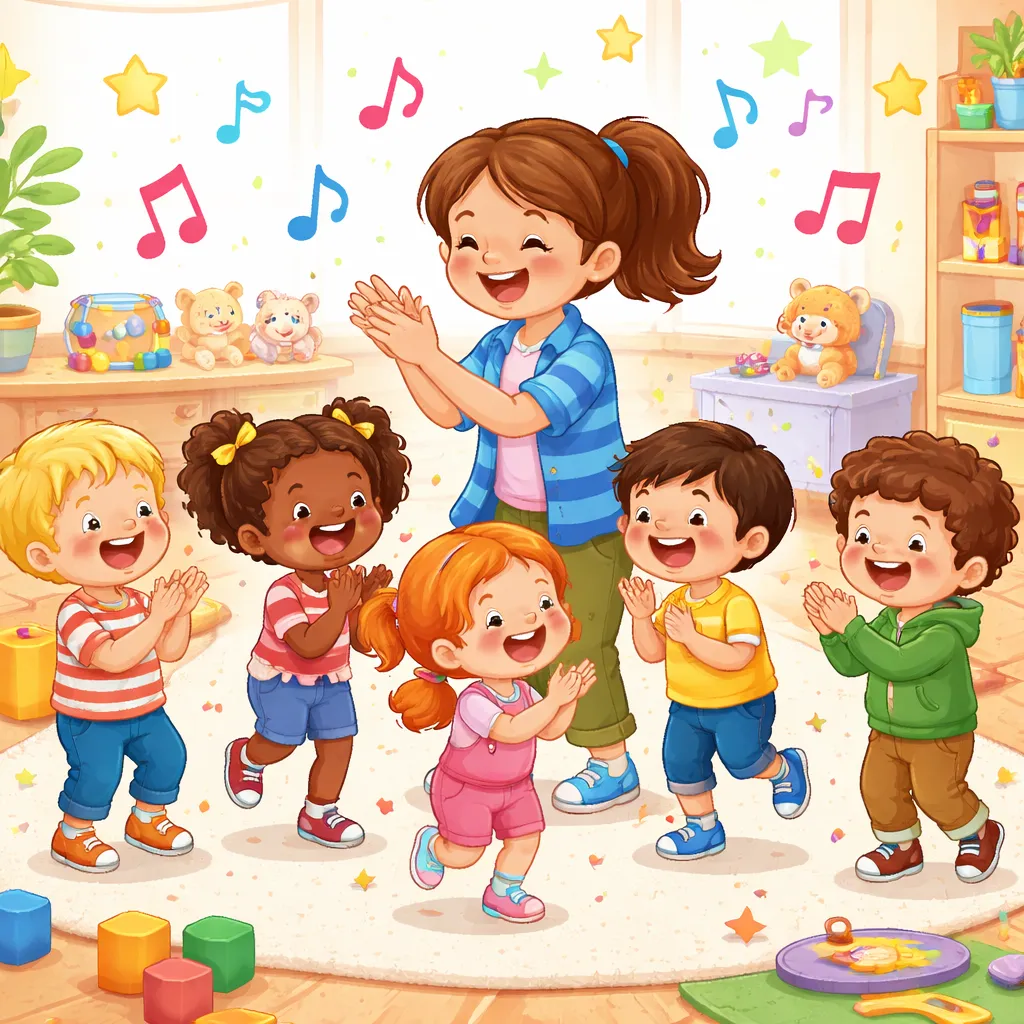

What is the Rhyme "If You're Happy and You Know It"? "If You're Happy and You Know It" is a lively and engaging English nursery rhyme loved by children around the world. It is not just a song to listen to; it is a song to do. Each verse invites children to show their feelings through physical actions. Clap your hands, stomp your feet, shout "hooray" – the song turns emotions into movement. The melody is bright and upbeat, and the instructions are very clear. This makes the English song: If You're Happy and You Know It a perfect choice for helping young children connect feelings with actions, all while having a wonderful time singing and moving together with family and friends.
The Complete Lyrics of the Nursery Rhyme Let us explore the words together. The song has a simple structure that invites you to add new verses. Here are the most popular verses to get everyone moving.
If you're happy and you know it, clap your hands! If you're happy and you know it, clap your hands! If you're happy and you know it, then your face will surely show it, If you're happy and you know it, clap your hands!
If you're happy and you know it, stomp your feet! If you're happy and you know it, stomp your feet! If you're happy and you know it, then your face will surely show it, If you're happy and you know it, stomp your feet!
If you're happy and you know it, shout "Hooray!" If you're happy and you know it, shout "Hooray!" If you're happy and you know it, then your face will surely show it, If you're happy and you know it, shout "Hooray!"
If you're happy and you know it, do all three! If you're happy and you know it, do all three! If you're happy and you know it, then your face will surely show it, If you're happy and you know it, do all three!
Vocabulary Learning from the Song This English song: If You're Happy and You Know It is a wonderful tool for building vocabulary. It introduces words for feelings, body parts, and actions. Learning these words through movement makes them very easy to remember.
First, the song teaches the word "happy." This is a basic feeling word. Talk with your child about what makes them happy. A favorite toy? A trip to the park? A hug from you? Connecting the word to real experiences gives it deep meaning. The song also mentions "your face will surely show it." This teaches children that our faces express how we feel. A smile shows happiness.
Next, the song introduces action verbs. "Clap" tells our hands what to do. "Stomp" tells our feet. "Shout" tells our voice. Each action is clear and easy to demonstrate. When children perform the action while saying the word, they build a strong mind-body connection that supports language development.
Phonics Points to Practice Let us listen for special sounds in the song. Phonics helps children understand the relationship between letters and sounds. This English song: If You're Happy and You Know It gives us many opportunities to practice.
Listen to the "h" sound at the beginning of "happy" and "hooray." It is a gentle breath sound. Put your hand in front your mouth and say "happy." Can you feel the air? Practice other words that start with "h" like "hat," "horse," and "hello." This builds sound awareness in a natural, playful way.
Another important sound is the "cl" blend at the beginning of "clap." Say "clap" slowly. First you hear the "c" sound, then quickly the "l" sound. Practice other words that start with "cl" like "clock," "cloud," and "clean." Recognizing these sound blends is an important step in learning to read.
Grammar Patterns We Can Learn This cheerful song teaches important grammar in a very natural way. The English song: If You're Happy and You Know It introduces conditional sentences and action verbs in a simple, repetitive pattern.
Look at the first line, "If you're happy and you know it, clap your hands." The word "if" introduces a condition. It means when something is true, something else happens. You can use this pattern in daily life. Say to your child, "If you are hungry, we will eat lunch," or "If you are tired, we will read a book." This helps children understand how we talk about possibilities and choices.
The song also uses action verbs as commands. "Clap your hands" tells someone what to do. These are called imperative sentences. You use them naturally every day. "Please pass the cup." "Come here." "Look at this." The song reinforces this common and useful sentence structure in a joyful way.
Learning Activities to Do at Home Bringing this English song: If You're Happy and You Know It into your daily life is simple and fun. Here are some activities you can try with no special materials needed.
A wonderful activity is the "Feelings Face" game. After singing the happy song, talk about other feelings. Ask your child, "How do you look when you are sad?" Make a sad face together. "How do you look when you are surprised?" Open your eyes wide. Then make up new verses. "If you're sleepy and you know it, close your eyes." "If you're excited and you know it, jump up high." This expands emotional vocabulary and awareness.
You can also have an "Action Parade." Sing the song and take turns choosing the actions. Your child can choose "wiggle your fingers" or "touch your nose" or "pat your head." Taking turns leading the song builds confidence and creativity. It also shows children that their ideas are valued and important.
Printable Materials for Learning Creating simple printables can make this English song: If You're Happy and You Know It more visual and engaging. You can make these materials together with your child.
A set of action cards is very useful. Draw simple pictures on cards or small pieces of paper. Draw hands clapping on one card. Draw feet stomping on another. Draw a mouth open wide for shouting on a third. As you sing each verse, hold up the matching card. This helps children connect the words with the actions before they can read.
Another idea is a "Feelings Chart." Draw simple faces showing happy, sad, surprised, and sleepy. Hang the chart where you can see it every day. During the day, you can point to the chart and ask, "How are you feeling now?" This builds emotional vocabulary and helps children learn to express their feelings with words.
Educational Games for Deeper Learning Games turn the song into an active, engaging experience. They encourage children to use the language from the English song: If You're Happy and You Know It in creative new ways.
The "Guess the Action" game is always fun. You sing the first part of the verse but stop before the action. "If you're happy and you know it, ..." Then you perform a silent action. Clap silently or stomp without sound. Your child guesses the action and sings the next line. Then switch roles. This game builds listening skills and anticipation.
Another wonderful game is "New Feeling Verses." Ask your child to think of a new feeling. Maybe "silly." Then create a verse together. "If you're silly and you know it, wiggle your ears." Maybe "brave." "If you're brave and you know it, roar like a lion." Creating new verses together shows children that language is flexible and fun. It encourages them to play with words and express their full range of emotions through music and movement.