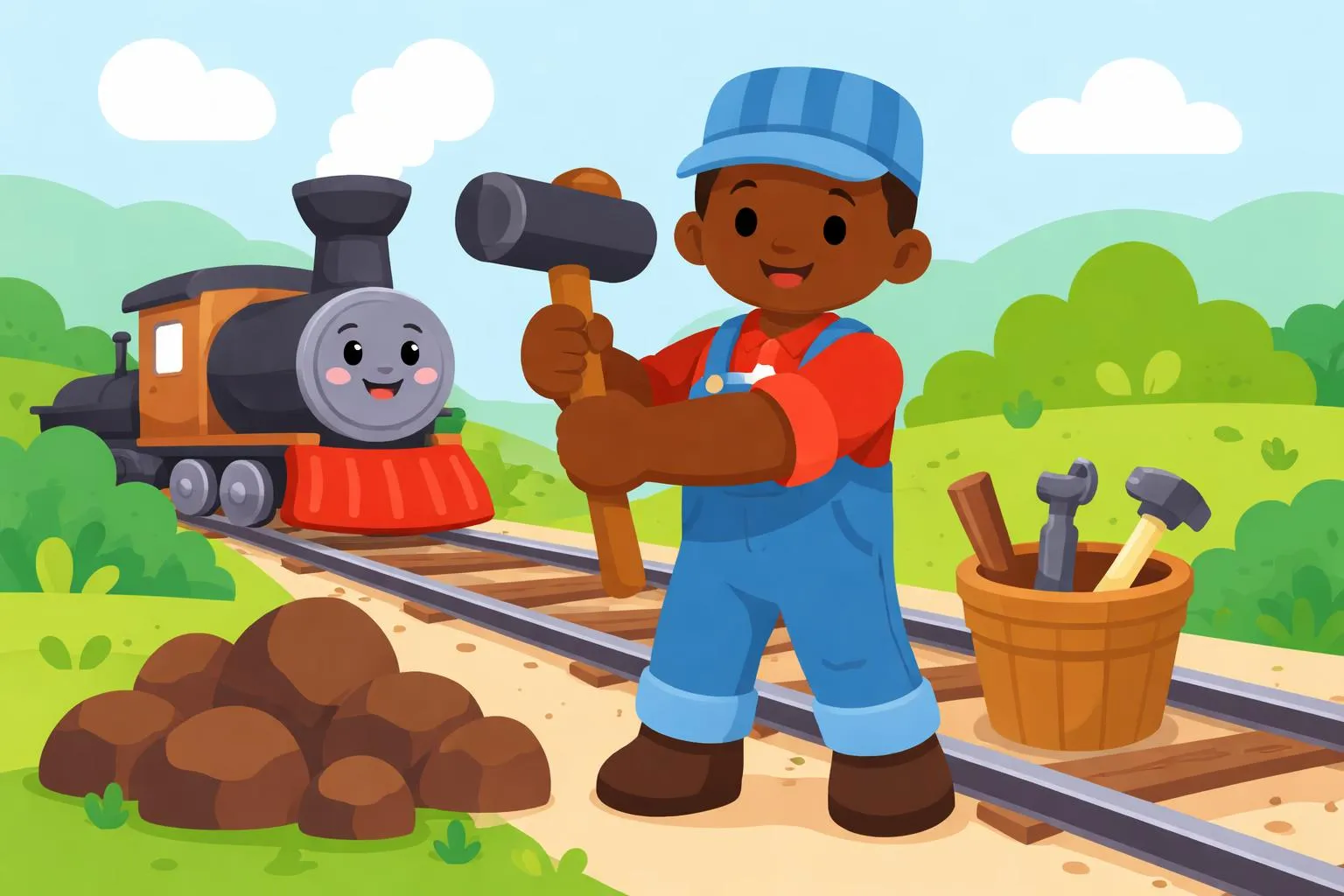

Original Poem:
When John Henry was a little tiny baby
Sitting on his mama's knee,
He picked up a hammer and a little piece of steel
Saying, "Hammer's going to be the death of me, Lord, Lord,
Hammer's going to be the death of me."
John Henry was a man just six feet high,
Nearly two feet and a half across his breast.
He'd hammer with a nine-pound hammer all day
And never get tired and want to rest, Lord, Lord,
And never get tired and want to rest.
John Henry went up on the mountain
And he looked one eye straight up its side.
The mountain was so tall and John Henry was so small,
He laid down his hammer and he cried, "Lord, Lord,"
He laid down his hammer and he cried.
John Henry said to his captain,
"Captain, you go to town,
Bring me back a TWELVE-pound hammer, please,
And I'll beat that steam drill down, Lord, Lord,
I'll beat that steam drill down."
The captain said to John Henry,
"I believe this mountain's sinking in."
But John Henry said, "Captain, just you stand aside--
It's nothing but my hammer catching wind, Lord, Lord,
It's nothing but my hammer catching wind."
John Henry said to his shaker,
"Shaker, boy, you better start to pray,
'Cause if my TWELVE-pound hammer miss that little piece of steel,
Tomorrow'll be your burying day, Lord, Lord,
Tomorrow'll be your burying day."
John Henry said to his captain,
"A man is nothing but a man,
But before I let your steam drill beat me down,
I'd die with a hammer in my hand, Lord, Lord,
I'd die with a hammer in my hand."
The man that invented the steam drill,
He figured he was mighty high and fine,
But John Henry sunk the steel down fourteen feet
While the steam drill only made nine, Lord, Lord,
The steam drill only made nine.
John Henry hammered on the right-hand side.
Steam drill kept driving on the left.
John Henry beat that steam drill down.
But he hammered his poor heart to death, Lord, Lord,
He hammered his poor heart to death.
Well, they carried John Henry down the tunnel
And they laid his body in the sand.
Now every woman riding on a C and O train
Says, "There lies my steel-driving man, Lord, Lord,
There lies my steel-driving man."
Analysis and Interpretation of the Poem
This poem tells the legendary story of John Henry, a folk hero in American culture, symbolizing the strength, determination, and spirit of human labor against the rise of machinery during the Industrial Revolution. The narrative begins with John Henry as a baby, already connected to the hammer and steel, foreshadowing his lifelong relationship with hard physical work.
John Henry is portrayed as a giant of a man, both in stature and strength, who uses a hammer to drive steel into rock. The poem contrasts his human power with the mechanical power of a steam drill, a new invention threatening to replace manual labor. John Henry’s determination to prove that human strength and willpower can surpass machines leads him to a contest against the steam drill.
Despite his victory—driving steel deeper than the machine—John Henry pays the ultimate price, dying from the physical toll of his effort. The poem ends with a tribute to John Henry, remembered by women on the train as the "steel-driving man," symbolizing respect for human endurance and sacrifice.
Background and Author Information
The story of John Henry is part of American folklore, particularly rooted in African American oral tradition. It originated in the late 19th century during the era of railroad expansion in the United States. The tale reflects the social and economic tensions of the time, especially the conflict between human laborers and industrial machinery.
The poem itself has been passed down through generations, often sung as a ballad or work song by railroad workers. The exact author is unknown, as it is a traditional folk song that evolved over time. Its enduring popularity highlights the cultural importance of storytelling in preserving history and values.
Reflections and Insights
John Henry’s story is a powerful reminder of the human spirit’s resilience and the value of hard work. It also raises important questions about progress and technology: while machines can increase efficiency, they can also threaten the livelihoods and dignity of workers.
For modern readers, the poem encourages reflection on balance—how to embrace innovation without losing sight of human worth. It also inspires courage and perseverance, showing that even in the face of overwhelming odds, determination can make a difference.
Educational Value and Learning Points
From this poem, children and students can learn several important lessons and skills:
- Historical context: Understanding the Industrial Revolution and its impact on workers.
- Folklore and oral tradition: Appreciating how stories and songs preserve cultural heritage.
- Themes of perseverance and sacrifice: Recognizing the value of hard work and dedication.
- Human vs. machine: Discussing the ethical and social implications of technological progress.
- Literary devices: Identifying repetition, imagery, and narrative structure in poetry.
Practical Applications
- In history lessons, John Henry’s story can illustrate the human side of industrialization.
- In literature classes, students can analyze the poem’s structure and themes.
- In life skills education, the poem can inspire discussions about resilience and facing challenges.
- In technology and ethics discussions, it can serve as a starting point for debates about automation and employment.
Reading Comprehension Questions
- Who is John Henry and what is he famous for?
- What does the hammer symbolize in the poem?
- Why does John Henry want a twelve-pound hammer?
- What is the significance of the contest between John Henry and the steam drill?
- What happens to John Henry after he wins the contest?
- How do people remember John Henry at the end of the poem?
- What message does the poem convey about human labor and machines?
Answers
- John Henry is a legendary steel-driving man known for his incredible strength and determination.
- The hammer symbolizes human labor, strength, and perseverance.
- John Henry wants a heavier hammer to beat the steam drill in the contest.
- The contest represents the struggle between human effort and industrial machinery.
- John Henry dies from the physical strain of hammering so hard.
- People remember him as a hero, the "steel-driving man," honored by those who ride the train.
- The poem conveys that human spirit and effort are powerful but can be challenged by technological progress, highlighting both pride in labor and the cost of industrialization.