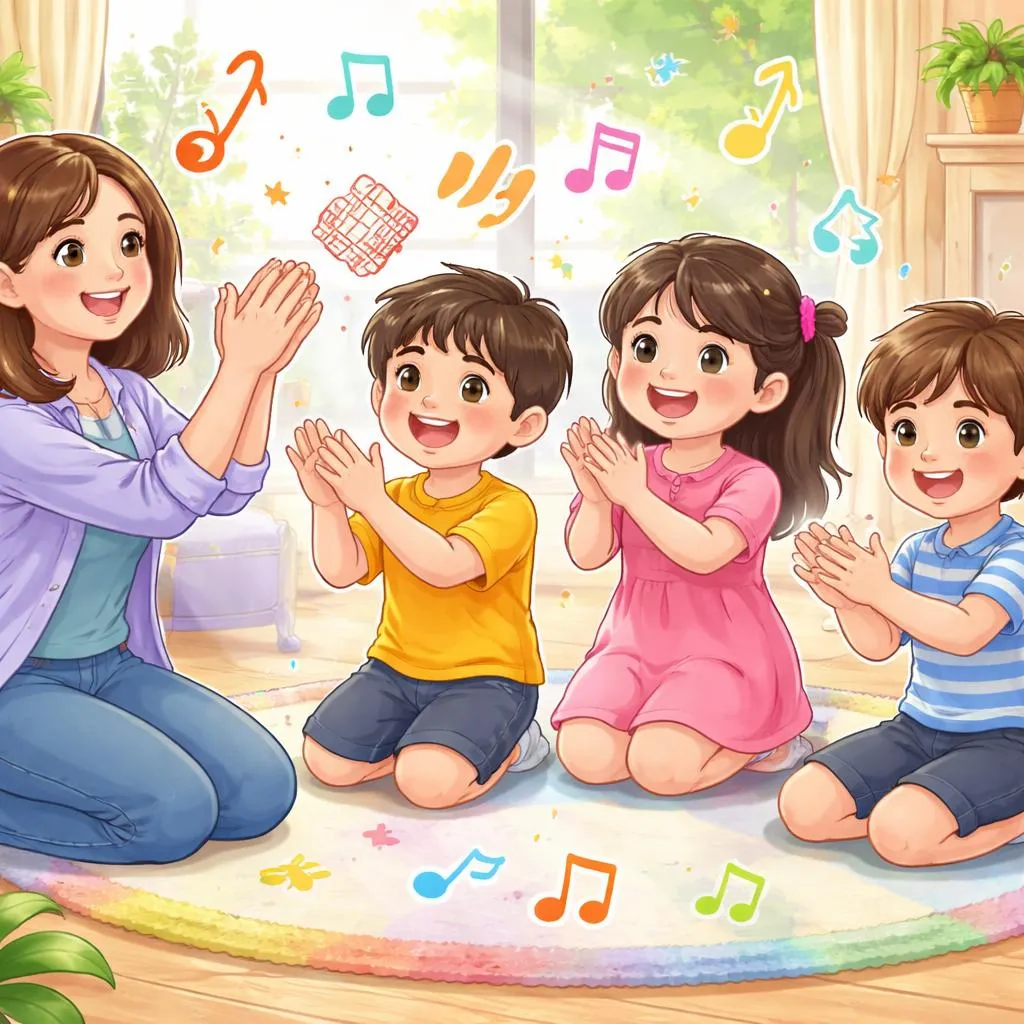

Hands clap together. A rhythm begins. A song comes alive. A children’s song can turn that simple clap into a joyful language lesson. Today, we explore a traditional Japanese children’s song called “手拍子の歌” (Tebyōshi no Uta), which translates to “The Hand Clapping Song.” This lively song uses clapping to create rhythm and joy. We will use this melody as a rhythmic, clapping path into English. Together, we will learn new words, explore important sounds, and discover how a simple song can make language learning feel like keeping a steady beat. The hands clap together. Your child can learn English with that same rhythmic, joyful energy.
What is the rhyme? “The Hand Clapping Song” (手拍子の歌) is a joyful Japanese children’s song that celebrates the simple pleasure of clapping hands. The song has a steady, rhythmic beat. Children often use hand movements. They clap to the rhythm. They tap their knees. They snap their fingers. The song creates a joyful, participatory atmosphere. It teaches rhythm, coordination, and the joy of making music together. When we bring this song to English learning, we keep its rhythmic, clapping spirit. We use the familiar melody to introduce English words in a way that feels like keeping time with your hands.
The lyrics of nursery rhymes To appreciate this song, we first look at the original Japanese words. Then we see how they translate into English. This shows children that the same joyful clapping rhythm can be expressed in different languages. You do not need to know Japanese to enjoy the steady, clapping beat of the words.
Original Version (Japanese)
手をたたきましょう 手をたたきましょう みんなで 手をたたきましょう ぱちぱち ぱちぱち 手をたたきましょう
English Version
Let us clap our hands Let us clap our hands Everyone, let us clap our hands Pachi-pachi, pachi-pachi Let us clap our hands
A longer version adds different actions:
手をたたきましょう 足をたたきましょう みんなで 楽しく ぱちぱち とんとん
English Version
Let us clap our hands Let us tap our feet Everyone, happily Clap-clap, tap-tap
As you read these words, notice the steady, repeating rhythm. The rhythm moves like hands clapping. The story is simple and joyful. Let us clap our hands. Everyone, let us clap. Clap-clap, clap-clap. We can also tap our feet. This narrative invites children to move and make rhythm.
Vocabulary learning This song offers a wonderful set of words that connect to rhythm, movement, and togetherness. We can explore these words through conversation, pictures, and clapping play.
Start with the main action: clapping. In Japanese, it is 手をたたく (te o tataku). In English, we say “clap.” Clapping is hitting your hands together.
Here are the key words to focus on from the song:
Clap: Hit your hands together. Clap your hands.
Hands: The parts at the end of your arms. Show your hands.
Let us: A way to suggest doing something together. Let us clap.
Everyone: All people. Everyone claps.
Pachi-pachi: The sound of clapping in Japanese. In English, we say “clap-clap.”
Tap: Hit lightly. Tap your feet.
Feet: The parts at the end of your legs. Tap your feet.
Happily: With joy. We clap happily.
Use these words in natural moments. When you are happy, say “let us clap!” When you tap your foot, say “tap, tap.” These connections make the vocabulary meaningful.
Phonics points Phonics helps children understand the sounds that build English words. This song gives us several clear sounds to explore in a rhythmic, clapping way.
First, focus on the ‘cl’ blend at the beginning of “clap.” This is two consonants together. Say “c,” then quickly add “l.” Then add “ap.” Practice with “clap,” “cloud,” and “climb.” This blend sounds like the clapping motion.
Next, notice the short ‘a’ sound in “clap” and “tap.” Say “a” like in “apple.” Practice with “cat,” “hat,” and “clap.” This sound is short and crisp.
The word “pachi-pachi” is onomatopoeia. It sounds like the clapping. In English, we say “clap-clap.” You can practice sound words. “Clap-clap.” “Tap-tap.” “Pat-pat.” This builds sound vocabulary.
Finally, look at the ‘h’ sound in “hands” and “happily.” This is a soft, breathy sound. Say “h h h” like a gentle sigh. Practice with “hello,” “home,” and “hands.” The song also has “feet,” which contains the long ‘e’ sound. Say “ee” like in “see.”
Grammar patterns Even a simple song contains grammar that we can introduce gently. We do not need to use technical terms. Instead, we show how words work together through examples and play.
The song uses “let us” to make suggestions. “Let us clap.” “Let us tap.” You can practice making suggestions. “Let us sing.” “Let us play.” “Let us dance.” This builds social language.
Notice the imperative mood. “Clap” and “tap” are commands. You can practice giving gentle commands. “Clap your hands.” “Tap your feet.” This builds understanding of instructions.
The repetition of “clap-clap” and “tap-tap” adds rhythm and emphasis. You can practice repeating for rhythm. “Clap, clap.” “Tap, tap.” This adds musical language.
Also, look at the word “everyone.” This shows inclusion. You can practice with other inclusive words. “All together.” “Everybody.” “Each person.” This builds community language.
Learning activities Activities bring the song into the body and the imagination. They transform listening into active participation. These ideas are simple and require little preparation.
Clapping Rhythm Play the song and clap to the rhythm. Clap on the beat. When the song says “pachi-pachi,” clap two times. Try different speeds. Fast claps. Slow claps. This activity builds listening skills and rhythm.
Copycat Clap Clap a simple rhythm. “Clap, clap, rest.” Ask your child to copy it. Then switch roles. This builds listening and rhythm skills.
Body Percussion Make sounds with different body parts. Clap hands. Tap feet. Pat knees. Snap fingers. Say “clap, clap, tap, tap.” This builds body awareness and rhythm.
Printable materials Printable resources offer a quiet way to reinforce the song’s vocabulary. They are perfect for moments when children want to create or focus calmly.
Flashcards Create a set of flashcards. One card shows two hands clapping for “clap.” One shows hands for “hands.” One shows feet tapping for “tap.” One shows a group of people for “everyone.” One shows the word “clap-clap.” One shows a happy face for “happily.” Use these cards for a matching game. Sing a line from the song and ask your child to find the matching card. This builds word recognition.
Coloring Page Draw a simple scene. Show children clapping their hands together. Show children tapping their feet. Children can color the children and the background. As they color, talk about the actions. “What are they doing?” “How do they feel?” This keeps the language flowing naturally.
Rhythm Cards Create cards with rhythm patterns. “Clap — rest — clap.” “Clap, clap — tap, tap.” Your child can clap the pattern. This builds rhythm and literacy.
Educational games Games encourage repetition without boredom. They invite children to use the language in new and creative ways.
Clapping Says Play a game similar to “Simon Says.” Give commands using the song’s vocabulary. “Clapping says clap your hands.” “Clapping says tap your feet.” “Clapping says clap fast.” If you give a command without saying “clapping says,” the child does not move. This game builds listening skills.
Echo Clap Clap a pattern. Your child echoes it. Start simple. “Clap, clap.” Then more complex. “Clap, rest, clap, clap.” This builds listening and rhythm.
Freeze Dance Play music. When the music stops, freeze. When it starts, clap and move. This builds listening and self-control.
As you share “手拍子の歌” with your child, remember that you are celebrating rhythm and togetherness. Let us clap our hands. Everyone, let us clap. Clap-clap, clap-clap. We can also tap our feet. Learning a new language has its own rhythm. Words have beats. Sentences have flow. And when you learn together, the rhythm becomes a shared joy. Let this clapping song be your guide. Clap to the beat of new words. Tap to the rhythm of new sounds. Let the rhythmic spirit of the song remind you both that language is music, and every time you speak, you are keeping time with a beautiful beat.