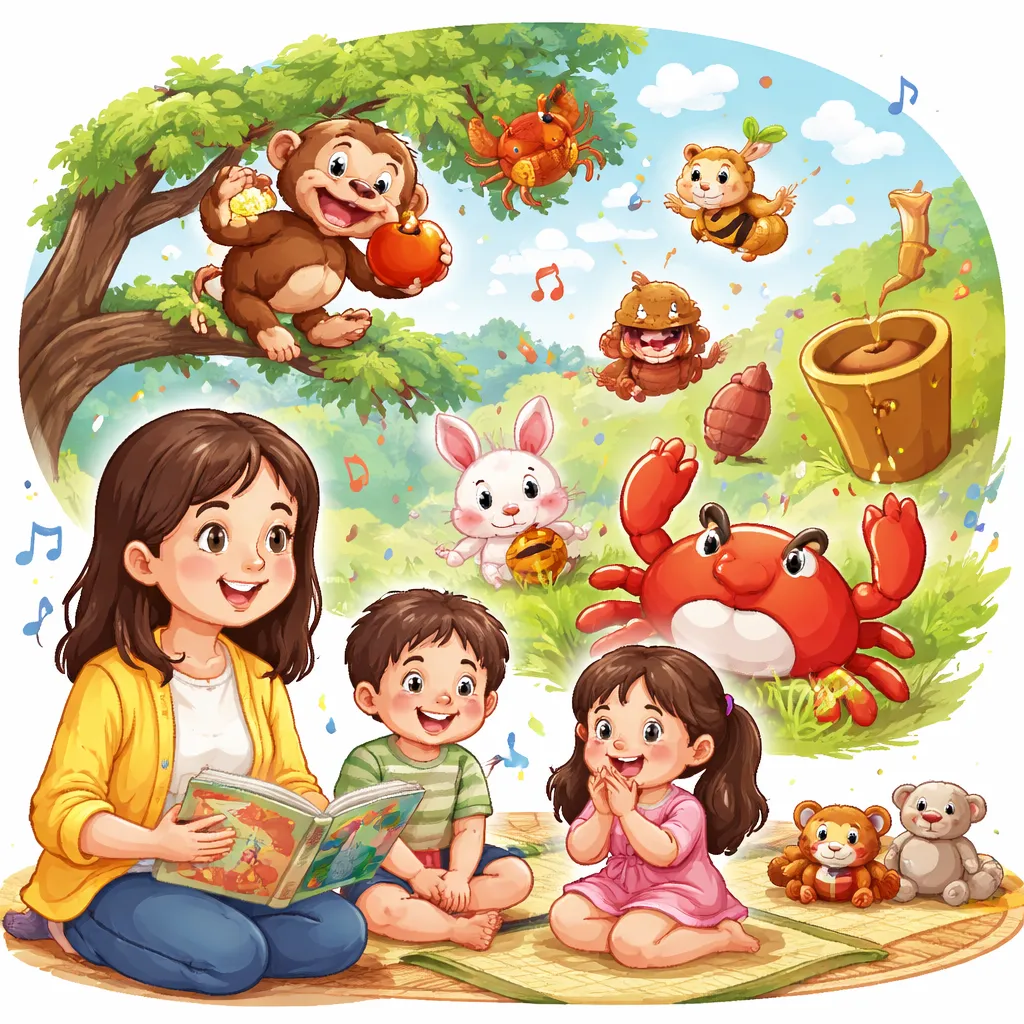

A monkey tricks a crab. The crab finds friends. Justice is served. A children’s song can turn that old folktale into a gentle language lesson. Today, we explore a traditional Japanese children’s song based on the folktale “さるかに合戦” (Sarukani Gassen), which translates to “The Monkey and the Crab.” This story-song follows a crab who is tricked by a monkey and then helped by friends to set things right. We will use this melody as a thoughtful, justice-filled path into English. Together, we will learn new words, explore important sounds, and discover how a simple song can make language learning feel like a story about fairness and friendship. The monkey was unfair, but the crab had good friends. Your child can learn English with that same sense of fairness and friendship.
What is the rhyme? “The Monkey and the Crab” (さるかに合戦) is a classic Japanese folktale that has been told for generations. It tells the story of a crab who drops a rice ball. A monkey tricks the crab out of the rice ball and also takes a persimmon. The crab seeks revenge with the help of friends—a chestnut, a bee, and a mortar. Together, they teach the monkey a lesson. The song version has a steady, storytelling rhythm. Children often use hand movements. They make monkey faces. They pretend to be crabs. They cheer for justice. The song creates a thoughtful, moral atmosphere. It teaches that being kind is better than being tricky. When we bring this song to English learning, we keep its storytelling, justice-filled spirit. We use the familiar melody to introduce English words in a way that feels like hearing a wise old tale.
The lyrics of nursery rhymes To appreciate this song, we first look at the original Japanese words. Then we see how they translate into English. This shows children that the same wise folktale can be told in different languages. You do not need to know Japanese to enjoy the storytelling rhythm of the words.
Original Version (Japanese)
さるかに合戦 さるかに合戦 かにさんは おにぎりを 落としてしまった それをさるが とってしまった
English Version
The monkey and the crab, the monkey and the crab The crab dropped a rice ball The monkey took it away
A longer version continues the story:
かにさんは なきました すると、くりさんが やってきて いっしょに おしおきしよう と、いいました
English Version
The crab cried Then the chestnut came “Let us punish him together,” He said
As the story continues, the chestnut, bee, and mortar help the crab get justice. The monkey learns his lesson.
Vocabulary learning This song offers a wonderful set of words that connect to animals, fairness, and friendship. We can explore these words through conversation, pictures, and storytelling.
Start with the main characters: the monkey and the crab. In Japanese, they are さる (saru) and かに (kani). In English, we say “monkey” and “crab.”
Here are the key words to focus on from the song:
Monkey: An animal that climbs trees. Show pictures of monkeys.
Crab: An animal with a shell and claws that lives near water. Show pictures of crabs.
Rice ball: A Japanese snack made of rice. Show pictures of rice balls.
Dropped: Let fall. The crab dropped the rice ball.
Took: Took without asking. The monkey took it.
Cried: Shed tears. The crab cried.
Chestnut: A nut that grows on trees. Show pictures of chestnuts.
Punish: To make someone pay for doing something wrong. Let us punish him.
Justice: Fairness, doing the right thing. The friends helped bring justice.
Use these words in natural moments. When you see a monkey, say “look, a monkey!” When you see a crab, say “a crab!” When someone takes something without asking, talk about fairness. These connections make the vocabulary meaningful.
Phonics points Phonics helps children understand the sounds that build English words. This song gives us several clear sounds to explore in a storytelling way.
First, focus on the ‘m’ sound at the beginning of “monkey.” This is a voiced sound made with the lips together. Say “m m m” like a hum. Practice with “mother,” “moon,” and “monkey.” This sound is round and warm.
Next, notice the short ‘o’ sound in “monkey” and “crab.” “Monkey” has the short ‘u’ sound in the second syllable? Let us focus on “crab.” “Crab” has the short ‘a’ sound. Say “a” like in “apple.” Practice with “cat,” “hat,” and “crab.” This sound is short and crisp.
The word “rice” contains the long ‘i’ sound. Say “eye” like in “my.” Practice with “ice,” “nice,” and “rice.” This sound is bright and clear.
Finally, look at the ‘tr’ blend in “trick” and “took.” “Took” does not have a blend. “Trick” has the ‘tr’ blend. Say “t,” then quickly add “r.” Then add “ick.” Practice with “train,” “tree,” and “trick.” The song also has “ball,” which contains the ‘aw’ sound. Say “aw” like in “saw.”
Grammar patterns Even a simple song contains grammar that we can introduce gently. We do not need to use technical terms. Instead, we show how words work together through examples and play.
The song uses the past tense to tell the story. “Dropped,” “took,” and “cried” describe what already happened. You can practice telling simple stories in the past tense. “The crab dropped the rice ball.” “The monkey took it.” This builds understanding of past tense.
Notice the phrase “let us punish him” uses “let us” to make a suggestion. You can practice making suggestions. “Let us play.” “Let us read.” “Let us help.” This builds social language.
The word “together” shows cooperation. You can practice with other “together” phrases. “Work together.” “Play together.” “Learn together.” This teaches cooperative language.
Also, look at the moral of the story. You can talk about fairness. “It is not fair to take something.” “Friends help each other.” This builds moral vocabulary.
Learning activities Activities bring the song into the body and the imagination. They transform listening into active participation. These ideas are simple and require little preparation.
Monkey and Crab Play Play the song and act out the story. One person is the monkey. One is the crab. Pretend to drop the rice ball. Pretend the monkey takes it. The crab cries. Friends come to help. Act out the lesson. This activity builds listening skills and storytelling.
Rice Ball Craft Make simple rice balls using rice or playdough. Shape them into balls. Talk about the story. “The crab dropped the rice ball.” This combines fine motor skills with language practice.
Fairness Talk Talk about fairness. What is fair? What is not fair? What do you do when something is unfair? This builds social and emotional vocabulary.
Printable materials Printable resources offer a quiet way to reinforce the song’s vocabulary. They are perfect for moments when children want to create or focus calmly.
Flashcards Create a set of flashcards. One card shows a monkey for “monkey.” One shows a crab for “crab.” One shows a rice ball. One shows a chestnut. One shows a bee. One shows a mortar. Use these cards for a matching game. Sing a line from the song and ask your child to find the matching card. This builds word recognition.
Coloring Page Draw a simple scene from the story. Show the monkey and the crab. Draw a rice ball. Children can color the monkey, the crab, and the rice ball. As they color, talk about the story. “What did the monkey do?” “How did the crab feel?” This keeps the language flowing naturally.
Story Sequence Cards Create four cards for the story. Crab drops rice ball. Monkey takes it. Crab cries. Friends help punish monkey. Your child can put the cards in order. This builds sequencing and storytelling skills.
Educational games Games encourage repetition without boredom. They invite children to use the language in new and creative ways.
Monkey Says Play a game similar to “Simon Says.” Give commands using the song’s vocabulary. “The monkey says drop the rice ball.” “The crab says cry.” “The friends say punish the monkey.” If you give a command without saying who, the child does not move. This game builds listening skills.
Fair or Not Fair Present situations. “Taking a toy without asking.” Is that fair? “Sharing a snack.” Is that fair? This builds moral vocabulary.
Friend Match Match the friends who helped the crab. Chestnut, bee, mortar. Talk about how they helped. This builds story comprehension.
As you share “さるかに合戦” with your child, remember that you are teaching about fairness and friendship. The monkey was tricky. The crab was sad. But friends came to help. They worked together. Justice was done. Learning a new language can also be about fairness—being fair to yourself as you learn, being a good friend to others who are learning. Let this old story be your guide. Be kind. Help your friends. Let the fair spirit of the crab and his friends remind you both that learning is better when we learn together, and the best lessons are about kindness.