
Have you ever dipped a brush into a pot of bright, gooey paint and made a swirl on paper? Have you mixed two colors together and watched a brand new color appear, like magic? Painting is a way to make the pictures in your head come to life. In India, a land of vibrant colors in clothes, festivals, and art, there’s a joyful song that celebrates this creative magic. Let’s open our paint box and sing along with the Hindi Song: The Little Painter (चित्रकार).
About the Song
Here is a colorful verse from this popular song in Hindi and English:
मैं एक छोटा चित्रकार, मेरे पास रंग बिरंगे
(Main ek chhota chitrakar, mere paas rang birange)
I am a little painter, I have colorful paints
लाल, नीला, पीला, हरा, बनाऊंगा चित्र सुंदर
(Laal, neela, peela, hara, banaunga chitr sundar)
Red, blue, yellow, green, I will make a beautiful picture
ब्रश से घूमूंगा कागज़ पर, बादल, फूल, खिलौना
(Brush se ghoomoonga kagaz par, badal, phool, khilona)
With my brush I will move on the paper, clouds, flowers, a toy
यह चित्र दे दूंगा माँ को, देखूंगा उसकी मुस्कान
(Yeh chitr de doonga maa ko, dekhoonga uski muskaan)
I will give this picture to mother, I will see her smile
This song’s original name uses the Hindi word “चित्रकार” (Chitrakar), which means “painter” or “artist.” It is a popular modern Indian children’s song. The song is sung from the happy perspective of a child who sees themselves as a true artist. The music is often lively, playful, and as free as a paintbrush dancing across a page. The Hindi Song: The Little Painter (चित्रकार) is a musical canvas, celebrating the joy of choosing colors, creating shapes, and making someone happy with a gift from your heart and hands.
What the Song is About
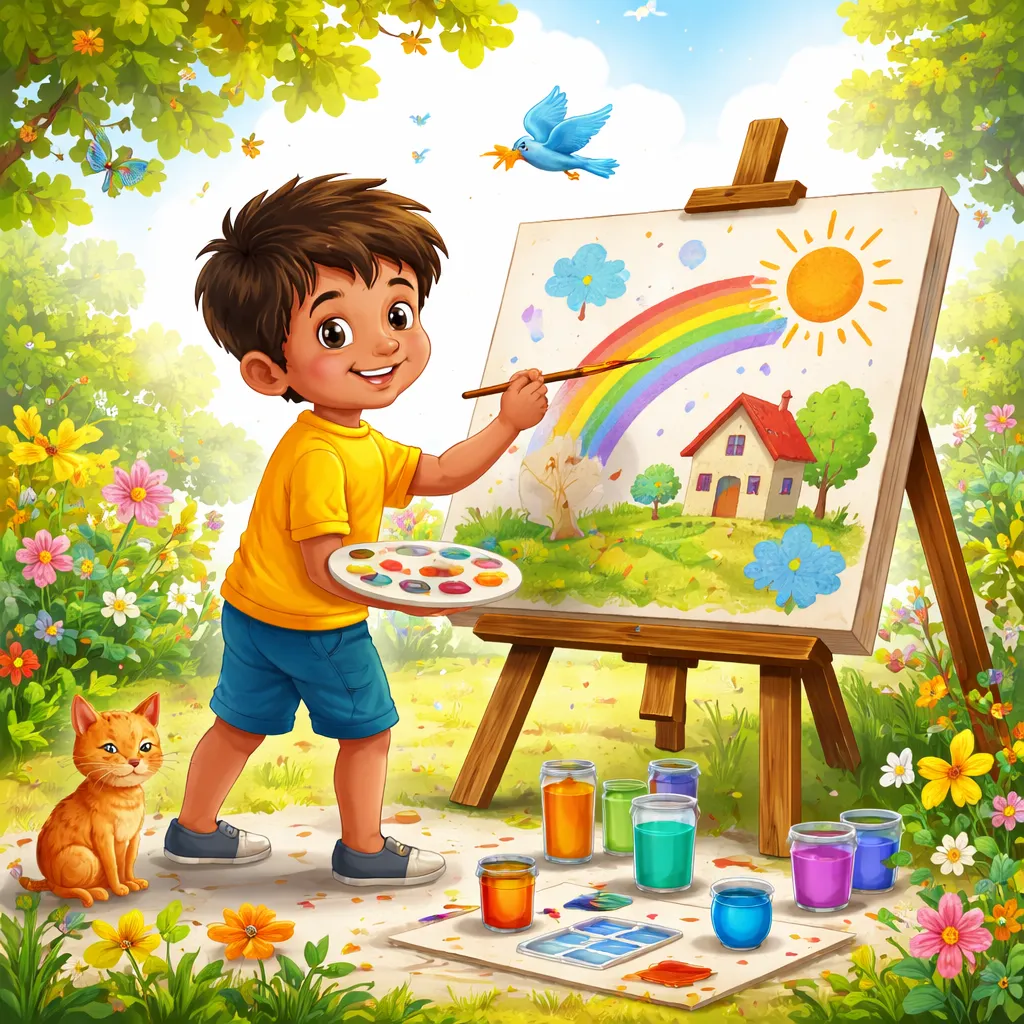
The song is a celebration of color and choice. First, the little painter shows us their wonderful tools: a whole set of colorful paints. They name the primary colors: “Red, blue, yellow, green,” the building blocks for every other color. With a clear goal, they say, “I will make a beautiful picture.” The song then shows the brush in action, moving freely: “With my brush I will move on the paper.” The painter doesn’t just draw one thing; they paint a whole happy scene of “clouds, flowers, a toy.” Finally, the painting needs a viewer. The artist’s favorite part is giving: “I will give this picture to mother, I will see her smile.” The whole creative process, from choosing the first color to presenting the finished piece, is an act of love and sharing.
Who Made It & Its Story
This song comes from the vibrant world of Indian children’s entertainment that encourages creativity. While specific creators aren’t widely listed, the song connects to India’s immense artistic heritage, from ancient cave paintings and temple art to modern styles. A day that bursts with color is Holi, the festival where people play with colored powders, celebrating joy and creativity. The Hindi Song: The Little Painter (चित्रकार) channels that colorful spirit into a personal, creative act. It is popular for three colorful reasons. First, it empowers every child to see themselves as an artist, with valid ideas and feelings to express. Second, it introduces color names and the creative process in a simple, exciting way. Third, its tune is often catchy and light, perfect for singing while actually painting or drawing, making the creative session even more fun.
When to Sing It
You can sing this song at the art table while working on a painting, naming each color as you use it. It’s perfect to hum during a walk outside, imagining how you would paint the sky, trees, and flowers you see. You could also sing it as a family before starting a big, collaborative art project on a large paper, getting everyone excited to create together.
The Hindi Song: The Little Painter (चित्रकार) gives us a palette of creative ideas. But every good artist knows there’s more to a painting than just color. This song is also a lesson in mixing knowledge. It teaches us the language of art, how to express our choices, and the cultural importance of sharing beauty. Let’s prepare our palette of learning and see what masterpiece we can understand.
What Children Can Learn
Vocabulary
This song helps us learn the specific language of art, color, and creation.
Palette: A thin board on which an artist mixes colors. Your paint box is like a palette.
Canvas: A strong cloth used as a surface for painting. Paper can be your canvas.
Stroke: A single movement of a brush, pen, or pencil. A short stroke can make a dot, a long stroke makes a line.
Blend: To mix colors or shades so they flow into each other without a sharp line. Blue and yellow blend to make green.
Express: To show a thought or feeling through words, art, or music. Painting is a way to express happiness.
Gallery: A room or building where people can go to look at works of art. Your refrigerator can be a home art gallery!
Language Skills
This song is a beautiful example of using “Will” for Spontaneous Decisions. We use “will” to express a decision you make at the moment of speaking, like choosing which color to use next.
What Is It?: Think of “will” as your instant choice word. When you’re painting and think, “I’ll use blue now,” that’s a spontaneous decision. The little painter is making choices as they go.
Finding the Secret: Look for the word “will” followed by a base verb (action word). It often shows a decision made right then. Ask: “Did the speaker just decide to do this?”
Using It:
◦   Formula: [Subject] + will + [base verb].

◦   For instant choices: “I will paint a sun here.” “I think I will use red.” “We will call this one ‘Happy Garden.’”

◦   In the song, the painter’s decisions are: “I will make a beautiful picture.” “I will give this picture to mother.” These are promises and choices made in the moment.
Sounds & Rhythm Fun
Listen to the colorful rhythm. The Hindi Song: The Little Painter (चित्रकार) often has a light, bouncy, and flowing rhythm. It might sound like the soft swish-swish of a brush or the happy tapping of a foot to music. The melody is often playful and moves up and down, like a brush making loops and lines. This light, free rhythm encourages creative movement and makes the color words and happy actions easy and fun to remember. You can use this same flowing, playful rhythm to make up a song about any creative activity, like dancing or building with clay.
Culture & Big Ideas
This song connects to India’s incredible history of visual storytelling. From the detailed miniature paintings of Rajasthan to the bold folk art of Madhubani, painting has always been a way to tell stories and celebrate life. The famous festival of Holi is the ultimate celebration of color, where the whole environment becomes a living painting. The Hindi Song: The Little Painter (चित्रकार) teaches three beautiful ideas. First, Art as Communication: A painting can tell a story or share a feeling without using any words at all. Second, Choice and Agency: The artist has the power to choose—what colors, what shapes, what story. This is a powerful feeling. Third, Creating for Connection: Sharing your art is a way to connect with others, to give them a piece of your imagination and see their happy response.
Values & Imagination
Imagine you are the little painter. Your blank paper is a whole world waiting to be filled. What will you put in the center? What color makes you feel happy? This song teaches you that your ideas are valuable and worth sharing. It encourages you to notice the colors all around you and appreciate beauty. A simple idea: The next time you see a beautiful sunset or a pretty flower, try to remember its colors. Later, see if you can mix paints to make those same colors on your own paper. You are being an artist, capturing a memory.
Your Core Takeaways
The Hindi Song: The Little Painter (चित्रकार) is a vibrant celebration of creativity, choice, and sharing. You learned art words like “palette,” “stroke,” and “blend.” You discovered how to use “will” to express your spontaneous decisions and intentions. You moved to the song’s light, flowing rhythm. You also connected the act of painting to India’s festival of colors, Holi, and its rich artistic traditions. Most importantly, the song teaches that your imagination is a powerful tool, that making art is a joyful way to express yourself, and that sharing your creation can brighten someone else’s day as much as it brightened yours to make it.
Your Practice Missions
- Be a “Spontaneous Choice” Artist. Take a piece of paper and some crayons. Close your eyes for a moment, then open them and immediately pick one color. Say, “I will start with [color]!” Make your first mark. Then, pick a second color spontaneously and say, “Now I will add [second color]!” Let your choices guide a quick, fun drawing.
- Create a “Gift of Color.” Paint or draw a picture specifically for someone in your home. While you make it, think about what they like. When it’s done, present it to them and say, “I made this for you.” Watch their smile, just like the little painter in the song wanted to see. This completes the creative cycle of imagining, making, and sharing.