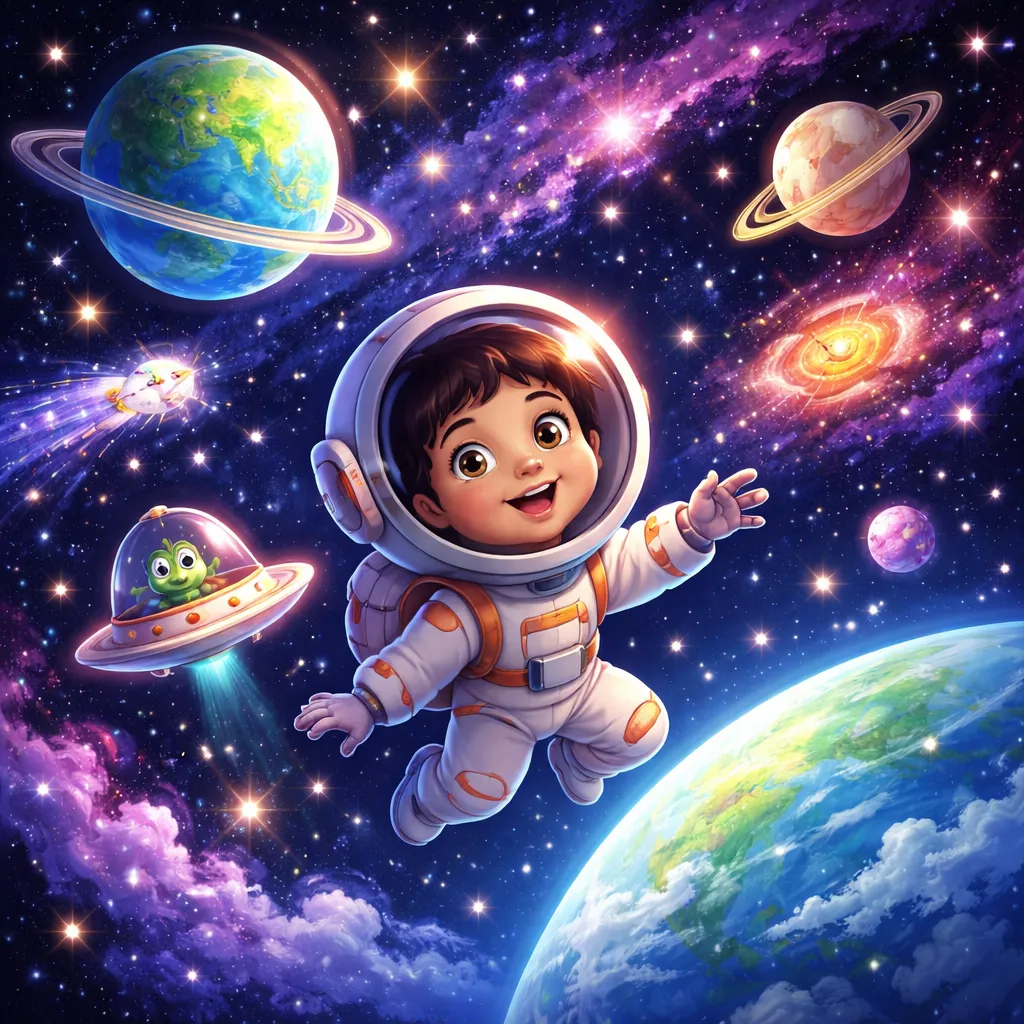

Have you ever lain on your back in the grass at night, looking up at the thousands of tiny, twinkling lights? Have you pointed to the brightest “star” and wondered if it’s actually a planet, or dreamed of what it would be like to fly up there? The universe is the biggest adventure waiting to happen. In India, a country that sends rockets and satellites to the stars, there is a song that lets you blast off on that adventure. Get ready for launch with the Hindi Song: The Little Astronaut (अंतरिक्ष यात्री).
About the Song Here is an exciting verse from this popular song in Hindi and English: मैं एक छोटा अंतरिक्ष यात्री, मेरा स्पेससूट नीला (Main ek chhota antariksh yatri, mera spacesuit neela) I am a little astronaut, my spacesuit is blue चाँद-तारों की सैर पर, जाने को है तैयार (Chaand-taron ki sair par, jaane ko hai taiyaar) Ready to go on a tour of the moon and stars गुरुत्वाकर्षण से ऊपर, मैं तैरूँगा आज़ादी से (Gurutvakarshan se upar, main tairunga aazadi se) Above gravity, I will float freely धरती माँ है नीचे, एक नीली गेंद (Dharti maa hai neeche, ek neeli gend) Mother Earth is below, a blue ball
This song’s original name uses the Hindi term “अंतरिक्ष यात्री” (Antariksh Yatri), which means “space traveler” or astronaut. It is a popular modern Indian children’s song. The song is sung from the perspective of a child who imagines themselves as an astronaut. The music often has a sense of wonder and excitement, with sounds that might make you think of beeping computers or the quiet, vast silence of space. The Hindi Song: The Little Astronaut (अंतरिक्ष यात्री) is a musical mission that celebrates science, curiosity, and the dream of exploring the final frontier.
What the Song is About The song is a countdown to a personal space mission. First, the little astronaut puts on a special blue spacesuit, getting ready for the journey. They declare they are “ready to go on a tour of the moon and stars.” This isn’t just looking up; it’s about visiting. Then comes the amazing part of space travel: “Above gravity, I will float freely.” The song pictures the astronaut gently tumbling inside the spaceship, a pen drifting in front of their face. Finally, they look out the window at the most breathtaking sight of all: “Mother Earth is below, a blue ball.” From so far away, our whole world looks like a beautiful, fragile, blue-and-white marble hanging in the blackness of space. The song is full of the wonder of science and the beauty of our home planet seen from a new perspective.
Who Made It & Its Story This song comes from contemporary Indian children’s media, which often aims to inspire the next generation of scientists and engineers. While the specific creators aren’t widely listed, the song reflects a huge source of national pride: India’s space program, ISRO. India has successfully sent missions to the moon and Mars, making space exploration a real and exciting part of the country’s modern identity. This Hindi Song: The Little Astronaut (अंतरिक्ष यात्री) channels that inspiration for children. It is popular for three stellar reasons. First, it taps into the universal childhood dream of becoming an astronaut and going to space. Second, it introduces basic, exciting science concepts like gravity and space travel in a simple, fun way. Third, its melody often feels adventurous and expansive, making it easy to imagine blasting off and soaring among the stars.
When to Sing It Sing this song while looking at a globe or a picture of the solar system, tracing the path you would take to the moon. It’s perfect to chant while jumping on a trampoline or bouncing on a bed, pretending you are bouncing in zero gravity. You could also sing it with your class during a science lesson about space, making a cardboard rocket for your mission control center.
The Hindi Song: The Little Astronaut (अंतरिक्ष यात्री) launches our imagination into orbit. But a successful mission requires training! This song is also a training manual. It teaches us the language of space, how to talk about future plans and possibilities, and the exciting science behind a modern national dream. Let’s begin our pre-flight check and see what we can learn.
What Children Can Learn
Vocabulary This song builds our vocabulary with words from astronomy and space travel. Orbit: The curved path of an object around a star, planet, or moon. The Earth orbits the Sun. The ISS orbits the Earth.
Gravity: The natural force that pulls objects with mass toward each other. It’s what keeps us on the ground. In space, astronauts experience microgravity.
Atmosphere: The layer of gases surrounding a planet. Earth’s atmosphere has the air we breathe. A spaceship must travel through the atmosphere to reach space.
Constellation: A group of stars that form a recognizable pattern in the night sky, like Orion or the Big Dipper.
Satellite: An object that orbits a larger object. The Moon is a natural satellite. A communication satellite is a human-made machine in orbit.
Voyage: A long journey, especially by spacecraft. The astronaut is on a great space voyage.
Language Skills This song is a great launchpad for learning to talk about the future using “Going to” for Plans. We use this to talk about intentions and plans that are already made or seem very likely. What Is It?: Think of “going to” as your mission plan. It describes something you intend or plan to do in the future. The astronaut isn’t just dreaming; they have a plan. “I am going to go on a tour.”
Finding the Secret: Look for the structure “am/is/are + going to + [base verb].” It points to a future action based on a present decision or evidence. Ask: “Is this sentence stating a plan or intention for the future?”
Using It:
◦   Formula: [Subject] + am/is/are + going to + [base verb].

◦   Examples: “I am going to build a model rocket.” “She is going to be a scientist.” “We are going to watch the stars tonight.”

◦   In the song, the plan is clear: “I am... ready to go on a tour.” The structure implies the intention: “I am going to tour the moon and stars.”
Sounds & Rhythm Fun Prepare for liftoff! The Hindi Song: The Little Astronaut (अंतरिक्ष यात्री) often has a building, exciting rhythm. It might start slower, like a countdown (“10, 9, 8...”), and then lift off into a faster, soaring melody. The music can sound electronic and futuristic, with sounds that sparkle like stars. This dynamic rhythm—from the tense countdown to the joyful soaring—helps tell the story of the mission and makes the feeling of adventure and wonder stick in your memory. You can use this building, exciting rhythm to make up a song about any big plan, like a science fair project or a sports event.
Culture & Big Ideas This song is directly inspired by the achievements of the Indian Space Research Organisation (ISRO). A landmark mission is Chandrayaan, India’s lunar exploration program. The success of such missions fills the country with immense pride and shows children that big dreams, backed by science and hard work, can come true. The Hindi Song: The Little Astronaut (अंतरिक्ष यात्री) teaches three big ideas. First, Dreams Powered by Science: Imagination is the first step, but it takes learning, math, and engineering to actually build a rocket and make the dream real. Second, A New Perspective on Home: Seeing Earth as a small, beautiful “blue ball” from space teaches us that we all share one home and must take care of it. Third, Exploration for All: The song inspires every child, regardless of background, to believe they can be part of the great adventure of discovering our universe.
Values & Imagination Imagine you are the little astronaut floating in the quiet spacecraft. What does the silence of space sound like? How does the Earth, glowing blue against the endless black, make you feel? This song teaches you to be curious, to ask “how” and “why,” and to appreciate the amazing science that explains our world. It also teaches global citizenship—from space, there are no borders, only one planet. A simple idea: On a clear night, go outside with a grown-up and find one constellation. Learn its name. Then, draw a picture of your spaceship flying toward it. What do you think you’ll find there?
Your Core Takeaways The Hindi Song: The Little Astronaut (अंतरिक्ष यात्री) is an inspiring anthem for curiosity, science, and big dreams. You learned space words like “orbit,” “gravity,” and “satellite.” You discovered how to use “going to” to talk about your future plans and intentions. You felt the song’s building, soaring rhythm that mimics a rocket launch. You also connected the song to India’s real-world space exploration achievements through ISRO. Most importantly, the song teaches that with curiosity and study, you can turn “I wish” into “I will,” that science is an adventure, and that seeing our world from a new perspective can fill us with wonder and a sense of shared responsibility.
Your Practice Missions
- Your “Mission Control” Plan. Think of one thing you really want to learn or do this month (like identify three constellations, build a Lego spaceship, or read a book about planets). Tell a family member your plan using “going to.” Say, “This month, I am going to [your goal].” You have just stated your mission objective!
- Draw the “Blue Ball” from Space. Take a white paper plate or a circle of paper. Using blue and green paints or crayons, draw Earth as the little astronaut sees it—a beautiful blue ball with swirls of white clouds. On the back, write one thing you love about our planet and one thing you can do to take care of it. Hang your “Earth” in your room.