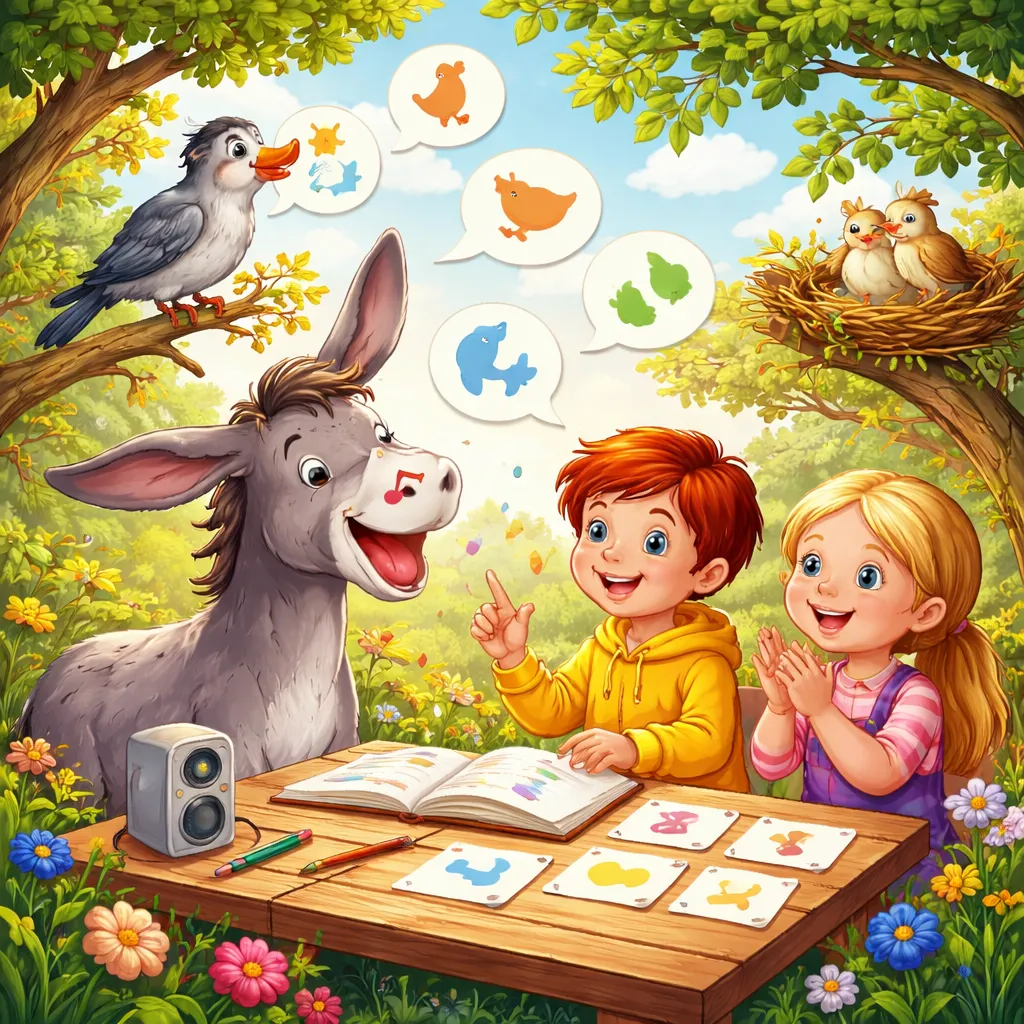

A cuckoo calls from the trees. A donkey brays from the field. Each has its own unique sound. When they sing together, something delightful happens. A children’s song can celebrate that joy of making sounds. Today, we explore a traditional German nursery rhyme called “Der Kuckuck und der Esel,” which translates to “The Cuckoo and the Donkey.” This playful song features two animals having a singing contest. We will use this melody as a joyful, sound-filled path into English. Together, we will learn new words, explore important sounds, and discover how a simple song can make language learning feel like a friendly competition of voices. The cuckoo and the donkey each sing their best. Your child can practice English sounds with that same playful confidence.
What is the rhyme? “Der Kuckuck und der Esel” is a beloved German folk song that has been sung by children for generations. It tells the story of a cuckoo and a donkey who argue about who has the better voice. They decide to have a singing contest. The cuckoo sings “kuckuck.” The donkey brays “ia, ia, ia.” The song ends by saying such a duet could be enjoyed by all. The song has a lively, playful rhythm. Children often use hand movements. They make a cuckoo call with their hands. They make donkey ears with their fingers. They take turns singing the different parts. The song creates a joyful, playful atmosphere. It celebrates the unique sounds each voice makes. When we bring this song to English learning, we keep its playful, sound-filled spirit. We use the familiar melody to introduce English words in a way that feels like a game of who can make the best sound.
The lyrics of nursery rhymes To appreciate this song, we first look at the original German words. Then we see how they translate into English. This shows children that the same playful contest can be expressed in different languages. You do not need to know German to enjoy the lively, back-and-forth rhythm of the words.
Original Version (German)
Der Kuckuck und der Esel Die hatten großen Streit Wer wohl am besten sänge Wer wohl am besten sänge Zur schönen Maienzeit
Der Kuckuck sprach: Das kann ich! Und fing gleich an zu schrein: Kuckuck, kuckuck, kuckuck, kuckuck! Kuckuck, kuckuck, kuckuck, kuckuck! Das klang so schön, so fein
Der Esel sprach: Das kann ich! Und fing gleich an zu schrein: I-a, i-a, i-a, i-a! I-a, i-a, i-a, i-a! Das klang so schön, so fein
Da ward ihr Streit entschieden Bei diesem schönen Duett Es sang so schön der Kuckuck Es sang so schön der Kuckuck Und der Esel, der Esel schrie drein
English Version
The cuckoo and the donkey They had a great dispute Who sings the very best now Who sings the very best now In springtime’s lovely hour
The cuckoo spoke: I can do it! And straight began to cry: Cuckoo, cuckoo, cuckoo, cuckoo! Cuckoo, cuckoo, cuckoo, cuckoo! That sounded so beautiful, so fine
The donkey spoke: I can do it! And straight began to cry: Hee-haw, hee-haw, hee-haw, hee-haw! Hee-haw, hee-haw, hee-haw, hee-haw! That sounded so beautiful, so fine
Then was their dispute decided With this beautiful duet So sweetly sang the cuckoo So sweetly sang the cuckoo And the donkey, the donkey brayed along
As you read these words, notice the playful repetition. The rhythm moves like two animals taking turns. The story is simple and joyful. A cuckoo and a donkey argue about who sings better. They both sing. They both sound beautiful. Their duet is wonderful. This narrative invites children to make sounds with confidence.
Vocabulary learning This song offers a wonderful set of words that connect to animals, sounds, and playful competition. We can explore these words through conversation, sound-making, and playful imitation.
Start with the main characters: the cuckoo and the donkey. In German, they are Kuckuck and Esel. In English, we say “cuckoo” and “donkey.” The cuckoo is a bird known for its call. The donkey is an animal known for its bray.
Here are the key words to focus on from the song:
Cuckoo: A bird that makes a “cuckoo” sound. Make the sound together.
Donkey: An animal that says “hee-haw.” Make the sound together.
Great dispute: A big argument. The cuckoo and donkey disagreed about who sings better.
Sings: Makes music with the voice. The animals are singing.
Springtime: The season after winter. This is when the contest happens.
Cry: To make a loud sound. The animals cry out their songs.
Beautiful: Very nice to hear. Both songs are beautiful.
Fine: Very good. The songs sound fine.
Duet: A song sung by two people or animals. The cuckoo and donkey sing a duet.
Brayed: The sound a donkey makes. The donkey brayed along.
Use these words in natural moments. When you hear a bird, ask “is that a cuckoo?” When you see a donkey, make the hee-haw sound. When two people sing together, say “what a beautiful duet!” These connections make the vocabulary meaningful.
Phonics points Phonics helps children understand the sounds that build English words. This song gives us several clear sounds to explore in a playful, sound-focused way.
First, focus on the ‘k’ sound at the beginning of “cuckoo.” This is a sharp, unvoiced sound made with the back of the tongue. Say “k k k.” Practice with “cat,” “kite,” and “cuckoo.” This sound appears in the bird’s call.
Next, notice the long ‘u’ sound in “cuckoo.” The “oo” makes the long ‘u’ sound, like “moon.” Say “oo oo.” Practice with “zoo,” “too,” and “cuckoo.” This is a rounded vowel sound.
The word “donkey” contains the ‘d’ sound and the ‘k’ sound. Say “d d d” with the tip of the tongue. Then “key.” Practice with “dog,” “day,” and “donkey.” The ‘d’ is voiced and crisp.
Finally, look at the ‘b’ sound in “beautiful” and “brayed.” This is a voiced sound made with the lips together. Say “b b b.” Practice with “boy,” “big,” and “beautiful.” The song also has “hee-haw,” which contains the long ‘e’ sound in “hee” and the short ‘a’ in “haw.” Say “ee” like in “see.” Say “aw” like in “saw.”
Grammar patterns Even a simple song contains grammar that we can introduce gently. We do not need to use technical terms. Instead, we show how words work together through examples and play.
The song uses the past tense to tell the story. “Had,” “spoke,” “began,” “sang,” and “was” describe things that already happened. You can practice by telling a simple story. “The bird sang. The donkey brayed.” This builds understanding of past tense.
Notice the phrase “I can do it!” This shows ability. “Can” means someone is able to do something. You can practice with other “can” phrases. “I can sing.” “You can hop.” This builds language about ability.
The repetition of the animal sounds is onomatopoeia. “Cuckoo” and “hee-haw” are words that sound like the sounds they describe. You can practice other animal sounds. “Moo.” “Baa.” “Meow.” This builds sound vocabulary.
Also, look at the word “so” for emphasis. “So beautiful, so fine.” You can practice using “so” to emphasize. “So happy.” “So tall.” “So funny.” This adds expressive language.
Learning activities Activities bring the song into the body and the imagination. They transform listening into active participation. These ideas are simple and require little preparation.
Animal Singing Contest Play the song and pretend to be the cuckoo and the donkey. Take turns. One person sings “cuckoo, cuckoo.” The other sings “hee-haw, hee-haw.” Then sing together as a duet. This activity builds listening skills and confidence in making sounds.
Sound Imitation Practice making different animal sounds. Cuckoo. Donkey. Cow. Dog. Cat. Take turns guessing the animal. This builds sound recognition and vocabulary.
Springtime Walk Go for a walk in spring (or look at pictures). Look for signs of spring. Flowers. Birds. Warm sun. Talk about why the animals were singing in springtime. This connects the song to the natural world.
Printable materials Printable resources offer a quiet way to reinforce the song’s vocabulary. They are perfect for moments when children want to create or focus calmly.
Flashcards Create a set of flashcards. One card shows the cuckoo. One shows the donkey. One shows a musical note for “sings.” One shows a spring flower for “springtime.” One shows a duet of two singers. One shows the words “cuckoo” and “hee-haw.” Use these cards for a matching game. Sing a line from the song and ask your child to find the matching card. This builds word recognition.
Coloring Page Draw a simple scene from the song. Show a cuckoo on a branch and a donkey in a field. Add musical notes floating between them. Children can color the cuckoo and the donkey. As they color, talk about the scene. “What are they doing?” “What sounds do they make?” This keeps the language flowing naturally.
Animal Sound Booklet Create a small booklet with different animals. On each page, write the animal name and draw its sound. Cuckoo: “cuckoo.” Donkey: “hee-haw.” Cow: “moo.” Your child can color each page. This builds literacy and sound vocabulary.
Educational games Games encourage repetition without boredom. They invite children to use the language in new and creative ways.
Cuckoo Says Play a game similar to “Simon Says.” Give commands using the song’s vocabulary. “The cuckoo says sing like a bird.” “The donkey says bray.” “Both animals say sing a duet.” If you give a command without naming an animal, the child does not move. This game builds listening skills.
Who Can Sing? Take turns singing different animal sounds. See who can make the best cuckoo call. Who can make the best donkey bray. Celebrate each sound. This builds confidence in making sounds.
Sound Match Record or imitate different animal sounds. Play them for your child. Ask them to match the sound to the animal picture. This builds listening discrimination skills.
As you share “Der Kuckuck und der Esel” with your child, remember that you are celebrating the joy of making sounds. The cuckoo sings “cuckoo.” The donkey brays “hee-haw.” Neither sound is wrong. They are just different. And when they sing together, they create something beautiful. Learning a new language is also about making sounds. Some sounds may feel new or silly at first. But every sound you make is a step toward the beautiful duet of conversation. Let the playful animals be your guide. Make sounds together. Laugh at the funny ones. Celebrate the clear ones. Let the joyful spirit of the cuckoo and the donkey remind you both that every voice has its own beautiful sound, and when you practice together, you create something wonderful.