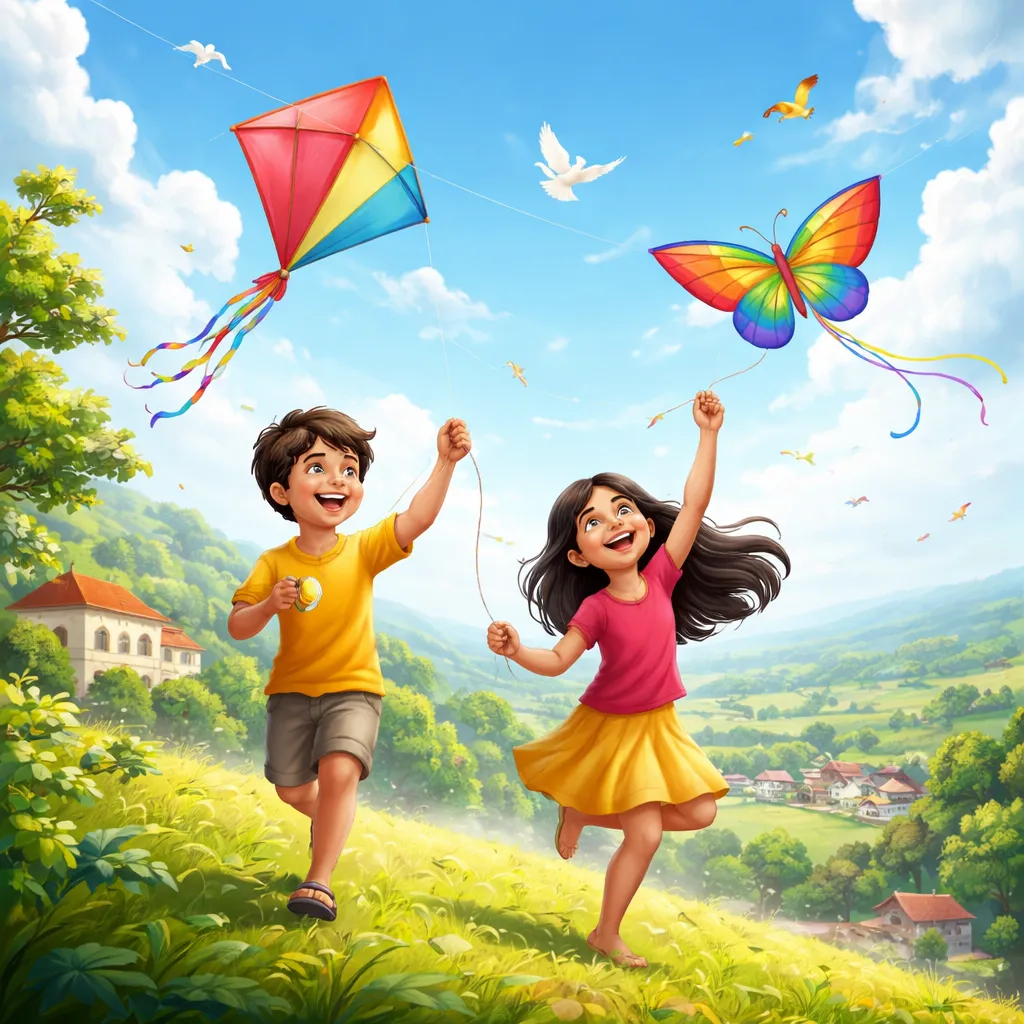

A kite rises into the sky. The wind lifts it higher. A string holds it steady. A children’s song can capture that soaring feeling and bring it into language learning. Today, we explore a traditional Hindi children’s song called “पतंग” (Patang), which translates to “The Little Kite.” This joyful song celebrates the simple pleasure of flying a kite in the open sky. We will use this melody as a soaring, uplifting path into English. Together, we will learn new words, explore important sounds, and discover how a simple song can make language learning feel like watching a kite dance in the wind. The kite rises higher and higher. Your child can learn English with that same uplifting, soaring spirit.
What is the rhyme?
“The Little Kite” (पतंग) is a cherished Hindi children’s song that has been sung for generations. It tells the story of flying a kite, watching it rise high into the sky, and feeling the joy of letting it soar. The song has a light, floating rhythm. Children often use hand movements. They hold an imaginary string. They let their kite rise higher. They look up at the sky. The song creates a joyful, free atmosphere. It celebrates the simple pleasure of flying a kite on a windy day. When we bring this song to English learning, we keep its soaring, uplifting spirit. We use the familiar melody to introduce English words in a way that feels like watching something beautiful rise into the sky.
The lyrics of nursery rhymes
To appreciate this song, we first look at the original Hindi words. Then we see how they translate into English. This shows children that the same joyful kite song can be told in different languages. You do not need to know Hindi to enjoy the light, floating rhythm of the words.
Original Version (Hindi)
पतंग, पतंग
ऊपर उड़ो
हवा आई, डोर थामी
बादलों में खो गई
English Version
Kite, kite
Fly up high
The wind came, I held the string
It got lost in the clouds
A longer version adds more detail:
रंग-बिरंगी पतंग
आसमान में उड़ती
डोर थामे बच्चा
खुशियाँ मनाती
English Version
Colorful kite
Flies in the sky
Child holding the string
Celebrating with joy
As you read these words, notice the light, floating repetition. The rhythm moves like a kite dancing in the wind. The story is simple and joyful. Kite, kite, fly up high. The wind came, I held the string. It got lost in the clouds. Colorful kite flies in the sky. Child holding the string, celebrating with joy. This narrative invites children to imagine the freedom of a kite in the sky.
Vocabulary learning
This song offers a wonderful set of words that connect to nature, movement, and freedom. We can explore these words through conversation, pictures, and kite-flying play.
Start with the main object: the kite. In Hindi, it is पतंग (patang). In English, we say “kite.” Kites are toys that fly in the wind.
Here are the key words to focus on from the song:
Kite: A toy that flies in the wind on a string. Show pictures of kites.
Fly: To move through the air. The kite flies.
High: Far up. Fly up high.
Wind: Moving air. The wind came.
String: A thin rope. I held the string.
Held: Kept in hand. I held the string.
Lost: Could not be seen. It got lost in the clouds.
Clouds: White shapes in the sky. Lost in the clouds.
Colorful: Having many colors. A colorful kite.
Sky: The space above us. Flies in the sky.
Child: A young person. Child holding the string.
Celebrating: Showing joy. Celebrating with joy.
Use these words in natural moments. When you see a kite, say “look, a kite! It flies high.” When the wind blows, say “the wind came.” These connections make the vocabulary meaningful.
Phonics points
Phonics helps children understand the sounds that build English words. This song gives us several clear sounds to explore in a light, soaring way.
First, focus on the ‘k’ sound at the beginning of “kite.” This is a sharp, unvoiced sound made with the back of the tongue. Say “k k k.” Practice with “cat,” “kite,” and “kite.” This sound is crisp and clear.
Next, notice the long ‘i’ sound in “kite” and “fly.” Say “eye” like in “my.” Practice with “time,” “sky,” and “fly.” This sound is bright and reaching.
The word “wind” contains the ‘w’ sound and the short ‘i’ sound. Say “w w w.” Then add “ind.” Practice with “wind,” “winter,” and “wind.” The short ‘i’ is like “igloo.”
Finally, look at the ‘str’ blend in “string.” Say “s,” then quickly add “t,” then “r.” Then add “ing.” Practice with “strong,” “street,” and “string.” The song also has “clouds,” which contains the ‘cl’ blend. Say “c,” then quickly add “l.” Then add “ouds.”
Grammar patterns
Even a simple song contains grammar that we can introduce gently. We do not need to use technical terms. Instead, we show how words work together through examples and play.
The song uses the imperative mood. “Fly up high” is a command. You can practice giving gentle commands. “Fly high.” “Hold the string.” This builds understanding of instructions.
Notice the past tense “came” and “held” tell what happened. “The wind came.” “I held the string.” You can practice telling simple stories in the past tense. “The kite flew.” “It got lost.” This builds understanding of past tense.
The phrase “lost in the clouds” shows location. You can practice with other “in” phrases. “In the sky.” “In the wind.” “In the air.” This teaches spatial language.
Also, look at the descriptive word “colorful.” You can practice describing things. “A colorful kite.” “A bright sky.” “A happy child.” This builds descriptive language.
Learning activities
Activities bring the song into the body and the imagination. They transform listening into active participation. These ideas are simple and require little preparation.
Kite Flying
Play the song and pretend to fly a kite. Hold an imaginary string. Let the kite rise. Pull the string. Let it soar. Look up at the sky. Say “fly up high!” This activity builds listening skills and imaginative play.
Kite Craft
Create a simple kite using paper, string, and sticks (or a paper plate). Decorate it with colorful patterns. Take it outside to fly or pretend to fly it indoors. This combines fine motor skills with language practice.
Wind Game
Pretend to be the wind. Blow gently. The kite rises. Blow harder. The kite soars. This builds imagination and vocabulary.
Printable materials
Printable resources offer a quiet way to reinforce the song’s vocabulary. They are perfect for moments when children want to create or focus calmly.
Flashcards
Create a set of flashcards. One card shows a kite for “kite.” One shows a kite flying for “fly.” One shows wind for “wind.” One shows a string for “string.” One shows clouds. One shows a colorful kite. Use these cards for a matching game. Sing a line from the song and ask your child to find the matching card. This builds word recognition.
Coloring Page
Draw a simple sky scene. Show a colorful kite flying high. Draw clouds in the sky. Draw a child holding the string. Children can color the kite bright colors, the sky blue, and the clouds white. As they color, talk about the scene. “Where is the kite?” “What helps it fly?” This keeps the language flowing naturally.
Kite String Maze
Create a simple maze that looks like a kite string winding through the sky. Your child can trace the string with their finger, pretending to pull the kite. This builds fine motor skills and imagination.
Educational games
Games encourage repetition without boredom. They invite children to use the language in new and creative ways.
Kite Says
Play a game similar to “Simon Says.” Give commands using the song’s vocabulary. “The kite says fly high.” “The kite says hold the string.” “The kite says go into the clouds.” “The kite says be colorful.” If you give a command without saying “the kite says,” the child does not move. This game builds listening skills.
High and Low
Practice high and low. “The kite flies high!” Stretch up tall. “The kite flies low!” Crouch down. This builds opposite vocabulary.
Wind Game
Pretend to be the wind. Blow gently. The kite rises. Blow harder. The kite soars. This builds imagination and vocabulary.
As you share “पतंग” with your child, remember that you are celebrating the joy of letting go and rising higher. The kite flies up high. The wind came. I held the string. It got lost in the clouds. Colorful kite flies in the sky. Child holding the string, celebrating with joy. Learning a new language is like flying a kite. Sometimes you hold the string tight, holding onto a new word. Sometimes you let go and let it float into conversation. And always, there is joy in watching it rise. Let the soaring kite be your guide. Reach high. Let go. Let your heart be happy. Let the uplifting spirit of the song remind you both that every new word you learn is like a kite in the sky—light, free, and ready to fly.