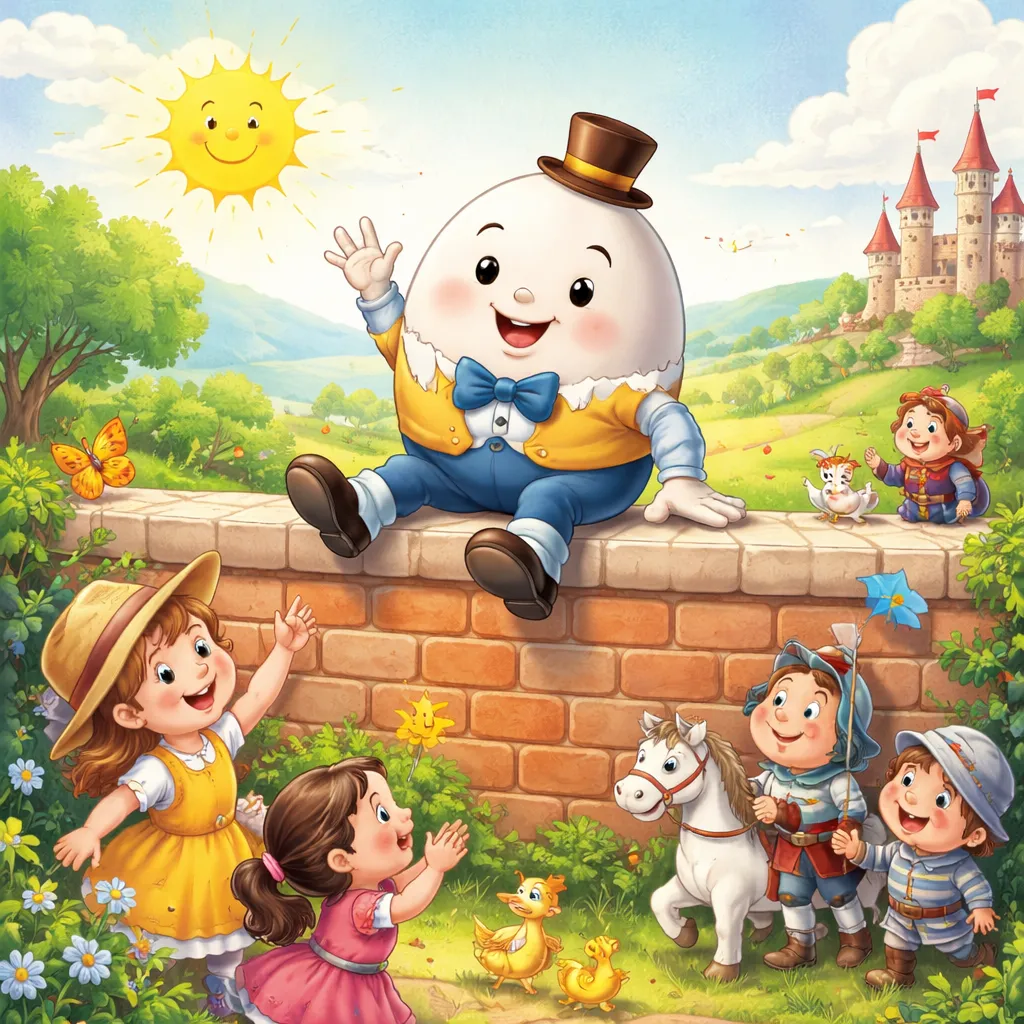

What is the Rhyme "Humpty Dumpty"? "Humpty Dumpty" is one of the oldest and most famous English nursery rhymes in the world. It tells the short but memorable story of a character named Humpty Dumpty who sits on a wall. He has a great fall. All the king's horses and all the king's men come to help. But they cannot put Humpty together again. For generations, children have wondered about this mysterious egg-shaped character. The English song: Humpty Dumpty introduces young learners to a simple story with a clear sequence. It teaches vocabulary about position, action, and consequence. The rhyme also opens up beautiful conversations about trying to help, even when things cannot be fixed. The mystery of Humpty keeps children thinking and asking questions long after the song ends.
The Complete Lyrics of the Nursery Rhyme Let us look at the words together. The rhyme is very short, which makes it perfect for young children to memorize.
Humpty Dumpty sat on a wall, Humpty Dumpty had a great fall. All the king's horses and all the king's men Couldn't put Humpty together again.
Some versions add a little more detail or repeat the lines, but this simple verse tells the complete story.
Vocabulary Learning from the Song This English song: Humpty Dumpty introduces children to important words about position, action, and royal life. Each word builds their understanding of language and story.
First, we meet the character "Humpty Dumpty." The song never says what Humpty is, but pictures usually show an egg with a face. This mystery is part of the fun. You can ask your child what they think Humpty looks like.
The song teaches position words. Humpty "sat on a wall." A wall is a structure made of bricks or stone. You can point to walls in your home or outside. "On" tells us where Humpty was. You can practice using "on" with other objects. "The toy is on the table." "The book is on the shelf."
The word "fall" is an important action word. A "great fall" means falling from high up. You can talk about being careful not to fall. This builds safety awareness along with vocabulary.
The song introduces royal words. "King's horses" and "king's men" tell us this story happens in a kingdom with a king. Horses were very important long ago for transportation and work. The king's men were soldiers or workers who served the king. This opens conversations about history and different times.
The word "couldn't" is a contraction for "could not." It teaches that sometimes things are impossible, even when many people try to help.
Phonics Points to Practice Let us listen for special sounds in the song. Phonics helps children connect letters to the sounds they hear. This English song: Humpty Dumpty gives us many sounds to explore.
Listen to the "h" sound at the beginning of "Humpty" and "had" and "horses." It is a gentle breath sound. Put your hand in front of your mouth and say "Humpty." Feel the air? Practice other "h" words like "happy," "house," and "hello."
The "d" sound appears in "Dumpty" and "had." It is a soft sound made with the tongue behind the teeth. Practice other "d" words like "dog," "daddy," and "door."
Listen to the "sh" sound in "horses" and "men" has a different sound but "horses" gives us the "s" at the end. The "all" sound in "wall" and "fall" is very important. It is the same sound you hear in "ball" and "tall." Recognizing these rhyming patterns helps children predict words and understand how language works.
The "c" sound in "couldn't" is a special sound. It is made at the back of the throat. Practice other "c" words like "cat," "cake," and "cup."
Grammar Patterns We Can Learn This simple rhyme teaches important grammar in a very natural way. The English song: Humpty Dumpty introduces past tense verbs, prepositions, and the concept of impossibility.
The song uses past tense throughout. Humpty "sat" on a wall. He "had" a great fall. The horses and men "couldn't put" him together. These are all past tense verbs. You can talk about your own day using past tense. "We sat on the grass." "You had a snack." "We couldn't find your toy." This helps children understand how we talk about things that already happened.
The song teaches prepositions of place. "On a wall" shows where Humpty was. You can practice using prepositions in daily life. "The cup is on the table." "The cat is under the chair." "The toy is in the box."
The ending teaches a powerful concept. "Couldn't put Humpty together again" shows that some problems have no solution. This opens conversations about accepting things we cannot change while still trying our best to help.
Learning Activities to Do at Home Bringing this English song: Humpty Dumpty into your daily life is simple and joyful. Here are some activities you can try with materials you already have.
A wonderful activity is the "Egg Humpty" craft. Take a real egg and carefully poke small holes in both ends. Blow out the inside so you have an empty eggshell. Let your child decorate it with markers to look like Humpty Dumpty. Then act out the rhyme together. Sit Humpty on a small wall made of blocks. Gently make him fall. Talk about how we cannot put the shell back together. This makes the abstract concept very real and visual.
Another activity is the "Wall Building" challenge. Use blocks, books, or boxes to build a wall. Practice sitting a toy on top. How high can you build before the toy falls? This teaches balance and physics in a playful way.
You can also have a "Helping Hands" conversation. After the rhyme, ask your child, "If you were there, how would you help Humpty?" Maybe a soft pillow to catch him. Maybe a net. Maybe glue. This builds problem-solving skills and empathy.
Printable Materials for Learning Creating simple printables can make this English song: Humpty Dumpty more visual and engaging. You can make these materials together with your child.
Story sequencing cards are perfect for this rhyme. Draw simple pictures on separate cards. Humpty sitting on a wall. Humpty falling. The king's horses and men coming. Everyone looking sadly at broken Humpty. Your child can arrange the cards in order and retell the story. This builds sequencing and narrative skills.
A Humpty Dumpty coloring page is always popular. Draw a simple egg-shaped Humpty sitting on a wall. Let your child color him. Add a crown if you like. Write "Humpty Dumpty" at the top. Display their artwork proudly.
You can also create simple word cards. Write words from the rhyme on cards. "Humpty," "wall," "fall," "king," "horses," "men," "together." Show each card as you sing that word. This builds early reading skills in a gentle, supportive way.
A jigsaw puzzle is a wonderful printable for this rhyme. Draw Humpty Dumpty on cardstock and color it. Cut the picture into several large pieces. Let your child try to put Humpty together again. When they succeed, talk about how the king's men could not do this. This connects the puzzle activity to the rhyme in a meaningful way.
Educational Games for Deeper Learning Games make learning active and exciting. They encourage children to use the language from the English song: Humpty Dumpty in new and creative ways.
The "What Happened?" game builds comprehension and prediction. Show your child a picture of Humpty on the wall. Ask, "What will happen next?" After they answer, show a picture of Humpty falling. Ask, "What happened?" Then show the king's horses and men. Ask, "What will they do?" This builds narrative understanding and sequencing skills.
The "New Endings" game encourages creativity. Ask your child, "What if Humpty Dumpty had a soft pillow below the wall?" Then create a new ending together. "Humpty Dumpty sat on a wall, Humpty Dumpty had a great fall. But a soft pillow caught him, and all the king's men said, 'Hooray! Humpty is safe today!'" This shows children that stories can change and they can be the authors.
The "Rhyming Words" game builds phonemic awareness. Say, "Wall and fall rhyme! Can you think of another word that rhymes with wall?" Ball, tall, call, hall. Write them down or say them together. This builds important pre-reading skills.
The "King's Helpers" game extends the story. Ask your child, "If you were one of the king's men, what would you bring to help Humpty?" A ladder? A soft net? A first aid kit? Glue? Tape? This builds problem-solving skills and imagination. It also opens conversations about helping others, even when the problem is very hard to solve.
The "Safety First" game connects the rhyme to real life. Talk about why Humpty should not sit on a high wall. What could he have done to be safe? Sat on a low wall. Had someone spot him. Used a safety net. This builds safety awareness while honoring the playful spirit of the beloved rhyme.