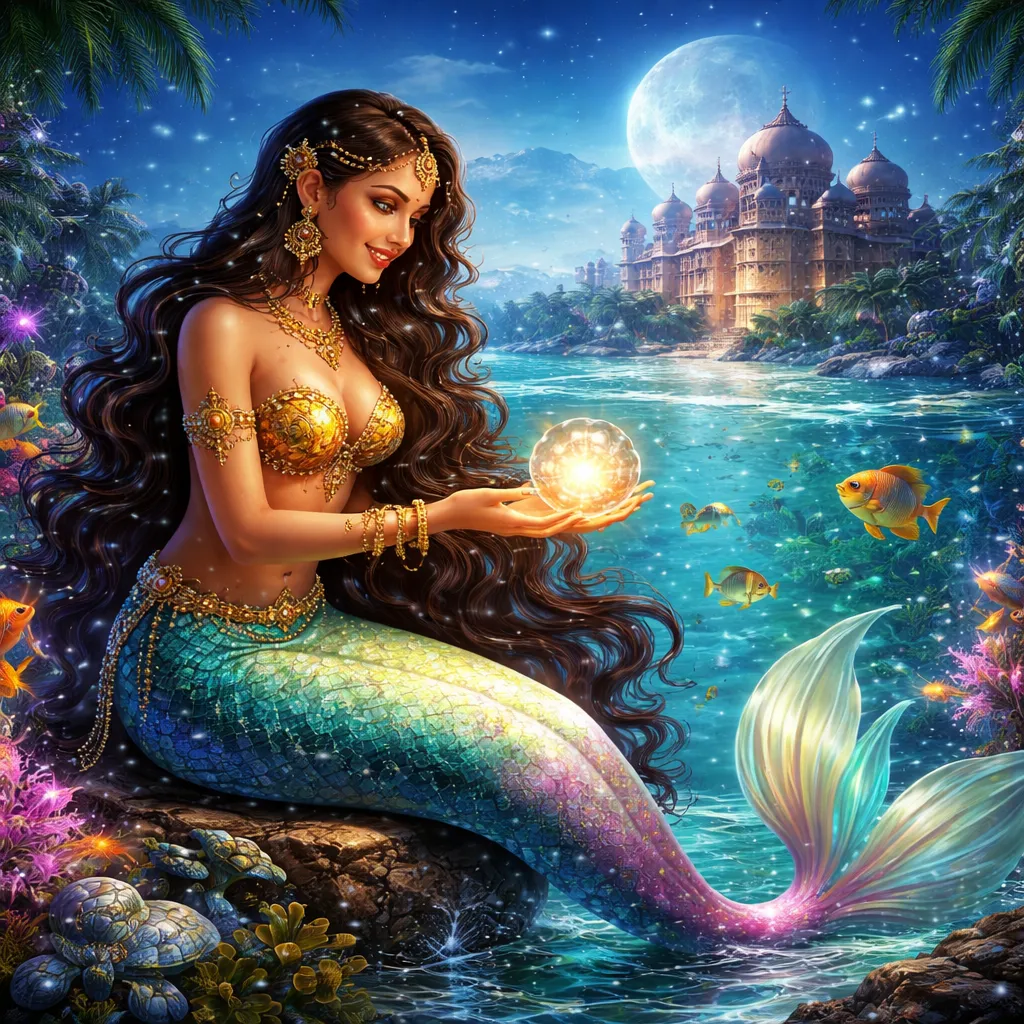

Have you ever put your ear to a seashell and heard a whispering sound? Or looked out at the endless blue sea and wondered what amazing creatures live deep below the waves? Stories of mermaids—beings who are part human, part fish—are told all over the world. In India, a land of ancient rivers and ocean stories, there is a magical song about one. Let’s dive into the Hindi Song: The Little Mermaid (मत्स्य कन्या).
About the Song Here is a verse from this enchanting song in Hindi and English: मैं मत्स्य कन्या, समुद्र की गहराई में (Main matsya kanya, samudra ki gehrai mein) I am the mermaid, in the depth of the sea मेरी पूँछ चमकती है, जैसे चाँदनी रात (Meri pooch chamakti hai, jaise chaandni raat) My tail shimmers, like a moonlit night मैं देखती हूँ दुनिया को, ऊपर की ओर (Main dekhti hoon duniya ko, upar ki or) I look at the world, towards the above क्या रहस्य हैं जमीन पर? मेरा है सवाल (Kya rahasy hain zameen par? Mera hai sawaal) What secrets are on the land? That is my question
This song’s original name is “मत्स्य कन्या” (Matsya Kanya), a Hindi term meaning “fish-maiden” or mermaid. It is a popular modern Indian children’s song. The song is sung from the mermaid’s own perspective. She describes her beautiful underwater home and her burning curiosity about the world above the surface. The music often has a flowing, watery quality, with melodies that rise and fall like waves. The Hindi Song: The Little Mermaid (मत्स्य कन्या) is an invitation to explore, to ask questions, and to dream about the connection between two different worlds.
What the Song is About The song paints a vivid picture of life under the sea. First, the mermaid introduces herself from her home in the deep, dark blue ocean. Her most beautiful feature is her tail, which shimmers and glows with a soft light, just like the silvery path the moon makes on the water at night. She is a creature of the deep, but her eyes are always looking up. She watches the light filter down from the world above and sees the dark shapes of ships passing overhead. This fills her heart with a big, important question: “What secrets are on the land?” She wonders about forests, mountains, and the creatures who walk on two legs. Her song is a poem of wonder, celebrating the beauty of her own home while dreaming of the mysteries of another.
Who Made It & Its Story This song is part of the rich tapestry of modern Indian children’s music that draws from global stories. While the specific creators are not widely known, the theme connects to universal myths and India’s own profound connection to water, from the sacred Ganges river to the long coastlines. The figure of a water nymph or divine being associated with rivers is present in Indian folklore. This Hindi Song: The Little Mermaid (मत्स्य कन्या) adapts that universal sense of wonder. It is beloved for three reasons. First, it captures the timeless childhood fascination with mythical creatures and the secret world of the ocean. Second, it beautifully expresses the feeling of curiosity—the desire to know about a world different from your own. Third, its melody is often serene and mysterious, making it easy to imagine floating in a calm, deep blue sea.
When to Sing It You can sing this song during a quiet bath, imagining you are in a deep ocean lagoon. It’s perfect to hum while visiting an aquarium, watching the fish glide and wondering what stories they might tell. You could also sing it on a beach, looking at the point where the sea meets the sky and thinking about the mermaid looking back at you from below the waves.
The Hindi Song: The Little Mermaid (मत्स्य कन्या) is a beautiful window into a world of water and wonder. But like the ocean itself, it has great depth. This song can teach us about the language of description, how to express our deepest questions, and how stories from different cultures flow into one another. Let’s dive deeper into the learning treasures this song holds.
What Children Can Learn
Vocabulary This song helps us build words for describing mysterious and beautiful places. Abyss: A very deep, seemingly bottomless space. The deepest part of the ocean is an abyss.
Luminescent: Producing or emitting light, often a soft, cool light. Some jellyfish are luminescent. The mermaid’s tail is luminescent.
Realm: A kingdom or a world. The ocean is the mermaid’s realm. The forest is the realm of animals.
Mystical: Relating to a spiritual or mysterious charm that inspires awe. An ancient, quiet forest can feel mystical.
Confluence: The meeting point of two rivers, or more broadly, the joining of two different things. A confluence of ideas is when two different thoughts meet.
Curiosity: A strong desire to know or learn something. Asking “why” and “how” shows curiosity.
Language Skills This song is a great way to learn about using “There is” and “There are” to talk about existence. We use these phrases to say that something exists in a place. What Are They?: Think of “There is” and “There are” as your “Look, it exists!” phrases. They help us point out or describe what exists in a scene. “There is a castle.” “There are many fish.”
Finding the Secret: Look for sentences that start with “There is” (for one thing) or “There are” (for more than one). They are often used to set a scene or describe a place. Ask: “Is this sentence telling me that something exists here?”
Using Them:
◦   For one thing: There is + [singular noun]. “There is a secret cave.” “There is a question in my heart.”

◦   For many things: There are + [plural noun]. “There are colorful corals.” “There are secrets on the land.”

◦   In the song’s theme, we can imagine: “There is a mermaid in the sea.” “There are many wonders in the deep.”
Sounds & Rhythm Fun Listen to the ebb and flow. The Hindi Song: The Little Mermaid (मत्स्य कन्या) often has a smooth, flowing, and gentle rhythm. It doesn’t jump; it sways and swirls like seaweed in a current. The melody might have long, held notes that feel like floating, and softer parts that feel like diving deep. The Hindi words have flowing sounds. This watery, undulating rhythm is very calming and helps you picture the ocean’s movement, making the mermaid’s world feel real and immersive.
Culture & Big Ideas While the classic mermaid tale is known globally, India has its own deep connection to water deities. A key figure is Goddess Ganga (the Ganges River), revered as a purifying, life-giving mother. Festivals like Ganga Dussehra celebrate the descent of this sacred river to Earth. The mermaid, as a being of the water, connects to this cultural respect for aquatic life. The Hindi Song: The Little Mermaid (मत्स्य कन्या) teaches three big ideas. First, The Beauty of Curiosity: Wondering about other lives and worlds is a beautiful and important part of growing up. Second, Respecting Different Worlds: The song values both the mermaid’s underwater home and the land world, seeing beauty and mystery in each. Third, The Longing for Connection: Many stories are about beings who want to understand or bridge different worlds, which is a feeling everyone can understand.
Values & Imagination Imagine you are the mermaid. What does the sunlight look like as it dances on the ocean floor far above you? What songs do the whales sing? If you could ask one question to a human child, what would it be? This song teaches you to value and protect the mysterious world of the ocean and all its creatures. It encourages respectful curiosity about cultures and lives different from your own. A simple idea: The next time you see a body of water—a pond, a river, or the sea—spend a minute quietly imagining the whole hidden world that exists beneath its surface. Draw a picture of what you think might be there.
Your Core Takeaways The Hindi Song: The Little Mermaid (मत्स्य कन्या) is a lyrical celebration of curiosity, the beauty of the ocean, and the dreams that connect different worlds. You learned descriptive words like “abyss” and “luminescent.” You discovered how to use “There is” and “There are” to describe what exists in a place. You moved with the song’s smooth, watery rhythm. You also connected the mermaid to India’s cultural reverence for water, seen in figures like Goddess Ganga. Most importantly, the song teaches that asking questions about the unknown is a gift, that every world has its own magic, and that stories help us explore the deepest parts of our imagination.
Your Practice Missions
- Create a “Curiosity Jar” for the Mermaid. Take a jar and some small papers. On each paper, write or draw one question the Little Mermaid might have about the land world. Examples: “What is a tree?” “How does a bird fly?” “What does sand feel like?” Put them in the jar. Now, pick one question and with a grown-up, find the answer in a book or online. You are helping the mermaid explore.
- Draw a “Two-Worlds Map.” On a large piece of paper, draw a wavy line across the middle. Below the line, draw the mermaid’s underwater realm with corals, fish, and her castle. Above the line, draw the land world as you think she imagines it—with tall towers (mountains?), moving creatures (animals?), and bright lights (the sun?). Label parts of your map using “There is…” and “There are…” sentences.