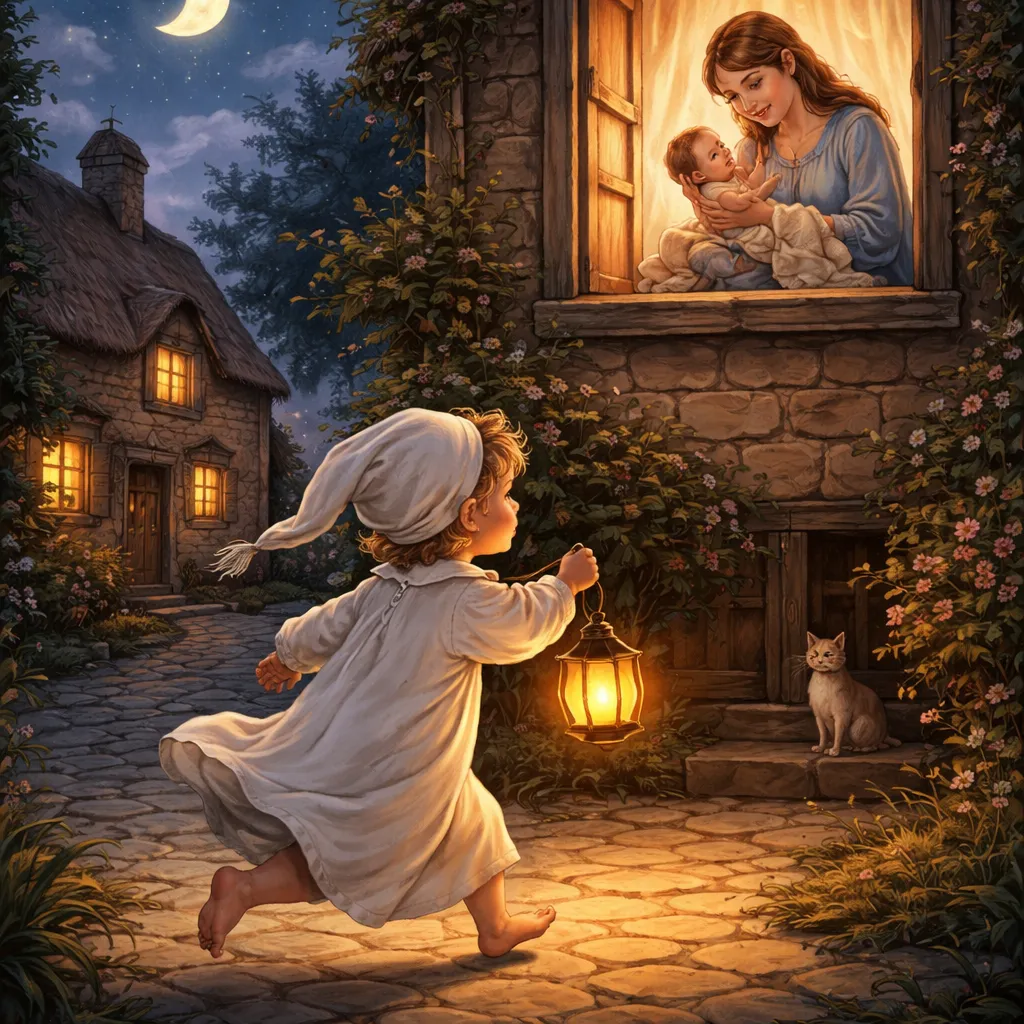

When the clock ticks close to bedtime, do you ever imagine a little friend checking on you? In a land of hills and castles, children have sung about a kind, small boy who does just that. His name is Wee Willie Winkie. This song is a gentle clock that sings, telling us it is time for sweet dreams.
About the Song
Let’s read the rhyme that has been sung for generations.
Wee Willie Winkie runs through the town, Upstairs and downstairs in his nightgown, Rapping at the window, crying through the lock, “Are the children all in bed? For now it’s eight o’clock.”
This short song is a classic bedtime verse. It is like a tiny, caring night-watchman in a poem. The song comes from Scotland. A Scottish poet named William Miller first wrote these words in 1841. He wrote it in the Scots language, which is very close to English. People loved his poem so much, they made it into a song for children all over the world. So, when you sing about Wee Willie Winkie, you are sharing a song from a long, long time ago, from a beautiful country famous for its lochs and stories.
What the Song is About
The song paints a clear picture in just a few lines. We see a little boy named Wee Willie Winkie. He wears his long nightgown. He is in a big hurry. He runs through the quiet, sleepy streets of his town.
He is so busy. He runs up the stairs of a house. Then he runs down the stairs. He goes to a window and taps on the glass with his knuckles. He puts his mouth near the keyhole in the door. Then he calls out his important question. He asks the families inside if all the boys and girls are tucked in bed. He gives everyone a reminder that the clock says it is eight, the perfect time for sleep.
Who Made It & Its Story
A kind man named William Miller gave us Wee Willie Winkie. He was a poet from Glasgow, Scotland. He loved writing poems for children. His poem “Wee Willie Winkie” was part of a bigger book of rhymes. Children loved it right away.
The song became famous for three wonderful reasons. First, it makes a bedtime helper who is friendly and fun. Wee Willie Winkie is not scary; he is a child like them, on an important mission. Second, it gives a clear and simple rule. The song says bedtime is at eight o’clock. This helped children learn about daily routines in a happy way. Third, the words are musical and stick in your mind. The rhythm feels like quick, light running feet, which makes it fun to say and easy to remember.
When to Sing It
This song is perfect for cozy nighttime moments. You can sing it softly while you are brushing your teeth. Look in the mirror and pretend you are Willie getting ready for his run through the town. You can sing it as part of your family’s goodnight hug. A parent can sing it while tucking you into bed, making the song a warm, sleepy blanket of sound.
What Children Can Learn
This little rhyme is a treasure box full of learning gifts. Let’s open it up and see what is inside.
Vocabulary
The song teaches us some special words. “Wee” is a word from Scotland that means very small or little. A “nightgown” is a long, soft shirt that people, especially children, wore to sleep in long ago. “Rapping” means knocking on something quickly and lightly. A “lock” is the part of a door where you put a key. “Eight o’clock” is a way to say the time when the big hand is on the twelve and the small hand is on the eight.
Let’s use these words in new sentences! You can say, “The wee kitten fit in my hand.” Or, “My grandma gave me a cozy nightgown.” You might say, “I heard a rapping sound on the window in the rain.” When playing, you could pretend, “I turned the key in the lock to open my treasure chest.” And you can always ask, “Is it eight o’clock yet? Time for my story!”
Language Skills
The song shows us a very useful grammar friend: the Present Continuous Tense. We use this when we are talking about an action that is happening right now. How do we know? We look for the verb “to be” (like is, am, are) plus a verb ending in “-ing”.
Look at the first line: “Wee Willie Winkie runs…” Wait, that’s not “-ing”! You are right. This is the simple present, telling us what he usually does. But we can easily change it to the present continuous to paint a picture of him doing it right now. We would sing: “Wee Willie Winkie is running through the town.” See? “Is” + “running”. This makes us feel like we are watching him this very second. We can do this with any action. “I eat” becomes “I am eating.” “You play” becomes “You are playing.” It makes our stories feel alive!
Sounds & Rhythm Fun
Listen to the music in the words. “Town” and “gown” sound the same at the end – they rhyme. “Lock” and “clock” are another perfect rhyming pair. This rhyming makes the song catchy and fun, like a word game.
The rhythm is like little running footsteps. Try clapping your hands with the beat: WEE WILlie WINkie RUNS through the TOWN. The beat is steady and bouncy. The melody usually has a tune that goes up and down in a simple, gentle way. This steady rhythm is like a train on a track; it helps your brain remember the words in the right order. Now, you can be a songwriter! Use the same beat and rhyme. Try: “Little Lucy Locket skips through the park, / Looking for her puppy from morning till dark.” See? You just made a new song!
Culture & Big Ideas
Wee Willie Winkie shows us a slice of life from old Scotland. Long ago, before electric lights, towns got very dark at night. People often went to bed earlier, soon after the sun went down. This song comes from that time, teaching children about the importance of a good sleep schedule in a gentle, story-like way.
The song shares three big ideas with us. The first idea is about time. It teaches us that clocks help us organize our day, and eight o’clock is a common time for children to rest. The second idea is about caring for others. Wee Willie Winkie is not just running; he is checking on all the children, making sure they are safe and resting well. The third idea is about routine. Having a regular bedtime helps our bodies and minds grow strong and be ready for a new day of adventures.
Values & Imagination
Let your imagination run wild with Wee Willie Winkie! Imagine you are his helper. What is your name? Maybe you are “Wee Wendy Whisper.” What are you wearing? A nightgown with moon and star patterns? Your town is asleep. What do you hear? The wind whistling? An owl hooting? What do you smell? The fresh night air? Maybe you ride on a friendly badger instead of running! Draw a picture of your nighttime journey.
The song helps us love the safety and warmth of our own homes and beds. It is a time for quiet stories and feeling loved. A good idea is to make a “Thankful for Bed” list. Before you sleep, think of three things about your bedtime that you like. Is it your soft pillow? Your favorite stuffed animal? The goodnight kiss from your family? Say them quietly to yourself. This fills your heart with happiness before dreams.
So, this small rhyme connects us to children from long ago and helps us love our own cozy nighttime moments.
Your Core Takeaways
Now you know all about Wee Willie Winkie, the friendly bedtime messenger from Scotland. You learned new words like “wee” and “rapping,” and you saw how to use the “-ing” form to show action happening now. You felt the running rhythm and even learned to make your own rhyme. You discovered how the song teaches us about time, caring for others, and the comfort of a good routine.
Your Practice Missions
First, be a timekeeper tonight. When your parent says it’s almost bedtime, put on your coziest pajamas like a nightgown. At exactly your bedtime, gently “rap” on your bedroom door three times. Then, call out in a whisper, “Are the children all in bed?” Wait for the answer, then jump into bed.
Second, draw a “Night Town” map. On a big piece of paper, draw your neighborhood at night. Draw your house, a friend’s house, a park, and a moon in the sky. Then, use a crayon to draw the windy, crazy path Wee Willie Winkie would take to check every window. Show your map to your family and tell them the story of his nightly run.