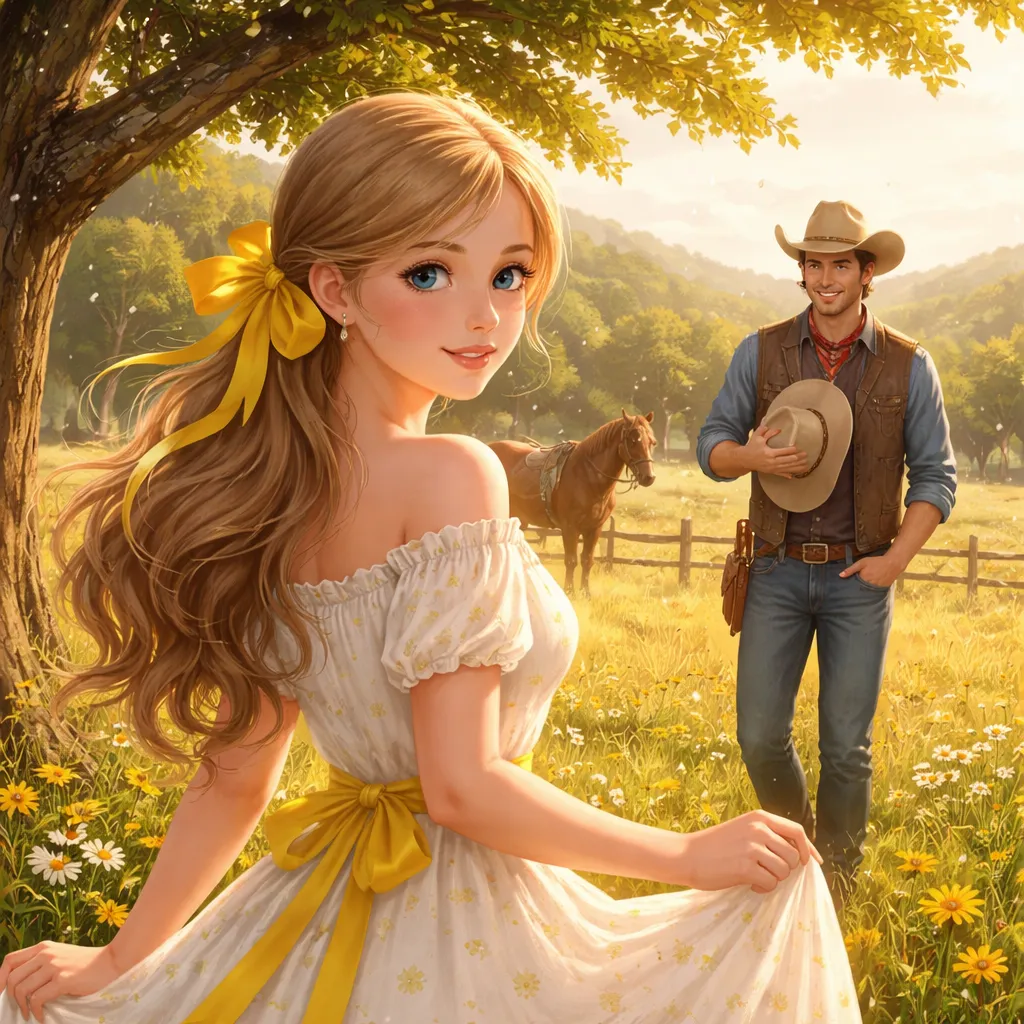

Have you ever seen someone wear a special ribbon or bracelet for a reason? Maybe to remember something important or to show support. There is a very old song about a girl who wore a ribbon for a very special reason. It’s a song about waiting, hoping, and the love for a soldier. Let’s learn about the marching tune “She Wore a Yellow Ribbon.”
About the Song
Let’s read the famous, repeating words of this traditional song.
Around her neck she wore a yellow ribbon, She wore it in the springtime, In the merry month of May. And if you asked her why the hell she wore it, She wore it for her lover who was far, far away. Far away, far away, far away, far away, She wore it for her lover who was far, far away.
This song is a traditional American folk song, often associated with the U.S. cavalry and military. It is a marching song with a catchy, repetitive chorus. The song tells a simple story of a young woman who wears a yellow ribbon as a symbol of her love and remembrance for a soldier who is away, likely at war. The version we know today was popularized by a 1949 Hollywood film called She Wore a Yellow Ribbon, starring John Wayne, which was about the U.S. Cavalry in the Old West. The song itself is much older, dating back to at least the 19th century, and the yellow ribbon has a long history as a symbol of remembrance for absent loved ones, especially those in the military.
What the Song is About
The song paints a clear, vivid picture. A young woman is standing perhaps in a town or near an army fort. She is wearing a bright yellow ribbon. The song tells us exactly where she wore it: around her neck. It also tells us when: in the beautiful, hopeful springtime, specifically in May.
People see her wearing the ribbon every day. They are curious. If someone were to ask her boldly why she wore it, she would have a clear answer. She wore it for her “lover,” a word meaning someone she loved deeply, who was a soldier. This soldier was not nearby; he was “far, far away,” likely serving in a distant place. The song repeats “far away” four times, emphasizing the great distance and the long time of waiting. The ribbon is her way of feeling connected to him and showing everyone that her heart was loyal and waiting for his return.
Who Made It & Its Story
“She Wore a Yellow Ribbon” is a traditional folk song, so its original author is unknown. It evolved from older British and American folk songs and marching tunes. The song became a standard of the U.S. military, particularly the cavalry, in the late 1800s. Soldiers would sing it on long marches. Its connection to the military and the symbolism of the yellow ribbon for remembrance made it a natural choice for the 1949 John Wayne film of the same name, which cemented the song’s popularity in modern culture. The yellow ribbon as a symbol of remembrance gained new life in the 20th century during times of war, such as when families tied yellow ribbons around trees to honor hostages or soldiers serving abroad.
This song has endured for three key reasons. First, its melody is a simple, strong, and unforgettable march that is easy to sing and remember, perfect for group singing. Second, it tells a universal story of love, separation, and loyalty that people can easily understand and relate to. Third, it is tied to powerful visual symbols (the ribbon, the cavalry) and real historical traditions, giving it a sense of authenticity and emotional depth.
When to Sing It
This song is perfect for energetic, group moments. You can sing it loudly while marching around your backyard or on a walk, stomping your feet to the beat like a soldier. You can sing it as a family while on a long car trip, taking turns singing the verses. You can also hum it while doing a craft, like drawing a picture of a soldier or making a paper ribbon.
What Children Can Learn
This symbolic marching song is packed with interesting lessons. Let’s march through them.
Vocabulary
The song teaches us descriptive and symbolic words. A “ribbon” is a long, narrow strip of fabric, used for decoration or as a symbol. “Yellow” is a bright color, often associated with sunshine, hope, and remembrance. “Springtime” is the season between winter and summer when plants grow. The “merry month of May” is a poetic way to say the happy month of May. A “lover” is a person you are in love with. “Far away” means at a great distance.
Let’s use these words! You can say, “I tied a yellow ribbon on my bicycle.” Or, “My cousin lives far away in another state.” New word: Symbol. A symbol is an object that represents an idea. The yellow ribbon is a symbol of remembrance.
Language Skills
This song is a great lesson in using the simple past tense to tell a story about the past. The entire song is a story, so it uses past tense verbs: “She wore a yellow ribbon.” “She wore it in the springtime.” “You asked her why she wore it.”
The song also uses the conditional mood in an “if” clause: “And if you asked her why she wore it…” This sets up a hypothetical question. The answer is in the same past tense, continuing the story. The repetition of “far away” is a literary device that emphasizes distance and longing. This structure helps in building a narrative.
Sounds & Rhythm Fun
Listen to the strong, steady, marching rhythm of the melody. The song has a very repetitive structure, which makes it easy to learn. The verses tell the story, and the chorus repeats the “far away” lines, driving the point home. The rhymes are simple and clear: “May” and “away,” and the internal rhyme in “ribbon” and “in” (in the springtime).
The rhythm is a bold, unwavering 4/4 march. Try clapping on the beat: A-ROUND her NECK she WORE a YEL-low RIB-bon. The melody is simple, uses a small range of notes, and is very easy to sing loudly. This strong, repetitive, and uncomplicated musical pattern is what makes it perfect for marching and remembering. You can write your own symbol song! Use the same marching rhythm. Try: “Around his wrist he wore a blue band, he wore it in the summer, in the sunny month of June. And if you asked him why he wore it, he wore it for his team playing a different tune. A different tune, a different tune, he wore it for his team playing a different tune.”
Culture & Big Ideas
“She Wore a Yellow Ribbon” is deeply embedded in American military and folk culture. It comes from a time when communication was slow (letters took weeks or months) and soldiers were away for long periods. The yellow ribbon became a public, silent way for women to show their fidelity and hope. The song reflects the social customs and hardships of 19th-century life, especially for those connected to the military. It also shows how folk songs were used to boost morale and pass the time.
The song conveys three important ideas. First, it’s about loyalty and faithfulness. The woman remains devoted to her soldier despite the distance and time. Second, it’s about public and private symbols. The ribbon is a public declaration of her private feeling, showing how people use symbols to communicate. Third, it touches on the emotion of waiting. The song captures the mixture of hope, loneliness, and steadfastness that comes with waiting for a loved one’s return.
Values & Imagination
Imagine the young woman in the song. What does she look like? What is her dress like? Is the ribbon tied in a bow or a simple knot? Where is she standing? On a porch? In a garden? Imagine the soldier far away. What is he doing? Riding a horse? Standing guard? Does he have a picture of her? Imagine the moment he returns. How would that scene look? Draw a picture of the woman wearing the ribbon. Then, on the other side of the paper, draw the soldier far away. Draw a yellow line (like the ribbon) connecting the two drawings, symbolizing their connection.
The song inspires us to think about symbols of love and loyalty in our own lives. A lovely idea is to create a “Modern Remembrance Ribbon.” With your family, talk about someone you miss or want to honor—a family member, a friend, or even a community helper. Choose a color that you think represents them (yellow for hope, blue for calm, etc.). Then, everyone can make a simple ribbon from paper or fabric and wear it for a day. Talk about how it feels to wear a symbol for someone.
So, as the last “far away” echoes, think about the simple power of this song. It is a vocabulary lesson in description and symbol. It is a grammar lesson in past tense storytelling. It is a music lesson in a strong, marching rhythm. From the first image of the ribbon to the final repeated distance, it wraps a timeless story of love and waiting in a tune that feels as steady and enduring as the loyalty it describes. “She Wore a Yellow Ribbon” teaches us that love can be shown in simple symbols, that waiting requires strength, and that some stories are best told in a song you can march to.
Your Core Takeaways
You are now an expert on the song “She Wore a Yellow Ribbon.” You know it is a traditional American folk and military march about a woman symbolically waiting for a soldier. You’ve learned words like “ribbon,” “springtime,” and “lover,” and you’ve practiced using the simple past tense to tell a story. You’ve felt its strong, marching rhythm and created your own version. You’ve also discovered the song’s connection to military history, its themes of loyalty and symbolism, and the emotion of hopeful waiting.
Your Practice Missions
First, stage a “Cavalry March.” Gather your family or friends. Pretend you are a cavalry troop on a long march. Sing the song loudly as you march (in place or around the room). Take turns being the “singer” who leads the song. Try to march in perfect time with the beat. This helps you feel the song’s original use.
Second, design a “Ribbon of Remembrance.” The yellow ribbon in the song is a symbol. Think of a person, a pet, a place, or an idea (like kindness or bravery) that is important to you. Design a ribbon for it. Choose a color and decorate a strip of paper. On the back, write a short sentence: “This ribbon is for because _.” Wear it or display it. This lets you create your own personal symbol, just like in the song.