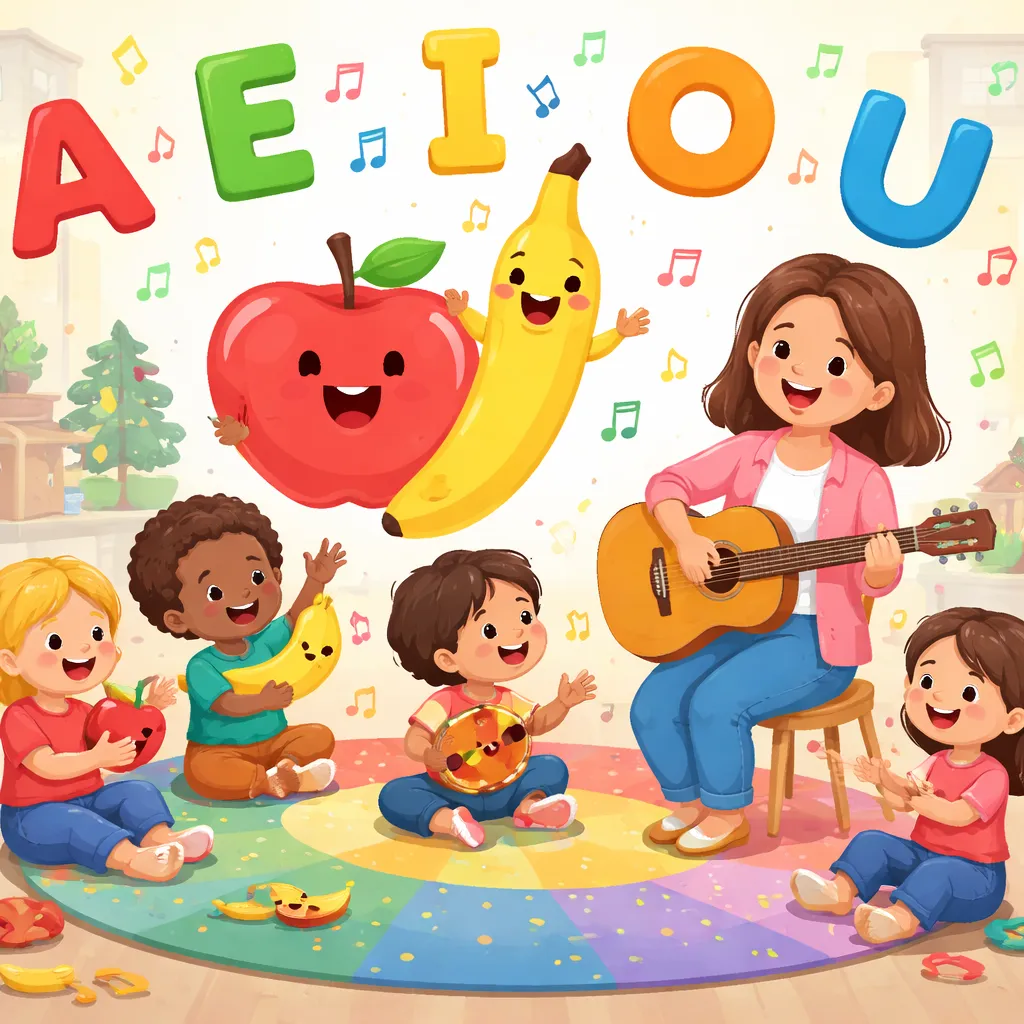

What is the Song "Apples and Bananas"? "Apples and Bananas" is a delightful and educational English song that helps children learn vowel sounds. The song starts with a simple verse about loving apples and bananas. Then it repeats the verse, changing all the vowel sounds to different vowels. The English song: Apples and Bananas has been a favorite in classrooms and homes for decades. Children love making silly sounds with their mouths. The song teaches phonemic awareness in the most playful way possible. By changing the vowels, children learn to hear the difference between sounds. They practice moving their mouths in new ways. The repetition makes it easy to learn. The silliness makes it impossible not to laugh. This song turns phonics practice into a joyful game that children want to play again and again.
The Complete Lyrics of the Nursery Rhyme Let us look at the words together. The song has several verses, each with a different vowel sound.
I like to eat, eat, eat apples and bananas. I like to eat, eat, eat apples and bananas.
Now with the long A sound (ay): I like to ate, ate, ate ay-pples and ba-nay-nays. I like to ate, ate, ate ay-pples and ba-nay-nays.
Now with the long E sound (ee): I like to eat, eat, eat ee-pples and bee-nee-nees. I like to eat, eat, eat ee-pples and bee-nee-nees.
Now with the long I sound (eye): I like to ite, ite, ite i-pples and bi-ni-nis. I like to ite, ite, ite i-pples and bi-ni-nis.
Now with the long O sound (oh): I like to ote, ote, ote oh-pples and bo-no-nos. I like to ote, ote, ote oh-pples and bo-no-nos.
Now with the long U sound (oo): I like to oot, oot, oot oo-pples and bo-noo-noos. I like to oot, oot, oot oo-pples and bo-noo-noos.
Vocabulary Learning from the Song This English song: Apples and Bananas introduces children to fruit words and vowel sounds. Each word builds their understanding of language and phonics.
First, the song teaches about "apples." Apples are round fruits that can be red, green, or yellow. They grow on trees. You can show your child a real apple. Talk about its color, shape, and taste.
The song teaches about "bananas." Bananas are long, yellow fruits that grow in bunches. They are soft and sweet. Show your child a real banana. Peel it and eat it together.
The phrase "I like to eat" teaches about preferences. This is a useful phrase for children. They can say what foods they like. "I like to eat apples." "I like to eat bananas."
The song changes the vowel sounds in each verse. This teaches children that changing a sound changes the word. "Apples" becomes "ay-pples" then "ee-pples" and so on. This is silly and fun, but it builds important phonemic awareness.
Phonics Points to Practice This song is ALL about phonics! The English song: Apples and Bananas is designed specifically to practice vowel sounds. Let us explore each one.
The first verse uses regular short vowels. "I like to eat apples and bananas." This is the baseline.
The second verse uses the long A sound. "Ay-pples and ba-nay-nays." The long A says its own name, like in "cake" and "rain." Practice saying words with long A. Play, day, say.
The third verse uses the long E sound. "Ee-pples and bee-nee-nees." The long E says its own name, like in "bee" and "tree." Practice saying words with long E. See, me, green.
The fourth verse uses the long I sound. "I-pples and bi-ni-nis." The long I says its own name, like in "kite" and "bike." Practice saying words with long I. My, sky, fly.
The fifth verse uses the long O sound. "Oh-pples and bo-no-nos." The long O says its own name, like in "go" and "no." Practice saying words with long O. Home, hope, cold.
The sixth verse uses the long U sound. "Oo-pples and bo-noo-noos." The long U says "oo" like in "blue" and "true." Practice saying words with long U. You, new, food.
Grammar Patterns We Can Learn This silly song teaches important grammar in a very natural way. The English song: Apples and Bananas introduces the phrase "I like to," verb patterns, and word transformation.
The song uses "I like to eat." This is a common pattern for talking about preferences. "Like to" is followed by a verb. You can practice this pattern. "I like to play." "I like to sing." "I like to dance."
The verb "eat" is repeated three times. "Eat, eat, eat." This repetition adds rhythm and emphasis. It shows that eating is the main action.
The song transforms words by changing vowel sounds. This teaches children that words are made of sounds that can be changed. You can try this with other words. "Cat" becomes "cayt" then "ceet" then "cite" and so on. This builds phonemic awareness.
Learning Activities to Do at Home Bringing this English song: Apples and Bananas into your daily life is simple and joyful. Here are some activities you can try with materials you already have.
A wonderful activity is the "Vowel Mouth" game. Watch your mouth in a mirror as you make different vowel sounds. See how your mouth changes shape. For long A, your mouth is wide. For long E, your mouth stretches wide. For long I, your mouth opens then closes. For long O, your mouth makes a circle. For long U, your mouth makes a small circle. This builds awareness of how sounds are made.
Another activity is the "Fruit Tasting" party. Eat apples and bananas together. While you eat, sing the song with all the silly vowels. This connects the phonics practice to real sensory experience.
You can also have a "New Fruit" game. Try the song with other fruits. "I like to eat oranges and grapes." Then change the vowels. "Ay-range-ays and gray-apes." This extends the learning to new words.
Printable Materials for Learning Creating simple printables can make this English song: Apples and Bananas more visual and engaging. You can make these materials together with your child.
Vowel cards are perfect for this song. Make six cards, each with a different vowel. A, E, I, O, U, and a card for the regular verse. Hold up the card for the verse you are singing. This helps children connect the sound to the letter.
A coloring page is always popular. Draw apples and bananas in a bowl. Let your child color the fruit. Write "Apples and Bananas" at the top. Display their artwork proudly.
You can also create simple word cards. Write words from each verse on cards. "Apples," "bananas," "ay-pples," "ba-nay-nays," "ee-pples," "bee-nee-nees," "i-pples," "bi-ni-nis," "oh-pples," "bo-no-nos," "oo-pples," "bo-noo-noos." Show each card as you sing that word. This builds early reading skills.
A mouth shape chart shows how to make each vowel sound. Draw simple pictures of mouths for each sound. This builds awareness of articulation.
Educational Games for Deeper Learning Games make learning active and exciting. They encourage children to use the language from the English song: Apples and Bananas in new and creative ways.
The "New Food" game encourages creativity. Ask your child, "What other foods can we sing about?" Cookies and milk? Pizza and bread? Create new verses with all the vowel changes. "I like to eat cookies and milk. I like to ate cay-kies and maylk." This shows children how to extend the pattern.
The "Vowel Detective" game builds listening skills. Say words with different vowel sounds. Ask your child to identify which vowel they hear. "Ay-pple" has the long A sound. "Bee-nee-nee" has the long E sound. This builds phonemic awareness.
The "Silly Sentence" game uses the vowel changes. Make up sentences and then change all the vowels. "My cat is fat" becomes "May cayt is fayt" with long A. This is silly and fun.
The "Mirror Mouth" game builds awareness of articulation. Use a mirror to watch your mouth make different vowel sounds. Notice how your lips, tongue, and jaw move. This builds understanding of speech production.
The "Fruit Shopping" pretend play uses the song. Set up a pretend fruit stand. Buy apples and bananas. Sing the song while you shop. This builds social skills and imagination.
The "Vowel Song Remix" is creative fun. Try singing the song with a different tune. Make it fast, then slow. Add dance moves for each vowel. This builds musical awareness.
The "Taste Test" activity connects to the fruit. Taste different kinds of apples. Sweet, sour, crunchy. Taste bananas at different ripeness. This builds sensory vocabulary.
The "Letter Match" game pairs vowels with words. Write the vowels A, E, I, O, U on cards. Find words that have each sound. This builds early reading skills.