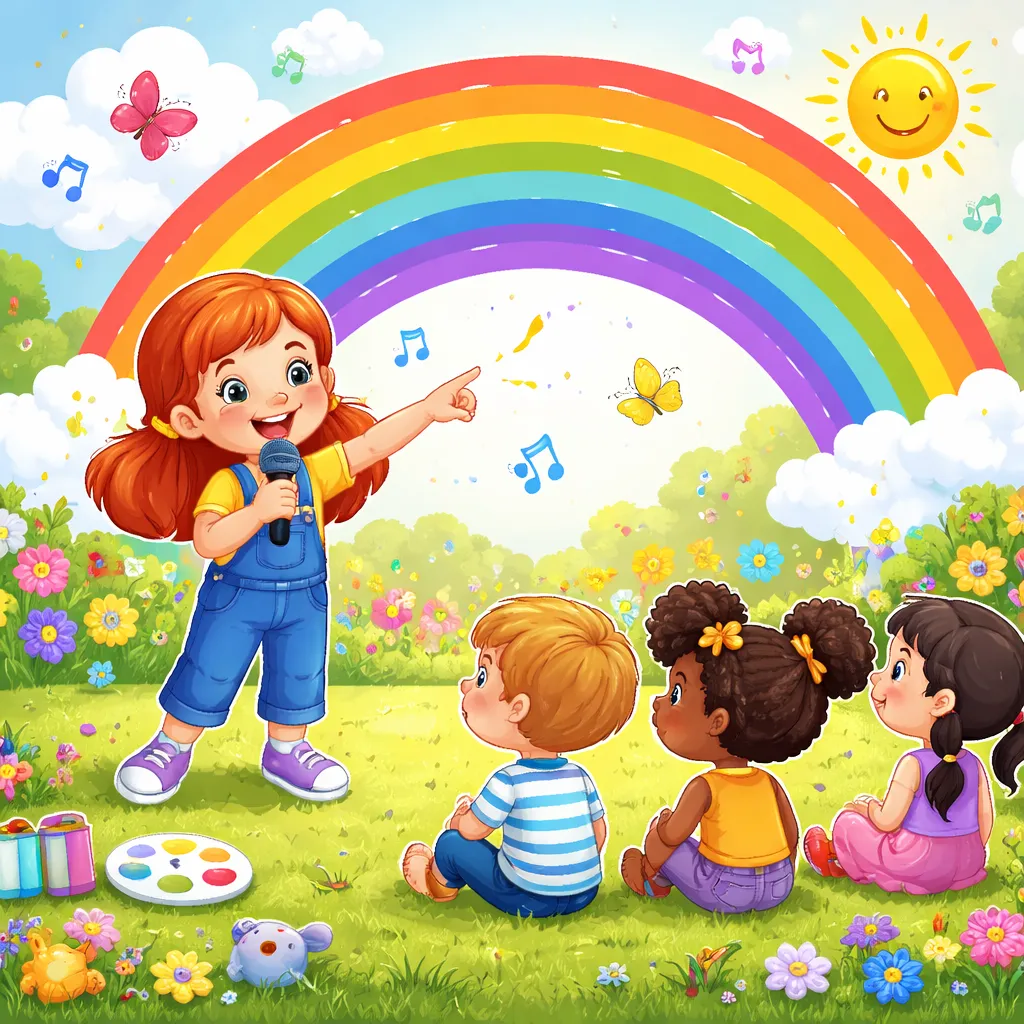

What is the Song "I Can Sing a Rainbow"? "I Can Sing a Rainbow" is a beautiful and gentle English song that helps children learn the colors of the rainbow. The song asks if you can sing a rainbow and then names each color in order. The English song: I Can Sing a Rainbow has been loved by children and teachers for decades. The sweet melody is calming and easy to remember. The song teaches the seven colors of the rainbow in a poetic way. Red and yellow and pink and green, purple and orange and blue. Children learn to name colors and remember their order. The song also teaches that colors are all around us, in the beautiful things we see. This gentle tune is perfect for quiet times, art activities, or any time children are learning about colors.
The Complete Lyrics of the Nursery Rhyme Let us look at the words together. The song is short and sweet.
Red and yellow and pink and green, Purple and orange and blue, I can sing a rainbow, Sing a rainbow, Sing a rainbow too.
Listen with your eyes, Listen with your eyes, And sing everything you see, You can sing a rainbow, Sing a rainbow, Sing along with me.
Vocabulary Learning from the Song This English song: I Can Sing a Rainbow introduces children to color words and sensory vocabulary. Each word builds their understanding of language and the world.
First, the song teaches color words. "Red," "yellow," "pink," "green," "purple," "orange," and "blue" are the colors of the rainbow. You can point to objects of each color as you sing. This builds color recognition.
The song teaches about a "rainbow." A rainbow appears in the sky when sun shines through rain. It has many colors in a beautiful arc. You can show your child pictures of rainbows or look for one after a rainstorm.
The phrase "sing a rainbow" is poetic. It means to describe a rainbow with your voice, to celebrate its beauty through song.
The song has a beautiful line: "Listen with your eyes." This means to really look and see, to pay attention to the colors around you. It teaches children to observe the world carefully.
"Sing along with me" is an invitation to join in. This encourages participation and togetherness.
Phonics Points to Practice Let us listen for special sounds in the song. Phonics helps children connect letters to the sounds they hear. This English song: I Can Sing a Rainbow gives us many sounds to explore.
Listen to the "r" sound at the beginning of "red" and "rainbow." It is a rolling sound made with the tongue. Practice other "r" words like "rabbit," "red," and "run."
The "y" sound appears in "yellow." It is a consonant sound made with the tongue. Practice other "y" words like "yes," "yellow," and "yummy."
Listen to the "p" sound in "pink" and "purple." It is a quick sound made by pressing lips together. Practice other "p" words like "pig," "pan," and "pretty."
The "g" sound in "green" is made at the back of the throat. Practice other "g" words like "game," "garden," and "good."
The long "o" sound in "orange" has a different sound but "go" is long o. The "bl" blend in "blue" is important. Say "blue" slowly. First the "b," then quickly the "l." Practice other "bl" words like "black," "block," and "blow."
Grammar Patterns We Can Learn This color song teaches important grammar in a very natural way. The English song: I Can Sing a Rainbow introduces the phrase "I can," color order, and sensory language.
The song uses "I can" throughout. "I can sing a rainbow." This teaches ability. You can practice using "can" in daily life. "I can jump." "I can draw." "You can sing too!"
The song lists colors in a specific order. This teaches children that rainbows have a pattern. You can practice putting things in order. First red, then orange, then yellow, and so on.
The phrase "listen with your eyes" is a beautiful example of sensory language. It combines two senses, hearing and seeing. You can explore other sensory combinations. "Taste with your fingers." "See with your ears." This builds creative thinking.
Learning Activities to Do at Home Bringing this English song: I Can Sing a Rainbow into your daily life is simple and joyful. Here are some activities you can try with materials you already have.
A wonderful activity is the "Rainbow Drawing" art project. Give your child paper and crayons or paints in rainbow colors. Draw a rainbow together. Name each color as you use it. Sing the song while you create. This builds color recognition and fine motor skills.
Another activity is the "Color Hunt" game. Go around the house or outside and find something of each rainbow color. A red apple, a yellow flower, a pink shirt, a green leaf, a purple grape, an orange carrot, a blue balloon. This builds observation and color matching skills.
You can also have a "Rainbow Snack" time. Prepare snacks in rainbow colors. Red strawberries, yellow bananas, green grapes, orange slices, blueberries. Arrange them in rainbow order on a plate. Sing the song before eating. This makes snack time educational and fun.
Printable Materials for Learning Creating simple printables can make this English song: I Can Sing a Rainbow more visual and engaging. You can make these materials together with your child.
Rainbow color cards are perfect for this song. Make seven cards, each in one rainbow color. Red, yellow, pink, green, purple, orange, blue. Hold up each card as you sing that color. This builds color recognition and sequencing.
A rainbow coloring page is always popular. Draw an outline of a rainbow with seven arcs. Label each arc with a color name. Let your child color each arc the correct color. Write "I Can Sing a Rainbow" at the top. Display their artwork proudly.
You can also create simple word cards. Write words from the song on cards. "Red," "yellow," "pink," "green," "purple," "orange," "blue," "rainbow," "sing," "listen," "eyes," "see." Show each card as you sing that word. This builds early reading skills.
A color matching game helps with color recognition. Make two sets of color cards. Play memory match by finding pairs of the same color.
Educational Games for Deeper Learning Games make learning active and exciting. They encourage children to use the language from the English song: I Can Sing a Rainbow in new and creative ways.
The "New Colors" game encourages creativity. Ask your child, "What if we added more colors?" Brown, black, white, gray? Create new verses with more colors. "Red and yellow and pink and green, purple and orange and blue, brown and black and white and gray, I can sing a rainbow too!" This shows children how to extend the pattern.
The "Color Mixing" science experiment is fascinating. Use finger paints or food coloring in water. Mix red and yellow to make orange. Mix yellow and blue to make green. Mix red and blue to make purple. This teaches children how colors are created.
The "Listen with Your Eyes" game practices observation. Go to a window and look outside. Describe everything you see using colors. "I see a blue sky. I see green grass. I see a red car." This builds descriptive language.
The "Rainbow Hunt" in nature is wonderful. After a rain, look for a real rainbow. Talk about the colors you see. If there is no rainbow, make one with a garden hose on a sunny day. Spray water into the air and look for the rainbow.
The "Color Day" theme makes learning fun. Pick one color each day. Wear that color. Eat foods of that color. Find objects of that color. Sing the song and emphasize that color. This builds deep color knowledge.
The "Sing Along" invitation is beautiful. Invite family members to sing along. Record yourselves singing together. Play it back and listen. This builds confidence and family bonds.
The "Rainbow Collage" art project uses different materials. Tear colored paper, fabric scraps, magazine pictures. Arrange them in rainbow order. Glue them down. This builds fine motor skills and creativity.
The "Feelings and Colors" discussion explores associations. What color makes you feel happy? Yellow. What color feels calm? Blue. This builds emotional vocabulary and self-awareness.