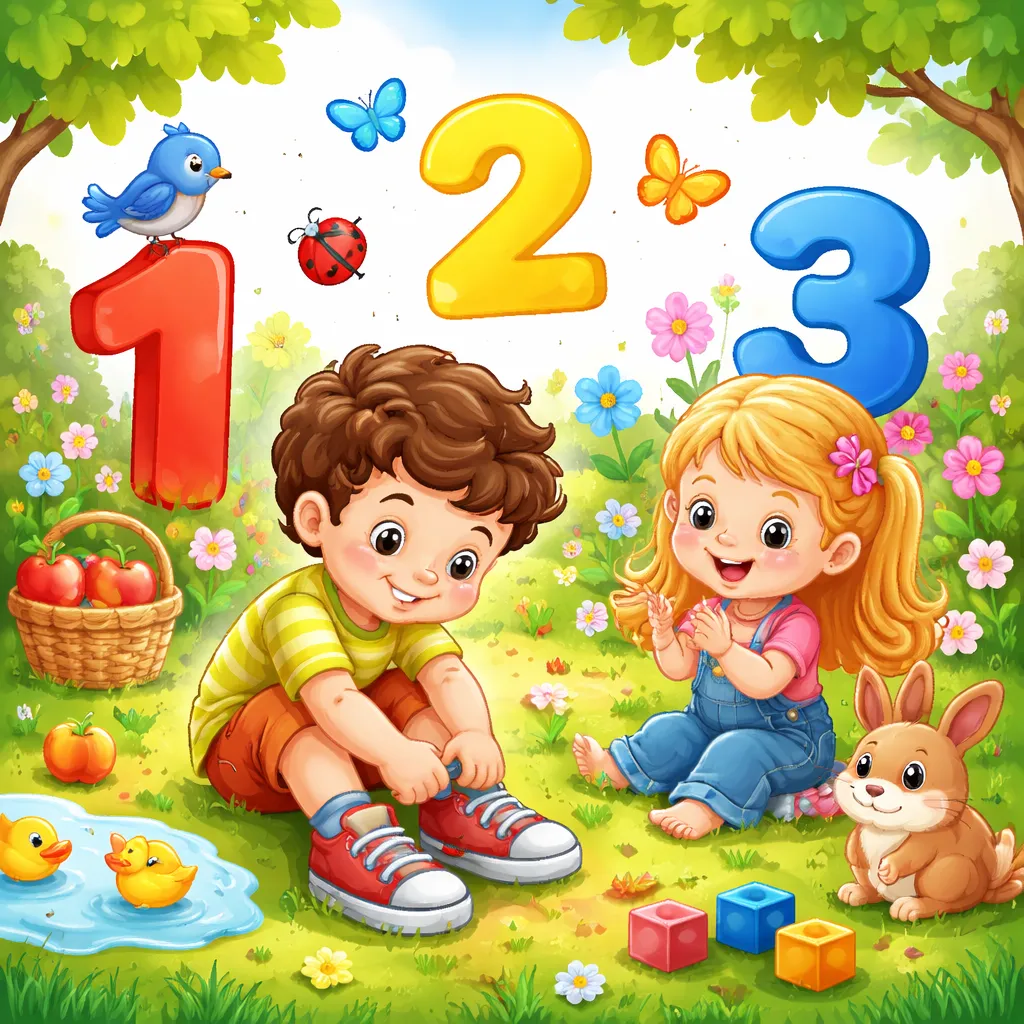

What is the Rhyme "One, Two, Buckle My Shoe"? "One, Two, Buckle My Shoe" is a classic English nursery rhyme that helps children learn to count from one to twenty. Each pair of numbers rhymes with a simple action or object. One, two, buckle my shoe. Three, four, knock on the door. The English song: One, Two, Buckle My Shoe has taught generations of children their numbers in a fun and memorable way. The rhyme connects numbers to everyday activities that children understand. Buckling shoes, shutting doors, picking up sticks, and laying them straight. These familiar actions make the numbers meaningful. The steady rhythm and clear rhymes help children remember the sequence. By the time they reach twenty, they have sung their way through all the numbers with smiles.
The Complete Lyrics of the Nursery Rhyme Let us look at the words together. The rhyme goes all the way to twenty.
One, two, buckle my shoe. Three, four, knock on the door. Five, six, pick up sticks. Seven, eight, lay them straight. Nine, ten, a big fat hen. Eleven, twelve, dig and delve. Thirteen, fourteen, maids a-courting. Fifteen, sixteen, maids in the kitchen. Seventeen, eighteen, maids in waiting. Nineteen, twenty, my plate's empty.
Vocabulary Learning from the Song This English song: One, Two, Buckle My Shoe introduces children to number words and everyday action phrases. Each word builds their understanding of language and daily life.
First, the song teaches number words from one to twenty. Children hear each number in order, paired with a rhyming word. This helps them remember the sequence. You can practice counting other things using the same numbers. How many toys? How many steps? How many crackers?
The song teaches action words. "Buckle" means fastening a shoe. "Knock" means tapping on a door. "Pick up" means lifting from the ground. "Lay straight" means arranging in a line. "Dig and delve" means digging in the earth. These verbs help children describe everyday activities.
Everyday objects appear throughout. "Shoe," "door," "sticks," "hen," "plate." These are things children see and use. Connecting numbers to familiar objects makes the learning concrete.
The phrase "big fat hen" adds a touch of humor. A hen is a chicken. Calling it big and fat makes children smile. This shows that learning can be fun and silly.
Phonics Points to Practice Let us listen for special sounds in the song. Phonics helps children connect letters to the sounds they hear. This English song: One, Two, Buckle My Shoe gives us many sounds to explore.
Listen to the "b" sound in "buckle" and "big." It is a strong sound made by pressing lips together. Say "buckle my shoe" slowly. Feel how your lips press together for "b." Practice other "b" words like "ball," "book," and "baby."
The "sh" sound appears in "shoe" and "shut." Put your finger to your lips and say "shhh." That is the sound! Practice other "sh" words like "ship," "fish," and "shop."
Listen to the "kn" sound in "knock" and "knee" but here it is "knock." The "k" is silent. You can explain that in some words, the "k" is quiet. Practice other "kn" words like "knee," "knife," and "knot."
The "p" sound in "pick" and "plate" is a quick sound made by pressing lips together. Practice other "p" words like "pig," "pan," and "pretty."
The long "i" sound in "five" and "nine" and "eleven" has different vowels but "five" gives us the long "i." You can hear it in words like "kite," "bike," and "sky."
Grammar Patterns We Can Learn This counting rhyme teaches important grammar in a very natural way. The English song: One, Two, Buckle My Shoe introduces imperatives, number-noun agreement, and rhyming patterns.
The song uses imperative forms throughout. "Buckle my shoe." "Knock on the door." "Pick up sticks." "Lay them straight." These are commands telling someone what to do. Children hear imperatives every day. "Eat your food." "Wash your hands." "Come here." The song adds playful imperatives to the mix.
The song teaches number-noun agreement. "One, two" goes with "shoe" (singular). "Five, six" goes with "sticks" (plural). Children absorb this naturally through the rhythm. You can practice using singular and plural. "One book, two books." "One cat, three cats."
The rhyming pattern helps children predict what comes next. "Two" rhymes with "shoe." "Four" rhymes with "door." This builds phonemic awareness and makes the song easier to remember.
Learning Activities to Do at Home Bringing this English song: One, Two, Buckle My Shoe into your daily life is simple and joyful. Here are some activities you can try with materials you already have.
A wonderful activity is the "Number Actions" game. As you sing each pair of numbers, do the action together. Pretend to buckle a shoe for one-two. Knock on a real or imaginary door for three-four. Pick up real or pretend sticks for five-six. Lay them straight for seven-eight. This connects numbers to physical movement and makes learning active.
Another activity is the "Number Hunt" around your house. Find things that come in pairs or groups. Two shoes by the door. Four legs on a chair. Six eggs in a carton. Count them together while singing the matching verse. This builds number sense in the real world.
You can also have a "Snack Time Counting" activity. When you reach "nineteen, twenty, my plate's empty," have a small snack on a plate. Count the crackers or grapes as you eat them. When the plate is empty, sing the last verse with satisfaction.
Printable Materials for Learning Creating simple printables can make this English song: One, Two, Buckle My Shoe more visual and engaging. You can make these materials together with your child.
Number cards from one to twenty are essential. Write each number on a separate card. On the back, draw a simple picture of the action or object from that verse. Your child can put the cards in order while singing. This builds number recognition and sequencing skills.
A matching game pairs numbers with actions. Make two sets of cards. One set has the numbers one through twenty in pairs. The other set has pictures of the actions. Buckle, knock, sticks, straight, hen, dig, etc. Your child matches each number pair to its action. This builds comprehension and memory.
You can also create simple word cards. Write key words from the song on cards. "Buckle," "shoe," "knock," "door," "sticks," "straight," "hen," "dig," "plate." Show each card as you sing that word. This builds early reading skills.
A coloring page for each number pair makes a beautiful book. Draw a simple scene for one-two, three-four, and so on. Let your child color them. Staple them together to make "My Counting Book." Read it together while singing.
Educational Games for Deeper Learning Games make learning active and exciting. They encourage children to use the language from the English song: One, Two, Buckle My Shoe in new and creative ways.
The "Missing Number" game builds number sequence skills. Sing the song but leave out a number. Your child must fill in the missing number. Start with easy skips and make them harder as your child improves. This builds listening and number sense.
The "New Rhymes" game encourages creativity. Ask your child, "What else could rhyme with two?" Blue, glue, true. Create new verses. "One, two, put on your shoe." "One, two, the sky is blue." Try new rhymes for each number pair. This shows children how to play with language.
The "Action Following" game builds listening skills. Call out a number pair. Your child does the action from the song. "One, two!" They pretend to buckle a shoe. "Three, four!" They knock on something. This builds quick thinking and physical response.
The "Number Walk" takes learning outside. Go for a walk and count things you see. One tree, two dogs, three flowers, four cars. Connect each count back to the song. This builds observation and counting skills in the real world.
The "Empty Plate" snack time uses the last verse. Give your child a small snack on a plate. Sing through the numbers while they eat. When they finish, they shout "Nineteen, twenty, my plate's empty!" This creates a joyful eating routine.
The "Shoe Buckling" practice uses the first verse. If your child has shoes with buckles or laces, practice together while singing. This builds self-help skills and connects the song to real life.
The "Door Knocking" game uses the second verse. Pretend to visit different animal houses. Knock on a pillow and say "Who lives here?" A bear! Knock on a chair. A cat! This builds imagination and social play.
The "Stick Collecting" outdoor activity uses verses five through eight. Go outside and collect small sticks. Count them as you pick them up. Lay them straight in a line. Count them again. This connects the song to nature and fine motor skills.
The "Big Fat Hen" drawing activity brings verse nine to life. Draw a big fat hen together. Count her feathers, her eggs, her spots. This builds creativity and connects to the silly part of the song.