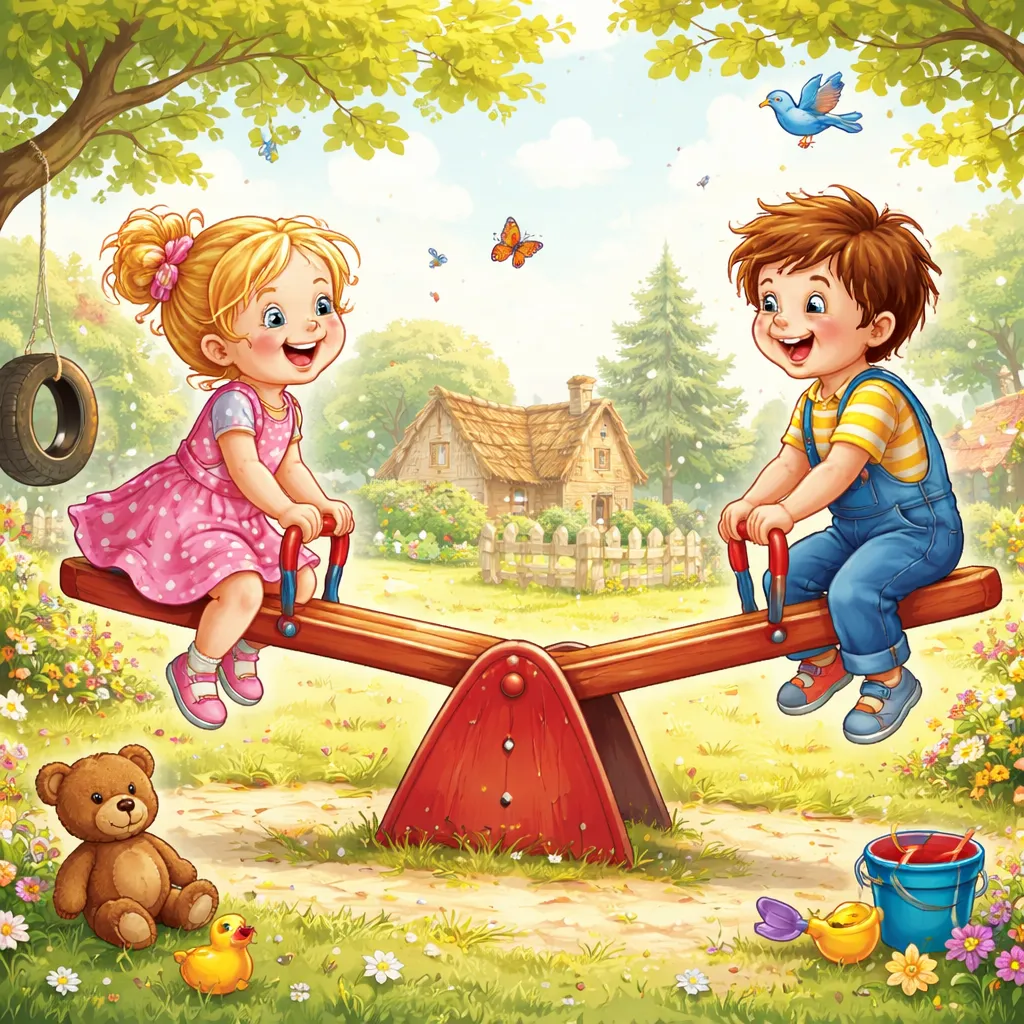

What is the Rhyme "See Saw Margery Daw"? "See Saw Margery Daw" is a cheerful English nursery rhyme that children often sing while playing on seesaws. The song describes the up and down movement of a seesaw with a catchy rhythm. Margery Daw sells her bed to lie on straw because she cannot pay for better things. The English song: See Saw Margery Daw has been sung on playgrounds for generations. The words "see saw" perfectly match the rocking motion of the seesaw. Children sing it as they go up and down together. The simple story about Margery Daw adds a touch of imagination to the physical play. The bouncy rhythm makes everyone want to move. This rhyme turns playground time into a musical experience.
The Complete Lyrics of the Nursery Rhyme Let us look at the words together. The rhyme is short and easy to remember.
See saw, Margery Daw, Jacky shall have a new master. Jacky shall have but a penny a day, Because he can't work any faster.
Some versions have different words, but this is the most common.
Vocabulary Learning from the Song This English song: See Saw Margery Daw introduces children to words about playground equipment, money, and work. Each word builds their understanding of language and daily life.
First, the song teaches about a "see saw." A seesaw is a playground equipment where two people sit on opposite ends and go up and down. If you have a seesaw at a local park, you can show your child how it works. The word "see saw" also sounds like the movement itself.
"Margery Daw" is a character name. Margery is an old name for a girl. Daw is a nickname. Together they create a playful, rhyming name that children enjoy saying.
The song introduces "Jacky," another character name. Jacky is a boy's name, short for Jack. Two characters appear in this short rhyme.
The song teaches about money. "A penny a day" is a very small amount of money. Long ago, children and workers were paid very little. You can explain that a penny is a coin, and a day means for each day of work.
The word "master" means the person Jacky works for. Long ago, children often worked as servants or apprentices. This is a historical concept that can be explained simply.
Phonics Points to Practice Let us listen for special sounds in the song. Phonics helps children connect letters to the sounds they hear. This English song: See Saw Margery Daw gives us many sounds to explore.
Listen to the "s" sound at the beginning of "see" and "saw." It is a soft sound made by pushing air through the teeth. Say "see saw" slowly. Feel the air. Practice other "s" words like "sun," "sand," and "sing."
The "m" sound appears in "Margery" and "master." It is a humming sound made with lips together. Practice other "m" words like "mommy," "milk," and "moon."
Listen to the "j" sound in "Jacky" and "jump" but here it is "Jacky." Practice other "j" words like "juice," "jacket," and "joy."
The "d" sound in "Daw" and "day" is a soft sound made with the tongue behind the teeth. Practice other "d" words like "dog," "daddy," and "door."
The short "a" sound in "saw" and "Daw" and "Jacky" has different vowels but "saw" gives us the "aw" sound. The short "e" sound in "penny" is also common. Pointing out these sounds builds phonemic awareness.
Grammar Patterns We Can Learn This playground song teaches important grammar in a very natural way. The English song: See Saw Margery Daw introduces future tense with "shall," present tense verbs, and cause and effect.
The song uses "shall" to talk about the future. "Jacky shall have a new master." "Jacky shall have but a penny a day." "Shall" is an old word for "will." This teaches children that there are different ways to talk about the future. You can use "will" in daily life. "You will have a snack soon." "We will go to the park tomorrow."
The song shows cause and effect. Jacky gets only a penny a day because he cannot work any faster. This simple cause and effect helps children understand why things happen. You can talk about cause and effect in daily life. "Because you ate your lunch, you can have a treat." "Because it is raining, we will play inside."
The phrase "can't work any faster" uses "can't" which is short for "cannot." This teaches children how we talk about things that are not possible.
Learning Activities to Do at Home Bringing this English song: See Saw Margery Daw into your daily life is simple and joyful. Here are some activities you can try with materials you already have.
A wonderful activity is the "Seesaw Movement" game. Sit facing your child on the floor. Hold hands and lean back and forth like a seesaw. Sing the song while you move. When you say "see," lean forward. When you say "saw," lean back. This brings the song to life through physical play.
Another activity is the "Playground Visit." If you have a seesaw at a local park, visit it with your child. Sing the song while you go up and down together. This connects the rhyme to real physical experience. If there is no seesaw, use a backyard swing or just pretend.
You can also have a "Work and Play" conversation. Talk about how Jacky had to work and only got a penny. Today, children go to school and play. What does your child like to play? What chores do they help with at home? This builds understanding of different times and lifestyles.
Printable Materials for Learning Creating simple printables can make this English song: See Saw Margery Daw more visual and engaging. You can make these materials together with your child.
A seesaw coloring page is perfect. Draw a simple seesaw with two children on it. One goes up, one goes down. Label them Margery Daw and Jacky if you like. Let your child color the scene. Write "See Saw Margery Daw" at the top. Display their artwork proudly.
Movement cards help with the seesaw game. Draw a picture of "up" and a picture of "down." Hold up the cards while you play. When you see "up," lean back. When you see "down," lean forward. This builds word recognition and following directions.
You can also create simple word cards. Write words from the song on cards. "See," "saw," "Margery," "Daw," "Jacky," "master," "penny," "day," "work." Show each card as you sing that word. This builds early reading skills.
A money matching game uses the penny from the song. Draw or use real pennies. Count them together. How many pennies make a nickel? A dime? This builds early math skills.
Educational Games for Deeper Learning Games make learning active and exciting. They encourage children to use the language from the English song: See Saw Margery Daw in new and creative ways.
The "New Names" game encourages creativity. Ask your child, "What if we used different names?" Tommy Daw? Sally Daw? Create new verses. "See saw, Tommy Daw, Susie shall have a new master." This shows children how to play with the name pattern.
The "Up and Down" game practices opposites. The seesaw goes up and down. What else goes up and down? An elevator. A bird. A bouncing ball. Act out things that go up and down together. This builds vocabulary through opposites.
The "Penny Hunt" game uses the money theme. Hide a few pennies around the room. Let your child find them. Count them together. How many pennies did Jacky get in a day? Just one! This builds counting skills.
The "Work Speed" game explores the idea of working faster. Do different tasks at different speeds. Walk slowly, then fast. Clap slowly, then fast. Sing slowly, then fast. Talk about how Jacky could not work faster. This builds understanding of speed and effort.
The "New Master" game imagines who Jacky's new master might be. A baker? A farmer? A teacher? Act out working for different masters. What would Jacky do? This builds imagination and role-playing skills.
The "See Saw Rhythm" game adds music. Pat your knees in a rocking rhythm while singing. Rock back and forth. This builds rhythm awareness and coordination.
The "Penny Day" counting practice uses the number one. Jacky gets one penny. Find other things that come in ones. One nose, one mouth, one you! This builds number sense.
The "Can't Work Faster" discussion explores feelings. How did Jacky feel? Maybe tired? Maybe sad? Talk about times when your child feels like they cannot do something faster. This builds emotional vocabulary and empathy.