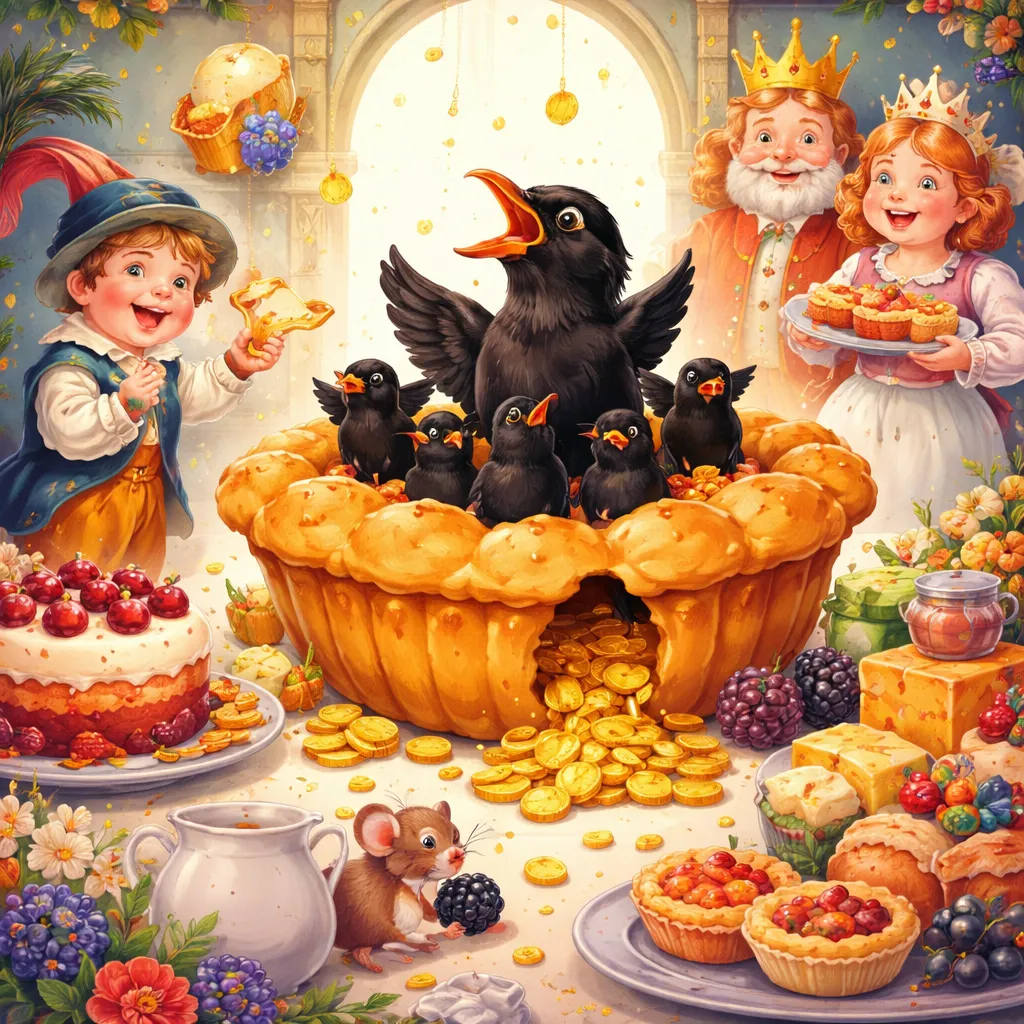

What is the Rhyme "Sing a Song of Sixpence"? "Sing a Song of Sixpence" is a delightful and famous English nursery rhyme full of whimsical images. The song tells a story about a pie full of living blackbirds that begin to sing when the pie is opened. It describes a king counting money, a queen eating bread and honey, and a maid whose nose is stolen by a blackbird. The English song: Sing a Song of Sixpence has delighted children for centuries with its silly and surprising scenes. The idea of birds inside a pie captures young imaginations. The royal characters make children feel like they are peeking into a palace. The mischievous blackbird stealing the maid's nose adds a touch of playful trouble. This rhyme is a feast of imagination, full of rich language and funny pictures.
The Complete Lyrics of the Nursery Rhyme Let us look at the words together. The full rhyme has several verses.
Sing a song of sixpence, A pocket full of rye. Four and twenty blackbirds, Baked in a pie.
When the pie was opened, The birds began to sing. Wasn't that a dainty dish, To set before the king?
The king was in his counting house, Counting out his money. The queen was in the parlor, Eating bread and honey.
The maid was in the garden, Hanging out the clothes. When down came a blackbird, And pecked off her nose!
Vocabulary Learning from the Song This English song: Sing a Song of Sixpence introduces children to wonderful old words about money, food, and royalty. Each word builds their understanding of language and history.
First, the song teaches about money. "Sixpence" is an old British coin. "A pocket full of rye" means a pocket full of rye grain. These are old-fashioned words that spark curiosity about long ago.
The song teaches counting. "Four and twenty" is an old way of saying twenty-four. This shows children that numbers can be said in different ways.
The idea of "blackbirds baked in a pie" is wonderfully silly. Blackbirds are small birds with black feathers. The picture of them popping out and singing when the pie opens is pure imagination. Children love this impossible image.
The song introduces royal words. "King" and "queen" are the rulers of a kingdom. The "counting house" is where the king counts his money. The "parlor" is a fancy sitting room. These words build vocabulary about palaces and royalty.
"Bread and honey" is a simple, sweet food. The maid is a servant who works in the palace. A blackbird pecking off her nose is silly and slightly shocking, which makes children laugh.
Phonics Points to Practice Let us listen for special sounds in the song. Phonics helps children connect letters to the sounds they hear. This English song: Sing a Song of Sixpence gives us many sounds to explore.
Listen to the "s" sound at the beginning of "sing" and "song" and "sixpence." It is a soft sound made by pushing air through the teeth. Say "sing a song" slowly. Feel the air. Practice other "s" words like "sun," "sand," and "silly."
The "p" sound appears in "pocket" and "pie" and "opened" has a different sound but "pie" gives us the "p." Practice other "p" words like "pig," "pan," and "pretty."
Listen to the "b" sound in "baked" and "birds" and "began." It is a strong sound made by pressing lips together. Practice other "b" words like "ball," "book," and "bubble."
The "k" sound in "king" and "counting" is made at the back of the throat. Practice other "k" words like "kite," "kangaroo," and "kiss."
The "qu" sound in "queen" is special. It sounds like "kw" together. Practice other "qu" words like "quick," "quiet," and "question."
Grammar Patterns We Can Learn This imaginative song teaches important grammar in a very natural way. The English song: Sing a Song of Sixpence introduces past tense, passive voice, and descriptive questions.
The song uses past tense throughout. The birds "were baked." The pie "was opened." The birds "began to sing." The king "was" in his house. These are all past tense forms. You can talk about past events in daily life. "We baked cookies yesterday." "The door was opened." "The birds began to sing this morning."
The phrase "was opened" is an example of passive voice. The focus is on the pie, not on who opened it. This is a more advanced structure that children absorb naturally through songs.
The question "Wasn't that a dainty dish?" teaches question forms with negatives. "Wasn't" is short for "was not." This is a playful way to ask a question. You can practice similar questions. "Isn't that a pretty flower?" "Aren't you a clever child?"
Learning Activities to Do at Home Bringing this English song: Sing a Song of Sixpence into your daily life is simple and joyful. Here are some activities you can try with materials you already have.
A wonderful activity is the "Surprise Pie" craft. Take a paper plate. Draw or glue pictures of blackbirds on the bottom half. Cover them with a top half of another plate, attached only at one edge so it lifts like a lid. When you open the "pie," the birds are revealed. Sing the song while opening and closing the pie. This brings the magical moment to life.
Another activity is the "Counting House" game. Use pretend coins or buttons. The king is counting his money. Count together with your child. How many coins does the king have? This builds early math skills while connecting to the song.
You can also have a "Bread and Honey" snack. Give your child a piece of bread with a little honey. Talk about the queen eating bread and honey in her parlor. This connects the song to a tasty treat.
Printable Materials for Learning Creating simple printables can make this English song: Sing a Song of Sixpence more visual and engaging. You can make these materials together with your child.
Story sequencing cards are perfect for this rhyme. Draw simple pictures on separate cards. Pie with blackbirds. Pie opening, birds singing. King counting money. Queen eating in parlor. Maid in garden, bird pecking nose. Your child can arrange the cards in order and retell the whole story. This builds sequencing and narrative skills.
A coloring page is always popular. Draw a big pie with birds flying out. Add a king, queen, and maid in the background. Let your child color the scene. Write "Sing a Song of Sixpence" at the top. Display their artwork proudly.
You can also create simple word cards. Write words from the song on cards. "Sixpence," "rye," "blackbirds," "pie," "king," "queen," "honey," "maid." Show each card as you sing that word. This builds early reading skills.
A matching game pairs characters with their actions. King with money. Queen with bread and honey. Maid with clothes and nose. Birds with pie and singing. Your child matches each character to what they do. This builds comprehension.
Educational Games for Deeper Learning Games make learning active and exciting. They encourage children to use the language from the English song: Sing a Song of Sixpence in new and creative ways.
The "What's in the Pie?" game encourages imagination. Ask your child, "What else could be baked in a pie?" Tiny toys? Candies? Little notes? Create new verses together. "Four and twenty jellybeans, baked in a pie. When the pie was opened, the beans began to bounce." This shows children how to extend the pattern.
The "Counting Money" game uses the king's counting house. Give your child a collection of coins or buttons. Count them together. Then hide some and count again. This builds early math skills.
The "Royal Parade" game adds movement. March around like a king, then like a queen, then like a maid. Use different walks for each character. This builds gross motor skills and imagination.
The "Nose Game" is silly fun. Touch your nose. Where is your nose? Now pretend a blackbird pecked it! Cover your nose and giggle. This builds body awareness through play.
The "Baking Pretend" game connects to the pie. Use play dough or real dough to make a pretend pie. Put small toys inside as "blackbirds." Bake it (in a pretend oven) and open it to see what's inside. This builds creativity and fine motor skills.
The "Parlor Tea Party" uses the queen's scene. Set up a little tea party with bread and honey (or a safe alternative). Pretend to be the queen and her guests. Practice polite manners. This builds social skills.
The "Garden Clothesline" game uses the maid's scene. Hang small pieces of fabric or doll clothes on a string with clothespins. Practice fine motor skills while pretending to be the maid. Watch out for blackbirds!
The "Rhyme Time" game explores other words that rhyme. "Sixpence" rhymes with? Fence, hence. "Rye" rhymes with? My, sky, fly. "Pie" rhymes with? My, sky, try. This builds phonemic awareness.