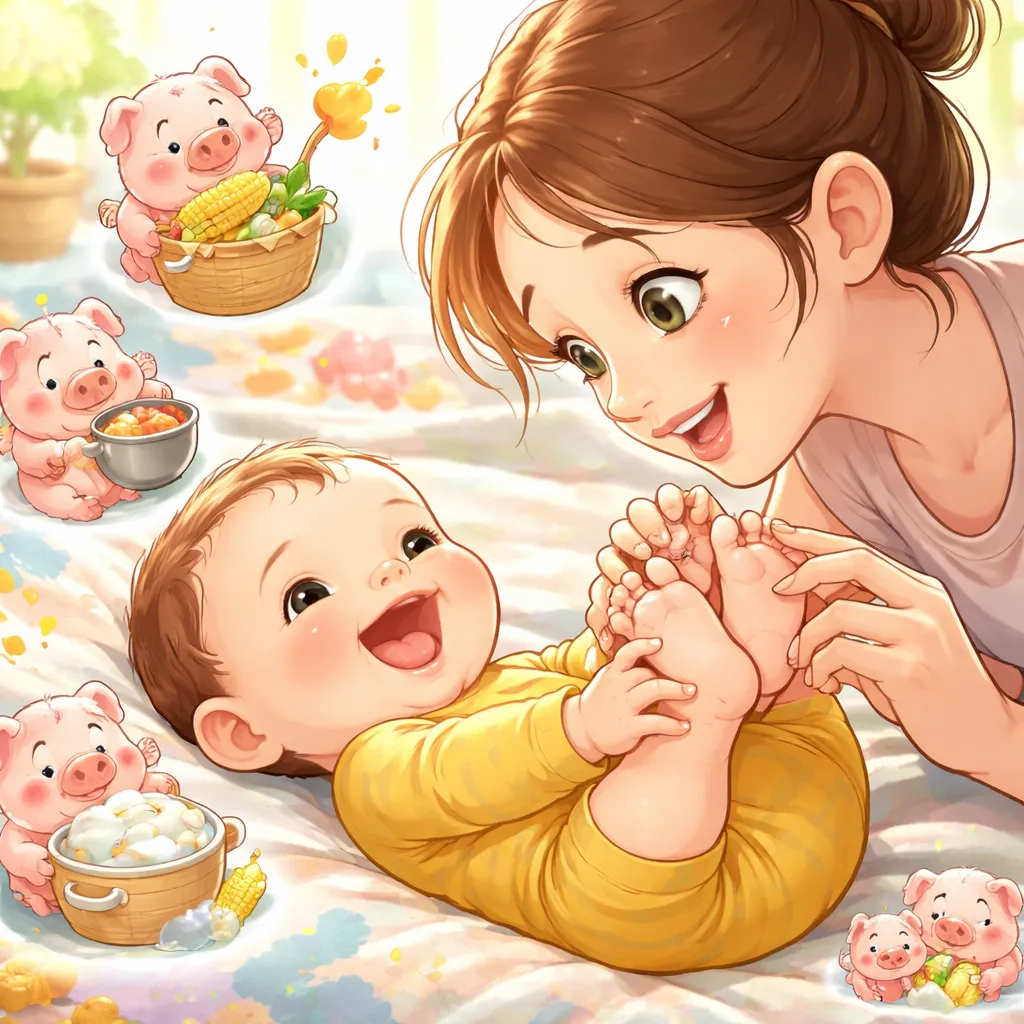

What is the Rhyme "This Little Piggy"? "This Little Piggy" is one of the most beloved English nursery rhymes for babies and very young children. It is not just a song to sing. It is a game to play. An adult takes the child's foot and wiggles each toe while saying the rhyme. Each toe becomes a little piggy going on an adventure. One goes to market. One stays home. One eats roast beef. One has none. And the littlest piggy goes "wee wee wee" all the way home. The English song: This Little Piggy creates a special bonding moment between adult and child. The gentle touch and playful words make babies laugh and wiggle. The game teaches body awareness as children learn to connect words with their toes. It introduces simple concepts like going, staying, eating, and coming home. Most of all, it fills little ones with joy and loving attention.
The Complete Lyrics of the Nursery Rhyme Let us look at the words together. The rhyme follows each toe from biggest to smallest.
This little piggy went to market. This little piggy stayed home. This little piggy had roast beef. This little piggy had none. And this little piggy went wee wee wee all the way home.
Vocabulary Learning from the Song This English song: This Little Piggy introduces children to important words about actions, food, and location. Each word builds their understanding of language and stories.
First, the song teaches about "piggy." A piggy is a little pig. Pigs are farm animals that are pink and have curly tails. You can show your child pictures of real pigs. The toes become pretend piggies in this game.
The song teaches action words. "Went" means going somewhere. "Stayed" means remaining in one place. "Had" means eating or owning something. "Went wee wee wee" is the sound the little piggy makes as it runs home. These verbs help children describe what characters do.
The song introduces different places and situations. "Market" is a place where people buy and sell things. "Home" is where you live. Children understand home very well. This connects the song to their own experience.
Food words appear in the rhyme. "Roast beef" is a kind of meat. "Had none" means the piggy did not get any food. You can talk about foods your child likes to eat. This builds food vocabulary.
Phonics Points to Practice Let us listen for special sounds in the song. Phonics helps children connect letters to the sounds they hear. This English song: This Little Piggy gives us many sounds to explore.
Listen to the "p" sound at the beginning of "piggy." It is a quick sound made by pressing lips together and releasing. Say "piggy" slowly. Feel how your lips pop open. Practice other "p" words like "puppy," "party," and "play."
The "w" sound appears in "went" and "wee." It is made with rounded lips. Practice other "w" words like "water," "window," and "wagon."
Listen to the "st" blend in "stayed" and "stayed" again. Say "stayed" slowly. First the "s," then quickly the "t." Practice other "st" words like "stop," "star," and "sticky."
The long "e" sound in "wee" says its own name. You can hear it in words like "bee," "tree," and "me." The "o" sound in "roast" and "home" is the long "o" sound. Pointing out these sound patterns builds phonemic awareness.
Grammar Patterns We Can Learn This toe game song teaches important grammar in a very natural way. The English song: This Little Piggy introduces past tense verbs, pronouns, and the concept of sequence.
The song uses past tense throughout. The piggy "went" to market. One "stayed" home. One "had" roast beef. One "had" none. These are all past tense verbs. You can talk about your own day using past tense. "We went to the store." "Daddy stayed home." "You had a snack." This helps children understand how we talk about things that already happened.
The word "this" is a demonstrative pronoun. It points to a specific thing. "This little piggy" means the one we are touching right now. You can practice using "this" in daily life. "This is your cup." "This is my book." "This little finger."
The song teaches sequence. First piggy goes to market. Second piggy stays home. Third piggy eats roast beef. Fourth piggy has none. Fifth piggy runs home. This order helps children understand that things happen in a sequence.
Learning Activities to Do at Home Bringing this English song: This Little Piggy into your daily life is simple and joyful. Here are some activities you can try with materials you already have.
A wonderful activity is the "Toe Game" itself. Take your child's foot gently. Touch each toe as you say the corresponding line. Wiggle the littlest toe and tickle it when you say "wee wee wee all the way home." Most babies and toddlers laugh with delight at this game. It builds body awareness and creates loving connection.
Another activity is the "Hand Piggy" version. You can play the same game on fingers. Each finger becomes a little piggy. This is great for times when feet are covered or for variety. Children love having the game played on both hands and feet.
You can also have a "Piggy Puppet" activity. Make simple finger puppets of little pigs. Use them to act out the story. One piggy goes to market. One stays home. This brings the rhyme to life through visual play.
Printable Materials for Learning Creating simple printables can make this English song: This Little Piggy more visual and engaging. You can make these materials together with your child.
Piggy puppets are perfect for this rhyme. Draw or print five little pig shapes. Color them pink. Attach small paper strips to fit around fingers. Your child can wear the puppets while you sing about each piggy. This builds fine motor skills and makes the story tangible.
A sequencing strip helps with story order. Draw five simple pictures in a row. Piggy going to market. Piggy staying home. Piggy eating roast beef. Piggy with no food. Piggy running home. Your child can point to each picture as you sing. This builds sequencing and comprehension.
You can also create simple word cards. Write words from the rhyme on cards. "Piggy," "market," "stayed," "home," "roast," "beef," "none," "wee." Show each card as you sing that word. This builds early reading skills in a gentle, supportive way.
A coloring page is always popular. Draw five little piggies in a row. Let your child color them pink. Write the words of the rhyme at the bottom. Display their artwork proudly.
Educational Games for Deeper Learning Games make learning active and exciting. They encourage children to use the language from the English song: This Little Piggy in new and creative ways.
The "New Adventures" game encourages creativity. Ask your child, "Where else could the piggies go?" One piggy went to the park. One piggy went to the store. One piggy went to grandma's house. Create new verses for each toe. This shows children how to extend the story pattern.
The "Food Choices" game explores different foods. Ask your child, "What could the third piggy eat instead of roast beef?" Pizza? Ice cream? Apples? Create new verses. "This little piggy had pizza." "This little piggy had ice cream." This builds vocabulary and personal connection.
The "Sound Effects" game adds fun sounds. When the little piggy goes "wee wee wee," make the sound together. Try different sounds for the other piggies. Maybe the market piggy says "oink oink." The staying home piggy says "snore snore." This builds vocal play and creativity.
The "Opposite Game" explores opposites. The first piggy went away. The second piggy stayed home. This teaches the concept of opposites. You can find other opposites. Big and little. Hot and cold. Up and down. This builds language concepts.
The "Counting Piggies" game builds number skills. Count your child's toes together. One, two, three, four, five. Wiggle each one as you count. Then count them backward. This builds number sense in a natural way.
The "Family Piggies" game makes the song personal. Use family members instead of piggies. "This little mommy went to work." "This little daddy stayed home." "This little brother had a snack." This connects the song pattern to the child's own life.
The "Tickle Game" adds physical joy. After singing "wee wee wee all the way home," give your child a gentle tickle. This creates positive association with the rhyme and makes them want to play again and again.
The "Bedtime Ritual" uses the song as part of settling down. After a bath, while putting on pajamas, play the toe game gently. This creates a calming routine that signals it is time to rest. The familiar rhyme soothes and comforts as part of the bedtime ritual.