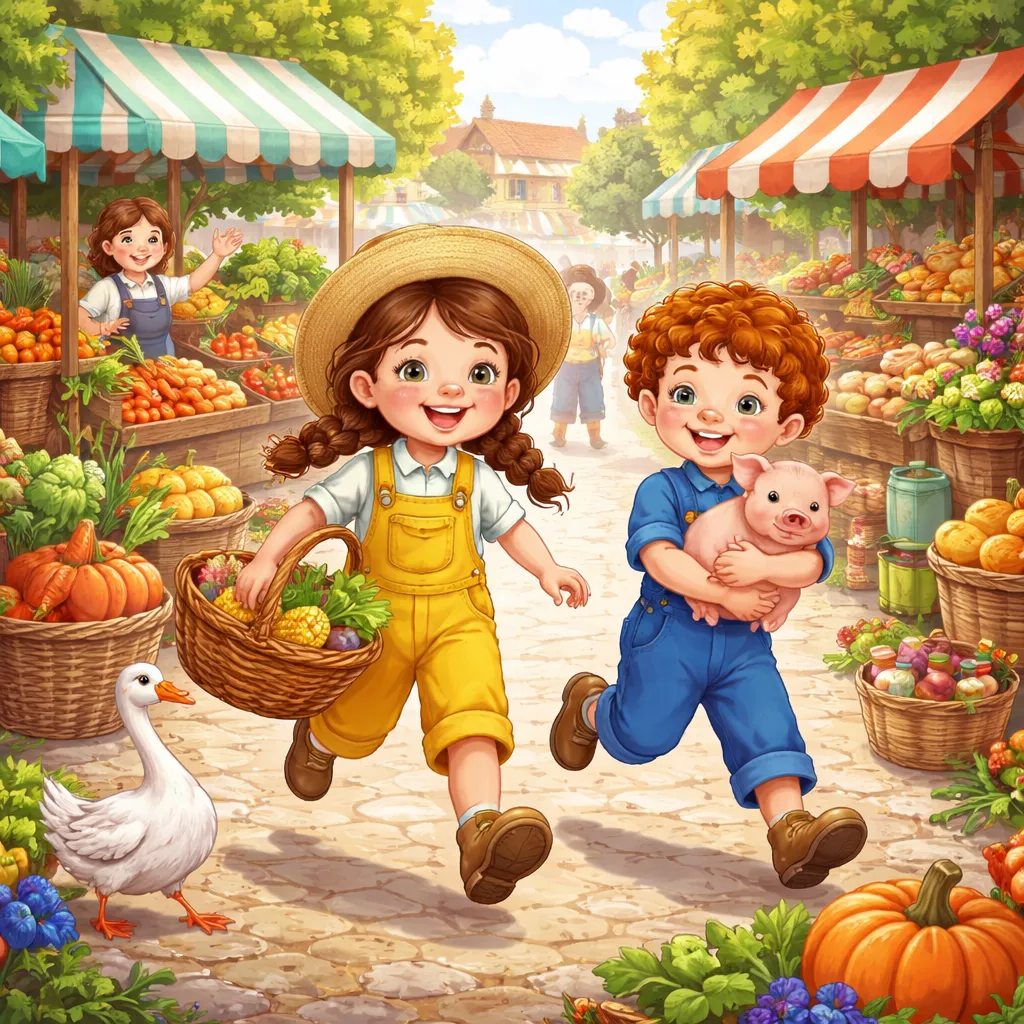

What is the Rhyme "To Market, to Market"? "To Market, to Market" is a lively and repetitive English nursery rhyme about going to buy food. The song tells the story of someone going to market to buy a fat pig, then coming home again. But the pig does not want to stay still! The journey home becomes a funny adventure. The English song: To Market, to Market has been sung by children for generations. The bouncy rhythm makes it perfect for bouncing a child on your knee. The repetition makes it easy to learn. The silly image of a pig jumping and jiggling makes everyone laugh. This simple rhyme teaches children about shopping, food, and the joy of coming home.
The Complete Lyrics of the Nursery Rhyme Let us look at the words together. The rhyme has several verses that repeat with different animals.
To market, to market, to buy a fat pig, Home again, home again, jiggety jig. To market, to market, to buy a fat hog, Home again, home again, jiggety jog.
To market, to market, to buy a plum bun, Home again, home again, market is done.
Vocabulary Learning from the Song This English song: To Market, to Market introduces children to words about shopping, animals, and movement. Each word builds their understanding of daily life.
First, the song teaches about "market." A market is a place where people buy and sell things. You can explain that some markets are outdoors with many stalls. Some are inside like grocery stores. Going to market means going shopping for food.
The song teaches animal words. A "fat pig" and a "fat hog" are both pigs. Hog is another word for a pig, especially a big one. These are animals that live on farms and provide food.
A "plum bun" is a sweet bun with plums inside. This is a treat you might buy at a market. You can talk about special treats your family likes to buy.
The song has fun movement words. "Jiggety jig" and "jiggety jog" describe the bouncy way of going home. These nonsense words sound like the movement itself. They make children want to bounce and move.
The phrase "market is done" means the shopping trip is finished. Time to go home and enjoy what you bought.
Phonics Points to Practice Let us listen for special sounds in the song. Phonics helps children connect letters to the sounds they hear. This English song: To Market, to Market gives us many sounds to explore.
Listen to the "m" sound at the beginning of "market." It is a humming sound made with lips together. Say "to market" slowly. Feel your lips press together. Practice other "m" words like "mommy," "milk," and "moon."
The "p" sound appears in "pig" and "plum." It is a quick sound made by pressing lips together. Practice other "p" words like "pig," "pan," and "pretty."
Listen to the "b" sound in "buy" and "bun." It is a strong sound made by pressing lips together. Practice other "b" words like "ball," "book," and "baby."
The "j" sound in "jiggety" and "jog" is a fun sound. Practice other "j" words like "jump," "juice," and "joy."
The short "i" sound in "pig" and "jig" is very common. You can hear it in words like "sit," "dig," and "wiggle."
Grammar Patterns We Can Learn This shopping song teaches important grammar in a very natural way. The English song: To Market, to Market introduces the infinitive "to" for purpose, prepositions, and repetitive patterns.
The song uses "to" to show purpose. "To market" means going toward the market. "To buy a fat pig" shows the reason for going. This teaches children how we use "to" to explain why we do things. You can practice this pattern. "We go to the park to play." "I read books to learn." "You eat food to grow."
The song uses the preposition "home" to show direction. "Home again" means returning to where you live. You can practice using location words. "Let's go home." "We are home." "Time to come home."
The repetitive pattern "to market, to market" and "home again, home again" teaches children about rhythm and repetition in language. This makes the song easy to learn and fun to say.
Learning Activities to Do at Home Bringing this English song: To Market, to Market into your daily life is simple and joyful. Here are some activities you can try with materials you already have.
A wonderful activity is the "Bouncing Game." Sit your child on your knee and bounce them gently while singing. On "jiggety jig" and "jiggety jog," bounce a little faster or in a different rhythm. This builds coordination and creates a loving bond. Children adore this physical play.
Another activity is the "Market Trip" pretend play. Set up a pretend market with toys or play food. Use a basket or bag for shopping. Take turns being the shopper and the seller. Sing the song while you shop. This builds imagination and social skills.
You can also have a "Real Market Visit." Take your child to a real farmers market or grocery store. Point out the different foods. Talk about what you are buying. Sing the song on the way there and on the way home. This connects the rhyme to real life.
Printable Materials for Learning Creating simple printables can make this English song: To Market, to Market more visual and engaging. You can make these materials together with your child.
A market scene coloring page is perfect. Draw a market with stalls selling fruits, vegetables, and pies. Add a pig and a plum bun. Let your child color the scene. Write "To Market, to Market" at the top. Display their artwork proudly.
Shopping list cards help with vocabulary. Draw or print pictures of things you might buy at the market. Pig, hog, plum bun, apples, bread, milk. Your child can use the cards to make a shopping list. This builds early writing and planning skills.
You can also create simple word cards. Write words from the song on cards. "Market," "buy," "fat," "pig," "home," "jiggety," "jig," "hog," "jog," "plum," "bun." Show each card as you sing that word. This builds early reading skills.
A sequencing strip helps with story order. Draw simple pictures showing going to market, buying a pig, coming home jiggety jig. Your child can point to each picture as you sing. This builds comprehension.
Educational Games for Deeper Learning Games make learning active and exciting. They encourage children to use the language from the English song: To Market, to Market in new and creative ways.
The "New Animal" game encourages creativity. Ask your child, "What other animal could we buy at market?" A fat cat? A fat rat? A fat hen? Create new verses. "To market, to market, to buy a fat hen, home again, home again, jiggety jen." This shows children how to play with the rhyming pattern.
The "Jiggety Movements" game adds different actions. Try different ways of going home. Hop home, skip home, tiptoe home. Sing "hopping home, hopping home, jiggety hop" or "tiptoe home, tiptoe home, jiggety tip." This builds gross motor skills and vocabulary.
The "Market Memory" game practices recall. After singing, ask your child, "What did we buy at the market?" A fat pig, a fat hog, a plum bun. Can you remember them all? This builds memory skills.
The "Shopping List" game extends the market theme. Make a real shopping list with your child before going to the store. Check items off as you find them. This builds organization and early literacy.
The "Pig Sounds" game adds animal noises. What sound does a pig make? Oink oink! Make pig sounds while singing. Try making sounds for other animals too. This builds phonemic awareness through play.
The "Home Again" game practices the returning home part. Go on a short walk around your house or yard. When you return, sing "home again, home again, jiggety jig!" This makes coming home feel special.
The "Plum Bun Baking" activity is a fun extension. Make simple buns or muffins together. Add raisins or dried plums if you have them. Call them "plum buns." Eat them while singing the song. This connects the rhyme to real cooking and eating.
The "Market is Done" cleanup routine uses the last line. When playtime or shopping is finished, sing "market is done" together. This creates a gentle transition signal that children understand.