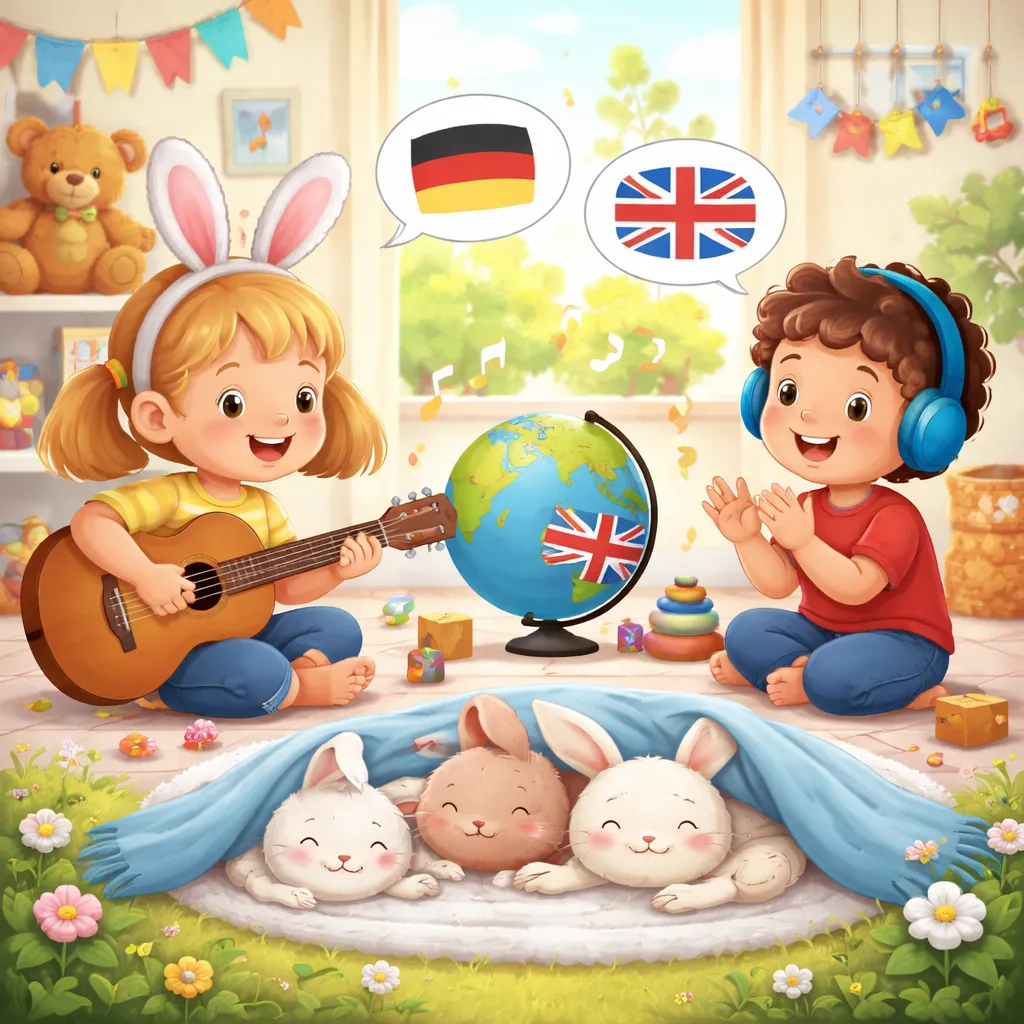

A quiet room. A gentle lullaby. A child drifting into sleep. These are some of the most comforting moments of childhood. A children’s song can bring that same sense of calm and security to language learning. Today, we explore a traditional German lullaby often called “Schlaf, Kindlein, schlaf,” which translates to “Sleep, Little Child, Sleep.” An English version known as “Sleeping Bunnies” has also become beloved. This gentle song invites children to rest and dream. We will use this melody as a peaceful path into English. Together, we will learn new words, explore important sounds, and discover how a simple song can make language learning feel as safe and comforting as bedtime. The bunnies sleep peacefully. Your child can learn English with that same sense of calm.
What is the rhyme? “Schlaf, Kindlein, schlaf” is a traditional German lullaby that has been sung to children for centuries. It was often used to soothe children to sleep. The English adaptation, sometimes called “Sleeping Bunnies,” uses the same gentle melody with new words about bunnies sleeping and waking. The song has a soft, rocking rhythm. Children often use hand movements. They pretend to sleep. They make bunny ears with their fingers. They “wake up” and hop around. The song creates a calm, nurturing atmosphere. It moves from quiet to active and back to quiet. When we bring this song to English learning, we keep its gentle, soothing spirit. We use the familiar melody to introduce English words in a way that feels like a peaceful moment before rest.
The lyrics of nursery rhymes To appreciate this song, we first look at the original German words. Then we see the popular English version. This shows children that the same comforting melody can carry different stories. You do not need to know German to enjoy the soft, rocking rhythm of the words.
Original Version (German)
Schlaf, Kindlein, schlaf Der Vater hüt’ die Schaf Die Mutter schüttelt’s Bäumelein Da fällt herab ein Träumelein Schlaf, Kindlein, schlaf
English Translation
Sleep, little child, sleep The father guards the sheep The mother shakes the little tree Down falls a little dream Sleep, little child, sleep
English Version (Sleeping Bunnies)
See the little bunnies sleeping Till it’s nearly noon Come and let us gently wake them With a merry tune
Oh how still they are Are they ill? Wake up, little bunnies! Hop, little bunnies, hop, hop, hop Hop, little bunnies, hop, hop, hop Hop, little bunnies, hop, hop, hop Hop, hop, hop!
As you read these words, notice the gentle repetition. The German version is soft and lulling. The English version starts quiet and becomes playful. The story is simple and comforting. Bunnies sleep. We wake them gently. They hop and play. This narrative invites children to explore the contrast between stillness and movement.
Vocabulary learning This song offers a wonderful set of words that connect to sleep, wakefulness, and gentle action. We can explore these words through conversation, quiet moments, and playful movement.
Start with the main character: the bunnies. In German, the song is about a child. In English, we say “little bunnies.” Bunnies are soft, gentle animals. You can look at pictures of sleeping bunnies together.
Here are the key words to focus on from the song:
Bunnies: Baby rabbits. Explain that bunnies are soft and like to sleep.
Sleeping: Resting with eyes closed. Pretend to sleep together.
Nearly noon: Close to midday. Explain that the bunnies sleep until almost lunchtime.
Gently: Softly, carefully. Show how to touch gently. The song says to wake them gently.
Merry tune: A happy song. We wake the bunnies with a merry tune.
Still: Not moving. The bunnies are still. Practice being still.
Ill: Sick. We wonder if the bunnies are ill because they are so still.
Wake up: To stop sleeping. The bunnies wake up.
Hop: To jump on one or two feet. Hop around the room together.
Use these words in natural moments. At bedtime, say “the little bunnies are sleeping. You are sleeping too.” In the morning, say “wake up! Hop like little bunnies.” These connections make the vocabulary meaningful.
Phonics points Phonics helps children understand the sounds that build English words. This song gives us several clear sounds to explore in a gentle, playful way.
First, focus on the short ‘u’ sound in “bunnies” and “tune.” Say “u” like in “up.” Then say “bunnies.” Practice with “fun,” “sun,” and “tune.” The ‘u’ in “tune” is actually a long ‘u’ sound, like “you.” So “tune” sounds like “toon.” This is a good opportunity to notice the difference.
Next, notice the ‘ng’ sound in “sleeping” and “morning.” Say “ng” like in “ring.” Then say “sleeping.” Practice with “sing,” “long,” and “morning.” This sound is made with the back of the tongue.
The word “still” contains the ‘st’ blend and the short ‘i’ sound. Say “s,” then quickly add “t.” Then add “ill.” Practice with “stop,” “star,” and “still.” The short ‘i’ sound is like “igloo.”
Finally, look at the ‘h’ sound in “hop” and “happy.” This is a soft, breathy sound. Say “h h h” like a gentle sigh. Practice with “hello,” “home,” and “hop.” The song also has “gentle,” which contains the ‘j’ sound. Say “j” like in “jump.”
Grammar patterns Even a simple song contains grammar that we can introduce gently. We do not need to use technical terms. Instead, we show how words work together through examples and play.
The song uses the present continuous tense. “Sleeping,” “waking,” and “hopping” show actions in progress. You can practice by describing what you are doing. “You are sleeping.” “We are hopping.” This builds understanding of ongoing actions.
Notice the question “are they ill?” This is a yes/no question. You can practice asking simple questions. “Are you tired?” “Are you happy?” This builds conversational skills.
The imperative mood is used in “wake up” and “hop.” These are commands. You can practice giving gentle commands. “Hop like a bunny.” “Wake up.” This builds understanding of how to give instructions.
Also, look at the repetition of “hop, hop, hop.” Repetition adds emphasis and rhythm. You can practice repeating words for emphasis. “Jump, jump, jump!” “Run, run, run!” This adds playful language.
Learning activities Activities bring the song into the body and the imagination. They transform listening into active participation. These ideas are simple and require little preparation.
Bunny Sleep and Hop Play the song and pretend to be bunnies. When the song says “sleeping,” lie down and close your eyes. When it says “wake up,” stretch. When it says “hop,” hop around the room. Repeat the quiet and active parts. This activity builds listening skills and physical expression.
Gentle Wake Up In the morning, use the song to wake up gently. Sing softly. “See the little child sleeping.” Then “wake up, little child!” Start the day with gentle movement. This connects the song to the daily routine.
Bunny Ears Craft Create simple bunny ears using a paper headband and construction paper. Wear them while singing the song. When the song says “hop,” wear the ears and hop. This combines a craft activity with language practice.
Printable materials Printable resources offer a quiet way to reinforce the song’s vocabulary. They are perfect for moments when children want to create or focus calmly.
Flashcards Create a set of flashcards. One card shows a sleeping bunny. One shows a clock showing noon. One shows a hand waking gently. One shows a musical note for “merry tune.” One shows a question mark for “are they ill?” One shows a hopping bunny. Use these cards for a matching game. Sing a line from the song and ask your child to find the matching card. This builds word recognition.
Coloring Page Draw a simple scene from the song. Show two little bunnies sleeping in a cozy nest. On another page, show them hopping happily. Children can color both scenes. As they color, talk about the scenes. “What are the bunnies doing here?” “What happens next?” This keeps the language flowing naturally.
Sleeping and Waking Chart Create a simple chart with two sides. One side says “sleeping.” The other says “awake.” Your child can draw or place pictures of themselves sleeping and awake. This builds understanding of opposites and daily rhythms.
Educational games Games encourage repetition without boredom. They invite children to use the language in new and creative ways.
Bunny Says Play a game similar to “Simon Says.” Give commands using the song’s vocabulary. “The bunny says sleep.” “The bunny says hop three times.” “The bunny says wake up gently.” If you give a command without saying “the bunny says,” the child does not move. This game builds listening skills.
Freeze Game Play the song. When the music plays, children hop like bunnies. When the music stops, they freeze like sleeping bunnies. This builds listening and self-control skills.
Are They Ill? Use different stuffed animals. Pretend they are sleeping. Ask “are they ill?” Gently wake them. Say “they are not ill. They are sleeping!” This builds questioning and caring language.
As you share this song with your child, remember that you are creating a space for both calm and joy. The bunnies sleep peacefully. Then they wake and hop with energy. Language learning can have that same rhythm. Some moments are quiet, for listening and absorbing. Other moments are active, for practicing and playing. Both are important. Let the gentle bunnies be your guide. Sing the song at quiet times. Hop with it during active times. Let the soothing spirit of the lullaby and the playful energy of the hopping bunnies remind you both that learning English is a journey with many paces. Sometimes you rest. Sometimes you hop. And both are wonderful.