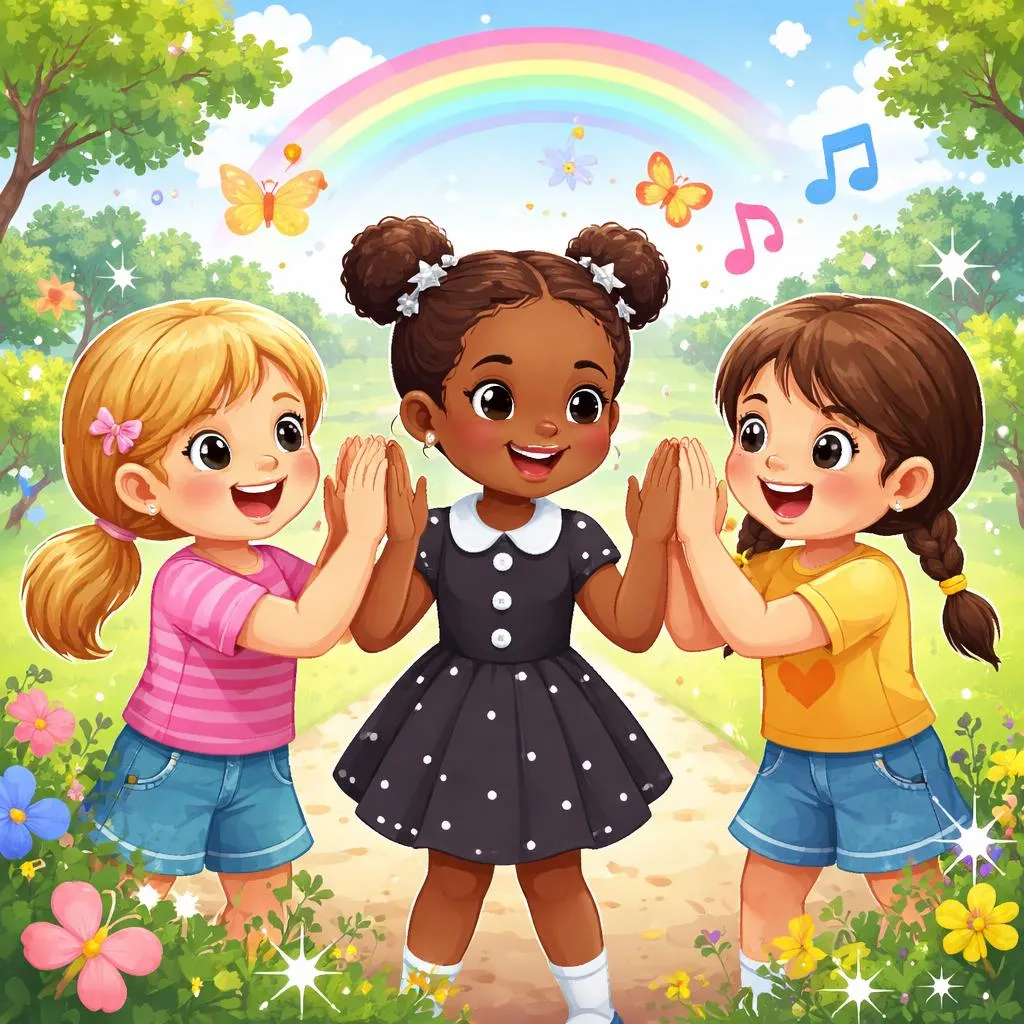

What is the Rhyme? Let's explore a classic childhood treasure, the "Miss Mary Mack" rhyme. This is more than just a poem. It is a vibrant hand-clapping game sung by children for generations. The rhyme tells a playful, rhythmic story about a character named Mary Mack and her encounter with an elephant. Its true magic happens in partnership. Children face a partner and clap hands in specific patterns while singing.
The rhythm of the lyrics to Miss Mary Mack drives the entire experience. The steady beat guides the clapping sequence. This turns the rhyme into a full-body learning activity. It engages the ears, the voice, and the hands in coordinated movement. We use this rhyme not only for fun but also to develop crucial timing, coordination, and auditory processing skills in a joyful, social way.
The Lyrics of the Nursery Rhyme The lyrics to Miss Mary Mack follow a classic and memorable pattern. The most common version begins like this:
Miss Mary Mack, Mack, Mack, All dressed in black, black, black, With silver buttons, buttons, buttons, All down her back, back, back.
The second verse continues the story:
She asked her mother, mother, mother, For fifty cents, cents, cents, To see the elephant, elephant, elephant, Jump over the fence, fence, fence.
The final verse delivers a delightful conclusion:
He jumped so high, high, high, He reached the sky, sky, sky, And he never came back, back, back, ‘Til the fourth of July, -ly, -ly.
The repetition of words and phrases is key. It makes the lyrics easy to memorize. This repetition also provides a predictable structure for the clapping game. Every "Mack, Mack, Mack" aligns with a specific clap or motion.
Vocabulary Learning The lyrics to Miss Mary Mack introduce some wonderful vocabulary words. Let's look at a few key terms. The word "silver" describes a shiny, metallic color. We can compare it to the color of a coin or a spoon. "Buttons" are small fasteners on clothing. Pointing to buttons on a shirt or jacket makes this word concrete.
The phrase "all down her back" gives us a spatial preposition. We can demonstrate "down" by moving a hand from shoulders to waist. "Fifty cents" is a great introduction to money terms. Showing real or pretend coins helps understanding. The word "fence" names a common outdoor structure. A simple drawing or picture can clarify this. Exploring these words deepens comprehension of the rhyme's playful story.
Phonics Points This rhyme offers excellent practice for specific phonics sounds. Let's listen for the strong consonant sounds at the beginning of words. The /m/ sound appears in "Miss," "Mary," "Mack," and "mother." Emphasize this sound. Ask learners to notice how their lips come together to make /m/.
The /b/ sound is prominent in "black," "back," and "buttons." The /j/ sound jumps out in "jump" and "July." The repetition in the lyrics to Miss Mary Mack reinforces these sounds perfectly. We can also focus on the short 'a' vowel sound in "Mack," "black," "back," and "asked." Clapping on these rhyming words highlights their shared sound pattern. This builds phonemic awareness in a natural, rhythmic context.
Grammar Patterns We can find simple but important grammar patterns within these lyrics. The rhyme uses the past tense to tell its story. We see regular past tense verbs with -ed endings, like "asked" and "jumped." We also see the irregular past tense "came" from "come." This provides a gentle, contextual example of different past tense forms.
The structure "She asked her mother for fifty cents" shows a clear sentence pattern: Subject + Verb + Indirect Object + Direct Object. While we don't need to use these terms with young learners, we can model the sentence frame. We can say, "She asked her teacher for a pencil," or "He asked his friend for a sticker." This shows how the grammar from the rhyme works in daily life.
Learning Activities A wonderful first activity is to master the hand-clap sequence. Start by teaching a simple patty-cake pattern. Practice the rhythm without words first. Then, add one line of the lyrics to Miss Mary Mack at a time. Go slowly. The goal is coordination, not speed. This activity builds motor planning and bilateral coordination.
Another engaging activity is "Rhyme Replacement." Keep the same rhythm but change some words. For example: "Miss Mary Mack... all dressed in blue, blue, blue... with golden buttons..." This encourages creativity. It also reinforces the syllable and beat structure of the original rhyme. Learners understand the pattern more deeply when they create their own variations.
Printable Materials A valuable printable is a "Lyrics and Clapping Guide" sheet. It can show the words with simple icons above key beats to indicate a clap, a partner clap, or a thigh slap. This visual guide supports kinesthetic learners. It helps them connect the words they see to the actions they do.
Consider creating a "Vocabulary Illustrator" page. This printable has words like "silver buttons," "fence," and "fifty cents" in boxes. Children can draw their own picture for each term. This personalizes the vocabulary. Another great sheet is a "Story Sequence" comic strip. It has four empty panels labeled: 1. Mary gets dressed. 2. Mary asks for money. 3. The elephant jumps. 4. The elephant is gone. Children draw the story in order, boosting narrative comprehension.
Educational Games Let's play "Rhythm Circle." Everyone sits in a circle and keeps a steady beat by tapping their knees. Go around the circle, with each person saying just one word of the lyrics to Miss Mary Mack in time with the beat. This requires intense listening and turn-taking. It breaks the rhyme down into its individual components.
Another fun game is "What Did Mary Ask For?" This is a memory and creativity game. After learning the rhyme, change the object Mary requests. Start with "She asked her mother for a little red truck." The next person repeats that and adds a new item: "She asked her mother for a little red truck and a jumping frog." This game builds auditory memory and vocabulary in a silly, cumulative way that matches the rhyme's playful spirit.
The enduring appeal of the lyrics to Miss Mary Mack lies in their perfect blend of story, rhythm, and social play. This rhyme gives us a framework for teaching language, sound, and coordination all at once. It shows us that some of the most powerful learning happens through joyful repetition and shared experience. Keep the claps going, explore the words, and watch as this simple rhyme builds confidence and connection, one rhythmic line at a time.