
What is the rhyme?
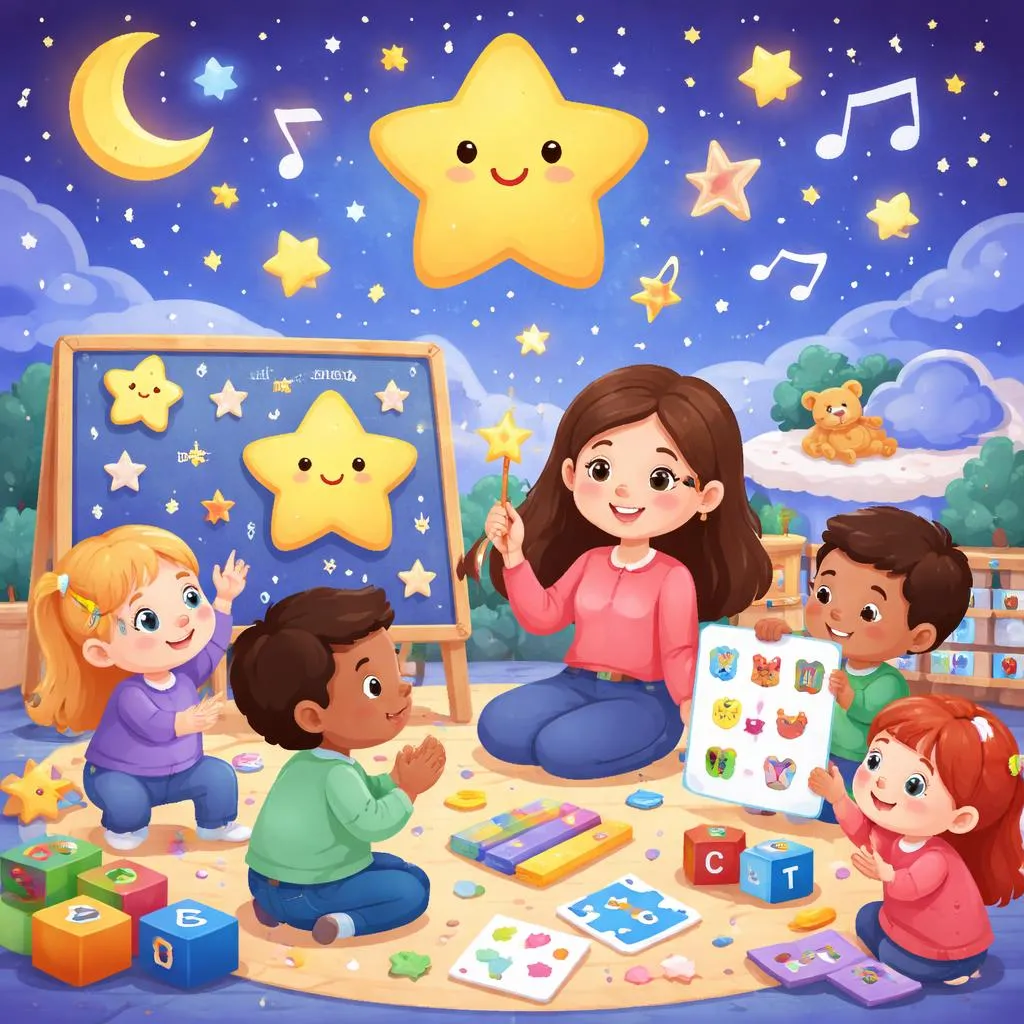
Lullaby Twinkle Little Star is a classic English nursery rhyme. Teachers often use this song to introduce early English sounds and rhythm.
The rhyme describes a shining star in the night sky. It creates a calm mood that supports listening and pronunciation practice.
In early education, this lullaby supports phonics, vocabulary, and basic grammar patterns. It also supports emotional learning through soothing language and melody.
The song works well in preschool, kindergarten, and beginner ESL classrooms. It connects music, language, and imagination in a natural way.
The lyrics of nursery rhymes
Teachers often introduce the most common version of the lullaby. This version uses simple vocabulary and repeating structures.
Twinkle, twinkle, little star, How I wonder what you are. Up above the world so high, Like a diamond in the sky.
Twinkle, twinkle, little star, How I wonder what you are.
The repetition makes the song ideal for memory and pronunciation practice. The rhythm supports stress patterns in English.
Teachers can sing slowly at first and then increase tempo. This approach improves listening accuracy and confidence.
Vocabulary learning
This lullaby includes high-frequency and descriptive words. Each word connects to concrete images or feelings.
Twinkle describes a shining light that flickers softly. Little describes size and expresses affection.
Star refers to a bright object in the night sky. Wonder expresses curiosity and imagination.
Above and high describe position and space. Diamond describes something bright and valuable.
Sky describes the space above the earth. World refers to the earth and all people and places.
Teachers can connect these words with pictures and gestures. For example, hands can sparkle to show twinkle.
Simple sentence models help expand vocabulary. “The star is high.” “The diamond is bright.”
This vocabulary supports science topics about space and nature. It also supports descriptive writing and storytelling.
Phonics points
Lullaby Twinkle Little Star offers rich phonics practice. Teachers can highlight vowel sounds, consonant blends, and rhyming patterns.
Short and long vowels Little shows short /ɪ/ in “li-ttle.” Star shows the long /ɑː/ sound. Sky shows the long /aɪ/ sound.
Consonant blends Twinkle includes the /tw/ blend. Star includes the /st/ blend. World includes the /w/ sound and /ld/ blend.
Rhyming patterns Star rhymes with are. High rhymes with sky. These pairs support rhyme awareness and phonemic awareness.
Teachers can clap for each rhyme pair. This practice builds early reading skills and sound discrimination.
Segmenting and blending activities work well with these words. For example, /s/ + /t/ + /aː/ + /r/ forms star.
Phonics instruction with music improves retention and motivation. This lullaby offers clear sound patterns for systematic phonics teaching.
Grammar patterns
The lullaby includes simple grammar structures that support early sentence patterns.
Exclamatory repetition “Twinkle, twinkle” shows repetition for emphasis. Teachers can explain that repetition adds rhythm and feeling.
Question structure “How I wonder what you are” shows a question idea in poetic form. Teachers can connect this to simple questions like “What are you?”
Prepositions “Up above the world” introduces spatial language. Above and in show position and location.
Simile structure “Like a diamond in the sky” shows comparison with like. Teachers can model simple similes such as “Like a bird in the sky.”
Simple sentence frames can follow. “I wonder what it is.” “It is high in the sky.”
These patterns support early grammar awareness without heavy terminology. They also support creative speaking and writing activities.
Learning activities
Teachers can design integrated lessons around lullaby twinkle little star. Each activity supports listening, speaking, reading, and writing.
Singing and gesture practice Teachers model gestures for star, sky, and twinkle. Movement reinforces meaning and memory.
Picture sequencing Learners arrange pictures that match each lyric line. This supports comprehension and narrative order.
Star observation talk Teachers show night sky pictures and guide simple discussion. “The star is bright.” “The sky is dark.”
Sentence building practice Learners use frames such as “The star is ____.” This expands descriptive language.
Creative drawing and labeling Learners draw a night sky and label star, sky, and diamond. This integrates art and literacy.
Rhyming word hunt Teachers present word cards and match rhyme pairs like star–are and high–sky. This builds phonological awareness.
Slow reading practice Teachers read lyrics line by line with pointing. This supports print awareness and word recognition.
Story extension Teachers invite learners to imagine where the star travels. This builds imagination and narrative skills.
These activities align with early childhood pedagogy and ESL best practices. They also maintain motivation through music and creativity.
Printable materials
Printable materials support structured and independent practice. Teachers often prepare these resources for classroom or home learning.
Lyric posters Large posters display the lyrics with illustrations. These support shared reading and visual learning.
Flashcards Cards include star, sky, diamond, world, and twinkle. These support vocabulary drills and games.
Phonics worksheets Worksheets highlight vowel sounds and rhyming words. These support decoding and early reading skills.
Coloring pages Pages show stars and night scenes with simple labels. These combine fine motor practice with vocabulary learning.
Mini-books Short booklets retell the lullaby with pictures. These support emergent reading and storytelling.
Printable resources reinforce classroom instruction and support review. They also help parents engage with early English learning at home.
Educational games
Games transform lullaby twinkle little star into an interactive learning tool. Teachers can select games for group, pair, or individual learning.
Star pointing game Teachers point to pictures and say a lyric line. Learners match the line to the correct picture.
Rhythm clapping game Teachers clap syllables in twinkle, little, diamond, and wonder. This supports syllable awareness and pronunciation.
Word fishing game Word cards float in a box. Learners pick a card and say a sentence with the word.
Guess the line game Teachers hum a line and learners say the lyrics. This strengthens listening and memory.
Role-play night sky scene Learners act as stars, sky, and moon. They use simple sentences during the role-play.
Phonics bingo Bingo cards include star, sky, high, and are. Teachers call sounds or words for matching.
These games integrate cognitive, social, and linguistic development. They also encourage active participation and joyful learning.
Lullaby Twinkle Little Star remains one of the most effective nursery rhymes for early English education. Its gentle melody, repetitive structure, and vivid imagery support language acquisition in a natural way.
Through guided teaching, phonics instruction, and creative activities, this lullaby becomes a powerful tool for building early literacy, listening skills, and expressive language. It also connects language learning with music, imagination, and emotional comfort, which strengthens engagement and long-term retention in early childhood classrooms.