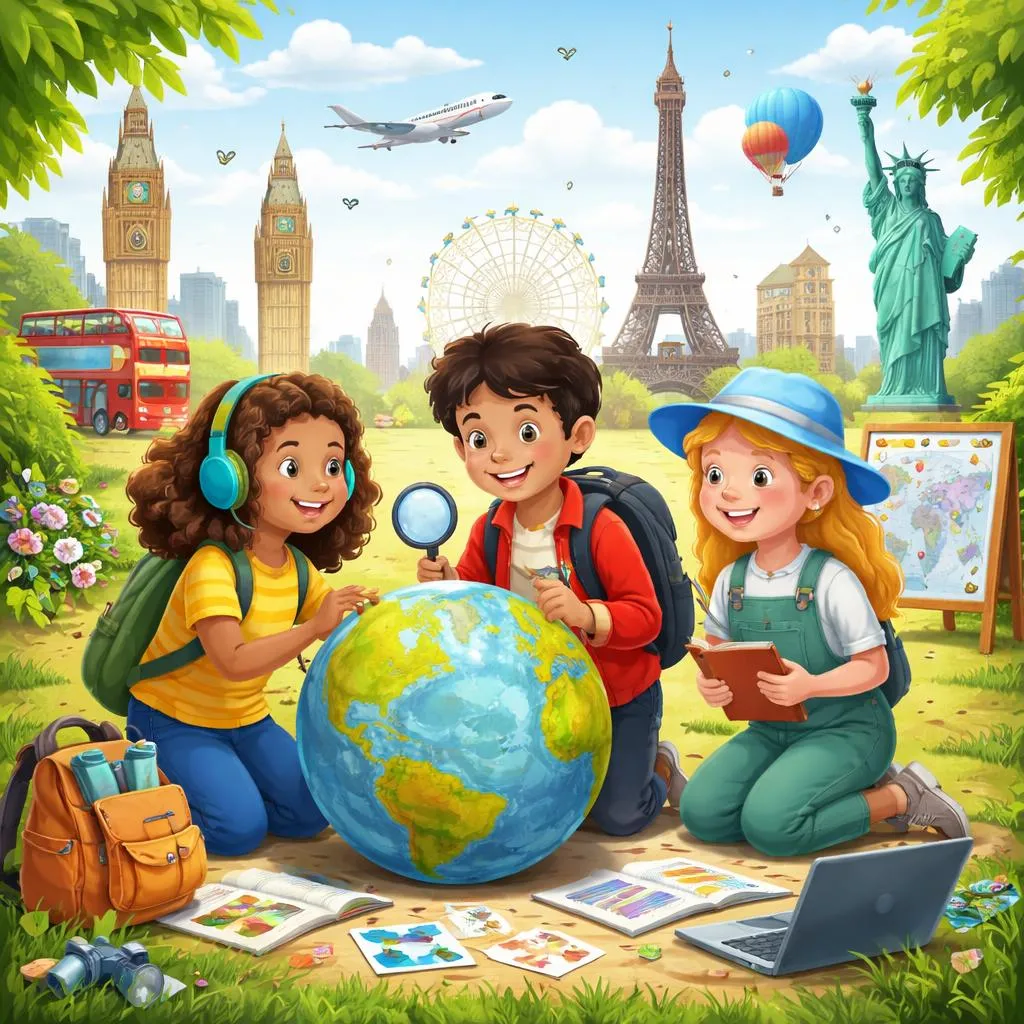

What are Places?
Places are locations where people live, work, play, and explore. They can be big or small, natural or man-made. Learning about places helps children understand the world around them. It also introduces vocabulary, sentence structures, and descriptive language.
Meaning and Explanation
The word “places” refers to any area, building, or location. Examples include schools, parks, homes, stores, mountains, rivers, and cities. Places can also be imaginary, like in stories or games. Learning about places builds curiosity, observation, and descriptive skills.
Categories of Places
Places can be grouped into categories for easier learning:
Homes and Buildings – house, apartment, school, library
Outdoor Spaces – park, garden, playground, beach
City Locations – market, street, bus stop, museum
Natural Places – forest, river, mountain, desert
Special Landmarks – tower, bridge, castle, statue
Each category has its own vocabulary and features.
Daily Life Examples
Children encounter places every day:
Walking to school: noticing the library, shops, or bus stops Visiting parks: seeing trees, swings, and fountains Going to the zoo: learning animal habitats Traveling with family: recognizing mountains, rivers, and cities
Using familiar examples makes learning practical and memorable.
Printable Flashcards for Places
Flashcards can include:
Pictures of buildings, parks, rivers, and mountains Names of places written clearly Matching games for words and images Short sentences: “The school is big.”
Flashcards help children remember words, improve reading, and practice speaking.
Learning Activities and Games
Memory game: Match images of places with their names. I spy game: “I spy a place with trees.” Role-play: Pretend to visit a market, park, or school. Story creation: Make a story about visiting different places.
Activities combine movement, imagination, and language practice.
Vocabulary Learning
Learning about places expands vocabulary in English. Words include building types, natural sites, and city areas. Children learn adjectives to describe places: big, small, tall, beautiful, crowded, quiet. For example: “The park is big and green.”
Phonics Points
Some key sounds appear in place names:
Initial sounds: /p/ in park, /s/ in school Ending sounds: /t/ in market, /n/ in garden Vowel sounds: /iː/ in tree, /oʊ/ in road
Singing songs or reading aloud about places reinforces pronunciation.
Grammar Patterns
Children learn sentence structures using places:
Prepositions: in, on, at, near – “The cat is in the garden.” Verbs: go, visit, see – “Go to the museum.” Adjectives: big, small, tall – “The tower is tall.” Questions: “Where is the library?” “Is the park near your house?”
Practicing these patterns helps build clear communication.
Cross-Curricular Connections
Geography: Understanding maps, cities, rivers, and mountains Math: Counting buildings, trees, or animals in different places Art: Drawing pictures of familiar or imaginary places Science: Learning about natural habitats and ecosystems
Connecting language learning with other subjects strengthens knowledge.
Creative Activities
Children can make their own “places book.” Draw different places, label them, and write sentences. Create imaginary towns or islands and describe them. Share stories about places they visit every day.
These activities build creativity, writing, and speaking skills.
Educational Games for Places
Treasure hunt: Hide objects in different “places” around a room. Role-play travel: Pretend to visit landmarks, parks, or cities. Sentence scramble: Arrange words to form sentences about places. Matching quiz: Match descriptions with the correct location.
Games help reinforce vocabulary, grammar, and listening skills.
Tips for Using “Places” in Learning
Use real-life examples whenever possible. Encourage children to describe places they see every day. Combine drawing, singing, and acting for interactive learning. Ask open-ended questions: “What is your favorite place?” “Why?” Practice prepositions and verbs with each place: go, see, visit, be.
Learning about places helps children understand the world, communicate clearly, and use English naturally. Exploring locations in books, games, or real life makes learning enjoyable and meaningful.