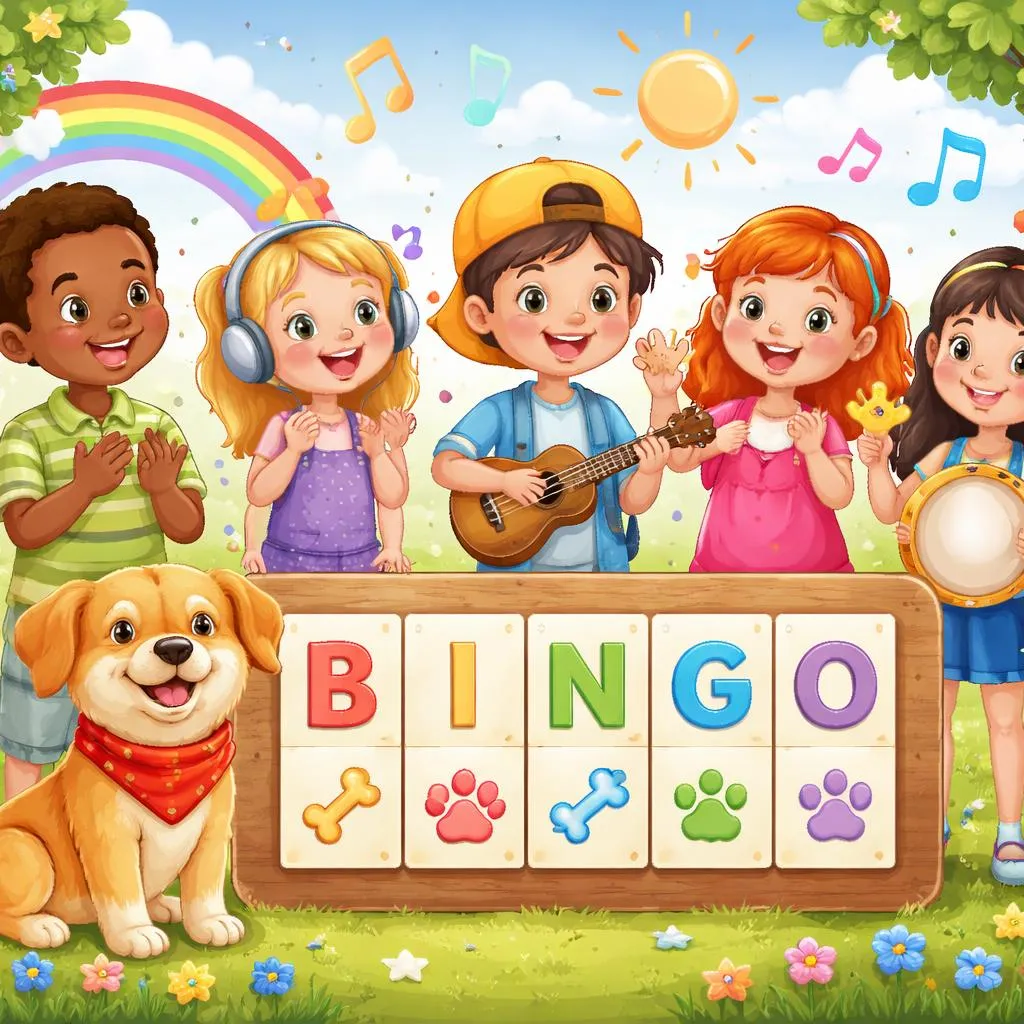

What Is the Rhyme “Bingo”?
“Bingo” is a classic English nursery rhyme that introduces rhythm, spelling, and simple vocabulary through song. The melody is cheerful and repetitive. The structure invites clapping, spelling, and movement. This makes it ideal for early language learning.
The rhyme tells a simple story about a farmer and a dog named Bingo. The name becomes the focus of spelling and sound practice. Each verse removes letters and replaces them with claps. This pattern builds memory and phonemic awareness.
In language learning environments, lyrics for bingo support listening skills, pronunciation practice, and early literacy.
The Lyrics of Nursery Rhymes: Lyrics for Bingo
Below is a common version of lyrics for bingo. Variations exist, but this version works well for teaching.
There was a farmer had a dog, And Bingo was his name-o. B-I-N-G-O, B-I-N-G-O, B-I-N-G-O, And Bingo was his name-o.
There was a farmer had a dog, And Bingo was his name-o. (Clap)-I-N-G-O, (Clap)-I-N-G-O, (Clap)-I-N-G-O, And Bingo was his name-o.
There was a farmer had a dog, And Bingo was his name-o. (Clap)-(Clap)-N-G-O, (Clap)-(Clap)-N-G-O, (Clap)-(Clap)-N-G-O, And Bingo was his name-o.
There was a farmer had a dog, And Bingo was his name-o. (Clap)-(Clap)-(Clap)-G-O, (Clap)-(Clap)-(Clap)-G-O, (Clap)-(Clap)-(Clap)-G-O, And Bingo was his name-o.
There was a farmer had a dog, And Bingo was his name-o. (Clap)-(Clap)-(Clap)-(Clap)-O, (Clap)-(Clap)-(Clap)-(Clap)-O, (Clap)-(Clap)-(Clap)-(Clap)-O, And Bingo was his name-o.
There was a farmer had a dog, And Bingo was his name-o. (Clap)-(Clap)-(Clap)-(Clap)-(Clap), (Clap)-(Clap)-(Clap)-(Clap)-(Clap), (Clap)-(Clap)-(Clap)-(Clap)-(Clap), And Bingo was his name-o.
These lyrics for bingo allow gradual letter removal. This reinforces spelling and listening.
Vocabulary Learning with Lyrics for Bingo
This rhyme includes simple and concrete vocabulary. Each word connects to real-life concepts.
“Farmer” refers to a person who works with animals or crops. “Dog” refers to a common animal friend. “Name” refers to a word used to identify someone or something. Letters like B, I, N, G, and O introduce alphabet sounds.
Through repeated singing, vocabulary becomes familiar. Words appear in meaningful context. This helps retention and comprehension.
Simple sentences like “Bingo was his name-o” show subject and verb structure. Repetition strengthens understanding of sentence rhythm.
Phonics Points in Lyrics for Bingo
Phonics instruction fits naturally into this rhyme. Each letter in B-I-N-G-O can connect to a sound lesson.
The letter B represents the /b/ sound, as in ball and bat. The letter I often represents the short /ɪ/ sound, as in sit. The letter N represents the /n/ sound, as in nose. The letter G can represent /g/ as in go. The letter O often represents the short /ɒ/ or long /oʊ/ sound.
Clapping instead of saying letters supports phoneme awareness. This trains listening and sound discrimination.
The rhythm also supports syllable awareness. Each line follows a predictable beat. This helps internalize English stress patterns.
Grammar Patterns in Lyrics for Bingo
Lyrics for bingo include simple grammar structures that support early sentence understanding.
The pattern “There was a…” introduces past tense. This structure appears often in English storytelling. It can lead to other examples like “There was a cat” or “There was a tree.”
The phrase “was his name” introduces the verb “to be” in past tense. This reinforces subject-verb agreement in a natural way.
The repeated phrase “And Bingo was his name-o” provides exposure to conjunctions like “and.” This supports sentence linking.
This rhyme also shows possessive structure in “his name.” This opens the door to possessive pronouns.
Learning Activities with Lyrics for Bingo
Active learning increases engagement and memory. Lyrics for bingo invite movement, rhythm, and participation.
Clapping activities build coordination and rhythm awareness. Spelling with gestures supports kinesthetic learning. Call-and-response singing builds listening and speaking confidence.
A circle activity can use a soft toy dog named Bingo. Passing the toy with each letter encourages turn-taking and social language.
Role-play can extend the story. A simple farmer role and a dog role can reinforce vocabulary and dialogue.
Printable Materials for Lyrics for Bingo
Printable materials enhance structured learning. Alphabet cards with B, I, N, G, and O can support spelling practice. Simple farm-themed flashcards can connect vocabulary with images.
A worksheet with missing letters encourages spelling practice. Coloring pages with a dog and a farm scene support creative expression while reinforcing vocabulary.
Sentence strips like “There was a farmer” and “Bingo was his name” can support sentence building.
Educational Games Based on Lyrics for Bingo
Games increase motivation and reinforce learning outcomes. Lyrics for bingo inspire many playful learning activities.
A spelling race game can involve arranging letter cards in order. A listening game can include clapping when a letter is missing. A rhythm game can involve tapping or drumming the beat of the song.
A memory game can match letters with pictures of words that start with those letters. This builds phonics connections.
A storytelling game can encourage adding new animals and names using the same song structure.
Meaning and Explanation of the Rhyme
The rhyme tells a simple story about a farmer and a dog named Bingo. The narrative is minimal, but the educational value is high.
The focus is not on plot. The focus is on repetition, spelling, and rhythm. This simplicity supports early language acquisition.
The playful removal of letters creates anticipation and fun. This encourages repeated practice without fatigue.
The rhyme also reflects traditional folk culture. Many nursery rhymes originate from oral traditions. Singing connects learners with cultural heritage.
Daily Life Examples Connected to Lyrics for Bingo
Real-life connections make learning meaningful. Pets in daily life can connect to the word “dog.” Farm visits or pictures of farms can connect to “farmer.”
Names in daily life connect to the concept of identity. Spelling one’s own name can mirror spelling B-I-N-G-O.
Clapping rhythms connect to music and movement in everyday activities. This supports holistic development.
How Lyrics for Bingo Support Language Development
This rhyme supports multiple language domains. Listening skills develop through melody and repetition. Speaking skills develop through singing and chanting.
Phonemic awareness develops through letter sounds and clapping. Vocabulary grows through repeated meaningful context. Grammar patterns appear naturally in sentences.
Memory and attention improve through repetitive structured verses. Social skills develop through group singing and turn-taking.
Creative Extensions Using Lyrics for Bingo
Creative tasks deepen engagement. New verses can be created with different animal names. For example, a cat named Coco or a cow named Momo.
Drawing scenes of the farmer and Bingo supports visual literacy. Writing short sentences about Bingo builds early writing skills.
A mini-book about Bingo can combine pictures and simple sentences. This integrates reading and writing.
Tips for Teaching with Lyrics for Bingo
Clear pacing helps comprehension. Slow singing at first supports pronunciation. Gradual increase in speed adds fun.
Gestures and facial expressions support understanding. Visual aids enhance meaning.
Repetition across sessions reinforces memory. Variation in activities keeps engagement high.
Encouraging creativity with new names and animals builds confidence and expressive language.
Integrating Lyrics for Bingo into English Curriculum
This rhyme fits well into phonics units, alphabet lessons, and rhythm activities. It can introduce spelling patterns and letter recognition.
It can also support social-emotional learning through group participation and shared joy.
In multilingual settings, this rhyme provides accessible entry to English sounds and structure.
Cultural and Musical Value of Lyrics for Bingo
“Bingo” is part of traditional English-speaking culture. Singing it connects learners to global musical heritage.
The melody appears in many children’s programs and classrooms. This familiarity creates a sense of belonging.
Music enhances memory and emotional engagement. This supports long-term language retention.
Lyrics for bingo remain relevant across generations due to simplicity and adaptability.
Using Technology with Lyrics for Bingo
Digital tools can support learning. Animated videos can illustrate the story. Interactive apps can reinforce spelling and phonics.
Recording singing sessions can support pronunciation practice. Karaoke versions can increase engagement.
Online worksheets and printable resources can supplement offline activities.
Encouraging Confidence Through Lyrics for Bingo
Singing in a group reduces anxiety. Simple repetitive lyrics build confidence in speaking English.
Clapping replaces difficult letters, which lowers cognitive load. This supports gradual mastery.
Celebrating participation rather than perfection encourages positive attitudes toward learning.
Building Literacy Skills with Lyrics for Bingo
Early literacy involves phonics, vocabulary, and print awareness. Lyrics for bingo support all three.
Seeing letters while singing links sounds to symbols. This supports decoding skills.
Repetition strengthens word recognition. Sentence patterns build early syntax awareness.
Reading printed lyrics supports left-to-right tracking and word segmentation.
Expanding Lessons Beyond the Rhyme
The farm theme can expand into a thematic unit. Farm animals, farm tools, and farm jobs can become vocabulary topics.
Songs about animals can connect to science topics. Stories about farms can support reading comprehension.
Art projects with farm scenes integrate creativity and language.
Emotional and Social Learning Through Singing
Singing together builds community. Turn-taking in clapping verses fosters cooperation.
Shared music experiences build positive classroom atmosphere. Emotional expression through music supports well-being.
Lyrics for bingo create joyful moments that strengthen engagement with language learning.
Long-Term Benefits of Using Lyrics for Bingo
Early exposure to songs improves pronunciation and rhythm. Musical memory supports language recall.
Positive experiences with English build motivation for future learning.
Foundational skills in phonics, grammar, and vocabulary support later academic success.
Lyrics for bingo offer a simple yet powerful tool for building these skills through play, rhythm, and meaningful repetition.
The melody continues to echo in classrooms, homes, and learning platforms, carrying letters, sounds, and joyful language moments into everyday learning experiences.