
Almost contemporaneously with the publication in 1637 of Descartes' geometry, the principles of the integral calculus, so far as they are concerned with summation, were being worked out in Italy. This was effected by what was called the principle of indivisibles, and was the invention of Cavalieri. It was applied by him and his contemporaries to numerous problems connected with the quadrature of curves and surfaces, the determination on volumes, and the positions of centres of mass. It served the same purpose as the tedious method of exhaustions used by the Greeks; in principle the methods are the same, but the notation of indivisibles is more concise and convenient. It was, in its turn, superceded at the beginning of the eighteenth century by the integral calculus.
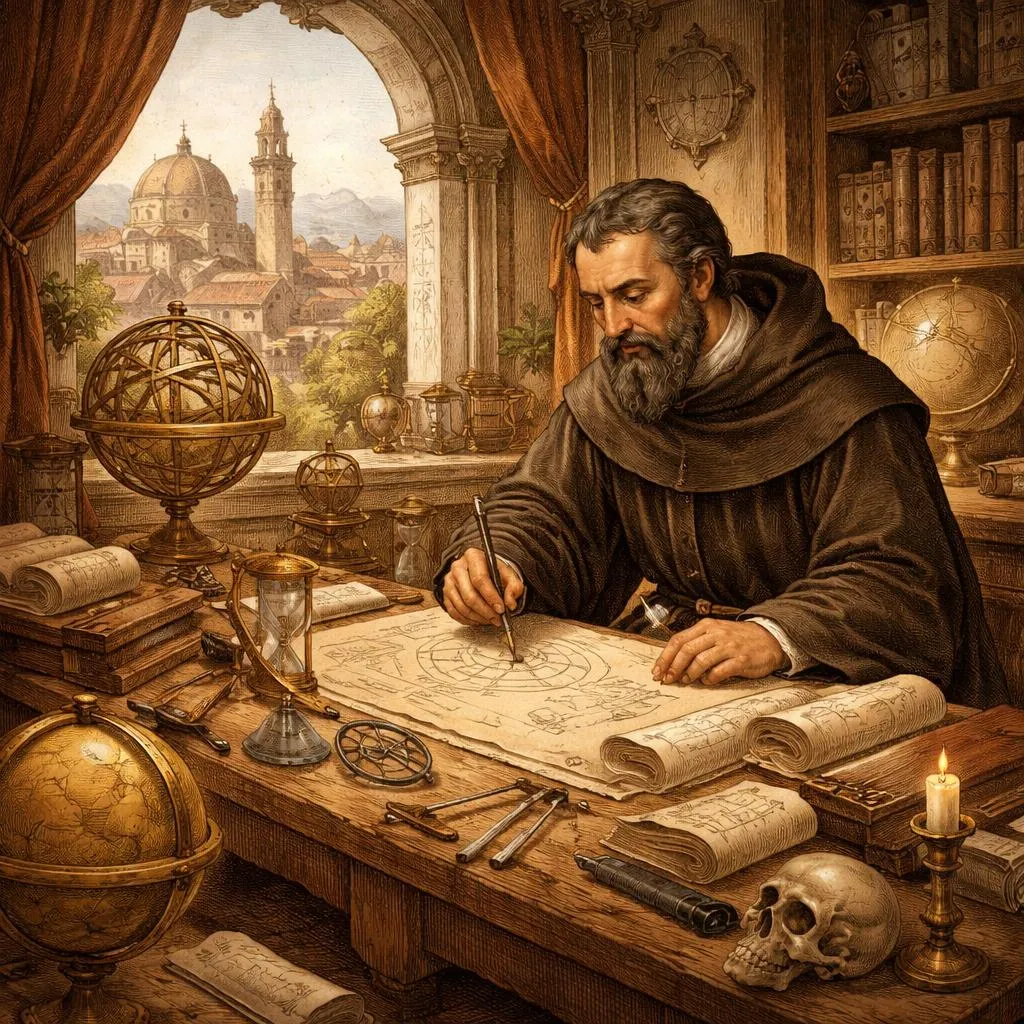
Bonaventura Cavalieri was born at Milan in 1598, and died at Bologna on November 27, 1647. He became a Jesuit at an early age; on the recommendation of the Order he was in 1629 made professor of mathematics at Bologna; and he continued to occupy the chair there until his death. I have already mentioned Cavalieri's name in connection with the introduction of the use of logarithms into Italy, and have alluded to his discovery of the expression for the area of a spherical triangle in terms of the spherical excess. He was one of the most influential mathematicians of his time, but his subsequent reputation rests mainly on his invention of the principle of indivisibles.
The principle of indivisibles had been used by Kepler in 1604 and 1615 in a somewhat crude form. It was first stated by Cavalieri in 1629, but he did not publish his results till 1635. In his early enunciation of the principle in 1635 Cavalieri asserted that a line was made up of an infinite number of points (each without magnitude), a surface of infinite number of lines (each without breadth), and a volume of an infinite number of surfaces (each without thickness). To meet the objections of Guldinus and others, the statement was recast, and in its final form as used by the mathematicians of the seventeenth century it was published in Cavalieri's Exercitationes Geometricae in 1647; the third exercise is devoted to a defence of the theory. This book contains the earliest demonstration of the properties of Pappus. Cavalieri's works on indivisibles were reissued with his later corrections in 1653.
The method of indivisibles rests, in effect, on the assumption that any magnitude may be divided into an infinite number of small quantities which can be made to bear any required ratios ( ex. gr. equality) one to the other. The analysis given by Cavalieri is hardly worth quoting except as being one of the first steps taken towards the formation of an infinitesimal calculus. One example will suffice. Suppose it be required to find the area of a right-angled triangle. Let the base be made up of, or contain n points (or indivisibles), and similarly let the other side contain na points, then the ordinates at the successive points of the base will contain a , 2 a ..., na points. Therefore the number of points in the area is a + 2 a + ... + na ; the sum of which is 1/2 n 2 a + 1/2 na . Since n is very large, we may neglect 1/2 na for it is inconsiderable compared with 1/2 n 2 a . Hence the area is equal to 1/2( na ) n , that is, 1/2 x altitude x base. There is no difficulty in criticizing such a proof, but, although the form in which it is presented is indefensible, the substance of it is correct.
It would be misleading to give the above as the only specimen of the method of indivisibles, and I therefore quote another example, taken from a later writer, which will fairly illustrate the use of the method when modified and corrected by the method of limits.
Let it be required to find the area outside a parabola APC and bounded by the curve, the tangent at A , and a line DC parallel to AB the diameter at A . Complete the parallelogram ABCD . Divide AD into n equal parts, let AM contain r of them, and let MN be the ( r + 1)th part. Draw MP and NQ parallel to AB , and draw PR parallel to AD . Then when n becomes indefinitely large, the curvilinear area APCD will be the the limit of the sum of all parallelograms like PN . Now
area PN : area BD = MP . MN : DC . AD .
But by the properties of the parabola
MP : DC = AM 2 : AD 2 = r 2 : n 2 ,
and MN : AD = 1 : n . Hence MP . MN : DC . AD = r 2 : n 3 . Therefore area PN : area BD = r 2 : n 3 . Therefore, ultimately,
area APCD : area BD = 1 2 + 2 2 + ... + (n-1) 2 : n 3 = 1/6 n (n-1)(2n-1) : n 3
which, in the limit, = 1 : 3.
It is perhaps worth noticing that Cavalieri and his successors always used the method to find the ratio of two areas, volumes, or magnitudes of the same kind and dimensions, that is, they never thought of an area as containing so many units of area. The idea of comparing a magnitude with a unit of the same kind seems to have been due to Wallis.
It is evident that in its direct form the method is applicable to only a few curves. Cavalieri proved that, if m be a positive integer, then the limit, when n is infinite, of (1 m + 2 m + ... + n m )/ n m+1 is 1/( m +1), which is equivalent to saying that he found the integral of x to x m from x = 0 to x = 1; he also discussed the quadrature of the hyperbola.
Antecedentes e Introdução do Autor
Este texto apresenta o trabalho pioneiro de Bonaventura Cavalieri, uma figura importante na história da matemática do início do século XVII. Nascido em Milão em 1598, Cavalieri foi um padre jesuíta e professor de matemática em Bolonha. Seu trabalho lançou as bases para o cálculo integral, um ramo da matemática que lida com a soma de quantidades infinitamente pequenas para encontrar áreas, volumes e outras grandezas. O princípio dos indivisíveis de Cavalieri foi uma ideia revolucionária que ajudou os matemáticos a ir além dos métodos gregos antigos de exaustão, oferecendo uma abordagem mais simples e flexível para calcular áreas e volumes.
Compreendendo o Princípio dos Indivisíveis
O princípio de Cavalieri afirma que uma linha é composta por infinitos pontos, uma superfície por infinitas linhas e um volume por infinitas superfícies. Essa ideia pode parecer abstrata ou até confusa a princípio, mas é um passo fundamental para o conceito de integração no cálculo moderno. Ao imaginar formas como compostas por fatias ou pontos infinitamente finos, Cavalieri pôde calcular áreas e volumes comparando essas fatias entre diferentes formas.
Por exemplo, para encontrar a área de um triângulo retângulo, Cavalieri imaginou a base como composta por muitos pontos e a altura contendo um número proporcional de pontos. Ao somar esses pontos, ele chegou à fórmula familiar para a área de um triângulo: metade da base vezes a altura. Embora seu método não tivesse o rigor que esperamos hoje, a ideia subjacente estava correta e abriu caminho para futuros matemáticos.
Significado e Impacto
O trabalho de Cavalieri foi significativo porque introduziu uma nova maneira de pensar sobre geometria e medição, que era mais intuitiva e menos complicada do que os métodos anteriores. Seu princípio dos indivisíveis antecipou o cálculo integral desenvolvido mais tarde por Newton e Leibniz. Esse método permitiu que os matemáticos resolvessem problemas envolvendo curvas e superfícies que antes eram muito difíceis ou impossíveis de lidar.
Seu trabalho também influenciou o estudo de parábolas, esferas e hipérboles, expandindo a compreensão dessas formas e suas propriedades. A abordagem de Cavalieri ajudou a preencher a lacuna entre geometria e álgebra, levando às poderosas ferramentas matemáticas usadas na ciência e na engenharia hoje.
O Que os Alunos Podem Aprender
-
Criatividade e Inovação Matemáticas: A história de Cavalieri mostra como novas ideias geralmente se baseiam nas antigas. Ele pegou o método grego antigo de exaustão e o aprimorou, imaginando formas como feitas de partes indivisíveis. Isso ensina aos alunos o valor do pensamento criativo e de olhar para os problemas de novas perspectivas.
-
Fundamentos do Cálculo: Embora o cálculo possa parecer complicado, o princípio de Cavalieri fornece uma introdução simples ao conceito de somar infinitas partes pequenas para encontrar um todo. Compreender esse princípio ajuda os alunos a apreciar as origens e a importância do cálculo.
-
Contexto Histórico: Aprender sobre Cavalieri ajuda os alunos a ver como a matemática se desenvolveu ao longo do tempo e como diferentes culturas contribuíram para o conhecimento. Também mostra como a ciência e a religião coexistiram, pois Cavalieri era um padre jesuíta e um matemático.
-
Resolução de Problemas: Os exemplos dados, como encontrar a área sob uma parábola, demonstram como o raciocínio matemático pode resolver problemas práticos. Os alunos podem aprender a aplicar etapas lógicas e usar aproximações para abordar questões complexas.
Aplicando Essas Lições na Vida e no Aprendizado
-
Na Escola: Os alunos podem usar o princípio de Cavalieri como um trampolim para entender a integração nas aulas de cálculo. Ele incentiva a divisão de problemas complexos em partes menores e gerenciáveis, uma habilidade útil em qualquer assunto.
-
Na Vida Diária: A ideia de somar pequenas partes para entender um todo pode ser aplicada em orçamento, culinária ou planejamento de projetos. Por exemplo, gerenciar o tempo dividindo as tarefas em segmentos menores espelha a abordagem indivisível.
-
Em Situações Sociais: A dedicação de Cavalieri à fé e à ciência mostra a importância de equilibrar diferentes aspectos da vida e respeitar diversos campos do conhecimento. Os alunos podem aprender a apreciar múltiplos pontos de vista e colaborar em diferentes disciplinas.
Cultivando Traços Positivos a Partir do Trabalho de Cavalieri
-
Curiosidade e Mente Aberta: A disposição de Cavalieri para explorar novas ideias incentiva os alunos a permanecerem curiosos e abertos ao aprendizado, mesmo quando os conceitos parecem difíceis ou desconhecidos.
-
Perseverança: Seu trabalho foi inicialmente criticado e não totalmente aceito, mas ele continuou a refinar suas ideias. Isso ensina o valor da persistência diante dos desafios.
-
Pensamento Analítico: O método dos indivisíveis exige análise cuidadosa e raciocínio lógico, habilidades valiosas em estudos e na tomada de decisões diárias.
Conclusão
O princípio dos indivisíveis de Bonaventura Cavalieri é mais do que apenas uma técnica matemática; é uma história de inovação, perseverança e evolução da compreensão humana. Para os alunos, oferece um vislumbre das origens do cálculo e do poder de pensar de forma diferente. Ao estudar seu trabalho, os jovens aprendizes podem obter insights sobre a resolução de problemas, a história da ciência e a importância de combinar criatividade com lógica. Essas lições se estendem além da matemática, incentivando uma mentalidade curiosa, persistente e analítica — qualidades que os servirão bem em todas as áreas da vida.
