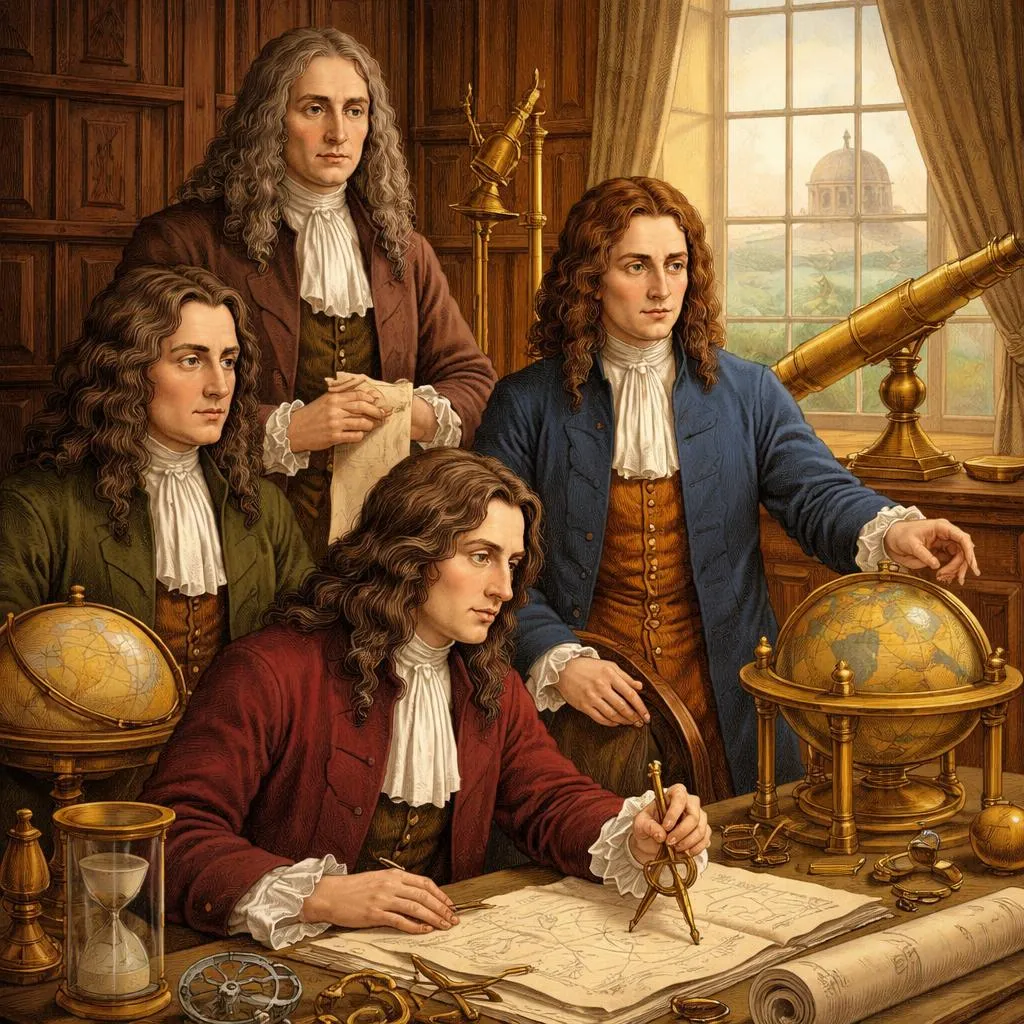

It was almost a matter of course that the English should at first have adopted the notation of Newton in the infinitesimal calculus in preference to that of Leibnitz and consequently the English school would in any case have developed on somewhat different lines to that on the continent, where a knowledge of the infinitesimal calculus was derived solely from Leibnitz and the Bernoullis. But this separation into two distinct schools became very marked owing to the action of Leibnitz and John Bernoulli, which was naturally resented by Newton's friends; and so for forty or fifty years, to the disadvantage of both sides, the quarrel raged. The leading members of the English school were Cotes, Demoivre, Ditton, David Gregory, Halley, Maclaurin, Simpson, and Taylor. I may, however, again remind my readers that as we approach modern times the number of capable mathematicians in Britain, France, Germany and Italy becomes very considerable, but that in a popular sketch like this book it is only the leading men whom I propose to mention.
To David Gregory, Halley and Ditton I need devote but few words.
David Gregory
David Gregory, the nephew of the James Gregory mentioned above, born at Aberdeen on June 24, 1661, and died at Maidenhead on Oct. 10, 1708, was appointed professor at Edinburgh in 1684, and in 1691 was on Newton's recommendation elected Savilian professor at Oxford. His chief works are one on geometry, issued in 1684; one on optics, published in 1695, which contains [p. 98] the earliest suggestion of the possibility of making an achromatic combinations of lenses; and one on the Newtonian geometry, physics, and astronomy, issued in 1702.
Halley
Edmund Halley, born in London in 1656, and died at Greenwich in 1742, was educated at St. Paul's School, London, and Queen's College, Oxford, in 1703 succeeded Wallis as Savilian professor, and subsequently in 1720 was appointed astronomer-royal in succession to Flamsteed, whose Historia Coelestis Britannica he edited; the first and imperfect edition was issued in 1712. Halley's name will be recollected for the generous manner in which he secured the immediate publication of Newton's Principia in 1687. Most of his original work was on astronomy and allied subjects, and lies outside the limits of this book; it may be, however, said that the work is of excellent quality, and both Lalande and Mairan speak of it in the highest terms. Halley conjecturally restored the eighth and lost book of the conics of Apollonius, and in 1710 brought out a magnificent edition of the whole work; he also edited the works of Serenus, those of Menelaus, and some of the minor works of Apollonius. He was in his turn succeeded at Greenwich as astronomer-royal by Bradley.
Ditton
Humphry Ditton was born at Salisbury on May 29, 1675, and died in London in 1715 at Christ's Hospital, where he was mathematical master. He does not seem to have paid much attention to mathematics until he came to London about 1705, and his early death was a distinct loss to English science. He published in 1706 a text book on fluxions; this and another similar work by William Jones, which was issued in 1711, occupied in England much the same place as l'Hospital's treatise did in France. In 1709 Ditton issued an algebra, and in 1712 a treatise on perspective. He also wrote numerous papers in the Philosophical Transactions . He was the earliest writer to attempt to explain the phenomenon of capillarity on mathematical principles; and he invented a method for finding the longditude, which has been since used on various occasions.
Cotes
Roger Cotes was born near Leicester on July 10, 1682, and died at Cambridge on June 5, 1716. He was educated at Trinity College, Cambridge, of which society he was a fellow, and in 1706 was elected to the newly-created Plumian chair of astronomy in the university of Cambridge. From 1709 to 1713 his time was mainly occupied in editing the second edition of the Principia . The remark of Newton that if only Cotes had lived "we might have known something" indicates the opinion of his abilities held by most of his contemporaries.
Cotes's writings were collected and published in 1722 under the titles Harmonia Mensurarum and Opera Miscellanea . His lectures on hydrostatics were published in 1738. A large part of the Harmonia Mensurarum is given up to the decomposition and integration of rational algebraical expressions. That part which deals with the theory of partial fractions was left unfinished, but was completed by de Moivre. Cotes's theorem in trigonometry, which depends on forming the quadratic factors of x n - 1, is well known. The proposition that "if from a fixed point O a line be drawn cutting a curve in Q 1 , Q 2 , ... , Q n , and a point P be taken on the line so that the reciprocal of OP is the arithmetic mean of the reciprocals of OQ 1 , OQ 2 , ... , OQ n , then the locus of P will be a straight line" is also due to Cotes. The title of the book was derived from the latter theorem. The Opera Miscellanea contains a paper on the method for determining the most probable result from a number of observations. This was the earliest attempt to frame a theory of errors. It also contains essays on Newton's Methodus Differentialis , on the construction of tables by the method of differences, on the descent of a body under gravity, on the cycloidal pendulum, and on projectiles.
de Moivre
Abraham de Moivre was born at Vitry on May 26, 1667, and died in London on November 27, 1754. His parents came to England when he was a boy, and his education and friends were alike English. His interest in the higher mathematics is said to have originated in his coming by chance across a copy of Newton's Principia . From the éloge on him delivered in 1754 before the French Academy it would seem that his work as a teacher of mathematics had led him to the house of the Earl of Devonshire at the instant when Newton, who had asked permission to present a copy of his work to the earl, was coming out. Taking up the book, and charmed by the far-reaching conclusions and the apparent simplicity of the reasoning, de Moivre thought nothing would be easier than to master the subject, but to his surprise found that to follow the argument overtaxed his powers. He, however, bought a copy, and as he had but little leisure he tore out the pages in order to carry one or two of them loose in his pocket so that he could study them in the intervals of his work as a teacher. Subsequently he joined the Royal Society, and became intimately connected with Newton, Halley, and other mathematicians of the English school. The manner of his death has a certain interest for psychologists. Shortly before it he declared that it was necessary for him to sleep some ten minutes or a quarter of an hour longer each day than the preceding one. The day after he had thus reached a total of something over twenty-three hours he slept up to the limit of twenty-four hours, and then died in his sleep.
He is best known for having, together with Lambert, created that part of trigonometry which deals with imaginary quantities. Two theorems on this part of the subject are still connected with his name, namely, that which asserts that sin nx + i cos nx is one of the values of (sin x + i cos x ) n , and that which gives the various quadratic factors of x 2 n - 2 px n + 1. His chief works, other than numerous papers in the Philosophical Transactions , were The Doctrine of Chances , published in 1718, and the Miscellanea Analytica , published in 1730. In the former the theory of recurring series was first given, and the theory of partial fractions which Cotes's premature death had left unfinished was completed, while the rule for finding the probability of a compound event was enunciated. The latter book, besides the trigonometrical propositions mentioned above, contains some theorems in astronomy, but they are treated as problems in analysis.
Stewart
Maclaurin was succeeded in his chair at Edinburgh by his pupil Matthew Stewart, born at Rothesay in 1717 and died at Edinburgh on January 23, 1785, a mathematician of considerable power, to whom I allude in passing, for his theorems on the problem of three bodies, and for his discussion, treated by transversals and involution, of the properties of the circle and straight line.
Contexto Histórico e Antecedentes
Este texto oferece um vislumbre fascinante do desenvolvimento da matemática e da astronomia na Grã-Bretanha durante o final do século XVII e início do século XVIII. Descreve a rivalidade entre as escolas inglesa e continental de cálculo, com foco nos seguidores de Isaac Newton e Gottfried Wilhelm Leibniz. Essa rivalidade moldou o curso do pensamento matemático por décadas. As figuras mencionadas — David Gregory, Edmund Halley, Humphry Ditton, Roger Cotes, Abraham de Moivre e Matthew Stewart — foram contribuintes-chave para o avanço da ciência e da matemática durante esse período.
Sobre os Autores e Matemáticos
- Isaac Newton (1643–1727): Embora não detalhado aqui, o trabalho de Newton lançou as bases para grande parte do cálculo e da física discutidos. Sua "Principia Mathematica" revolucionou a compreensão do movimento e da gravidade.
- David Gregory (1661–1708): Um matemático e astrônomo que contribuiu para a geometria e a óptica, incluindo ideias iniciais sobre lentes acromáticas.
- Edmund Halley (1656–1742): Famoso pelo Cometa Halley, ele também foi fundamental na publicação do trabalho de Newton e fez contribuições significativas para a astronomia.
- Humphry Ditton (1675–1715): Conhecido por seus livros didáticos sobre fluxões (cálculo) e álgebra, e por trabalhos iniciais sobre capilaridade e cálculo da longitude.
- Roger Cotes (1682–1716): Editor da segunda edição do Principia de Newton, conhecido por importantes teoremas em trigonometria e trabalhos iniciais sobre a teoria dos erros.
- Abraham de Moivre (1667–1754): Um pioneiro na teoria da probabilidade e trigonometria envolvendo números imaginários, seu trabalho lançou as bases para a estatística.
- Matthew Stewart (1717–1785): Conhecido por seu trabalho sobre o problema dos três corpos e propriedades geométricas.
Interpretação Detalhada e Significado
Esta coleção de biografias e realizações destaca a natureza colaborativa e, por vezes, competitiva do progresso científico. A preferência da escola inglesa pela notação de Newton influenciou a direção do cálculo na Grã-Bretanha, enquanto os matemáticos continentais seguiram a abordagem de Leibniz. A disputa entre essas escolas retardou o progresso, mas também aprimorou o rigor matemático.
Os trabalhos mencionados — que vão da geometria e óptica à astronomia e probabilidade — mostram como esses campos estavam interconectados. Por exemplo, os esforços de Halley garantiram que as ideias revolucionárias de Newton chegassem a um público mais amplo, enquanto a teoria da probabilidade de de Moivre tornou-se fundamental para a estatística e a análise de risco hoje.
Lições e Insights para Estudantes
- Persistência e Curiosidade: Muitos desses matemáticos enfrentaram desafios, desde disputas intelectuais até dificuldades pessoais. Sua persistência em estudar problemas complexos ensina aos alunos o valor da dedicação.
- Aprendizagem Interdisciplinar: A mistura de geometria, física, astronomia e probabilidade ilustra a importância de conectar diferentes campos para resolver problemas.
- Colaboração e Respeito: Apesar das rivalidades, esses estudiosos frequentemente construíram sobre o trabalho uns dos outros. Isso mostra a importância de respeitar as contribuições dos outros e trabalhar em conjunto.
- Inovação e Pensamento Crítico: A abordagem de De Moivre aos números imaginários e à probabilidade demonstra como o pensamento inovador pode abrir novas áreas de conhecimento.
- Aplicações Práticas: De melhorar a navegação calculando a longitude à compreensão da capilaridade, essas descobertas tiveram impactos no mundo real, incentivando os alunos a ver a relevância da matemática e da ciência.
Aplicando Essas Lições na Vida Diária
- Na Aprendizagem: Emule a curiosidade e a disciplina desses matemáticos, abordando assuntos desafiadores passo a passo e buscando entender suas aplicações no mundo real.
- Em Ambientes Sociais: Aprecie diversos pontos de vista e colabore com respeito, reconhecendo que o progresso muitas vezes vem do esforço compartilhado.
- Na Resolução de Problemas: Use abordagens interdisciplinares — combine conhecimentos de diferentes áreas para encontrar soluções criativas.
- No Crescimento Pessoal: Desenvolva paciência e persistência, sabendo que a maestria leva tempo e esforço.
Cultivando Traços Positivos a Partir Dessas Histórias
Os alunos podem aprender a valorizar a aprendizagem ao longo da vida, abraçar desafios e manter a humildade intelectual. As histórias incentivam a abraçar novas ideias, mesmo quando difíceis, e destacam a importância de contribuir para uma comunidade maior de conhecimento.
Ao estudar essas figuras históricas e seus trabalhos, os alunos não apenas adquirem conhecimento matemático, mas também inspiração para seguir seus próprios caminhos em ciência, tecnologia, engenharia e matemática (STEM), fomentando uma mentalidade que valoriza a curiosidade, a colaboração e a perseverança.
