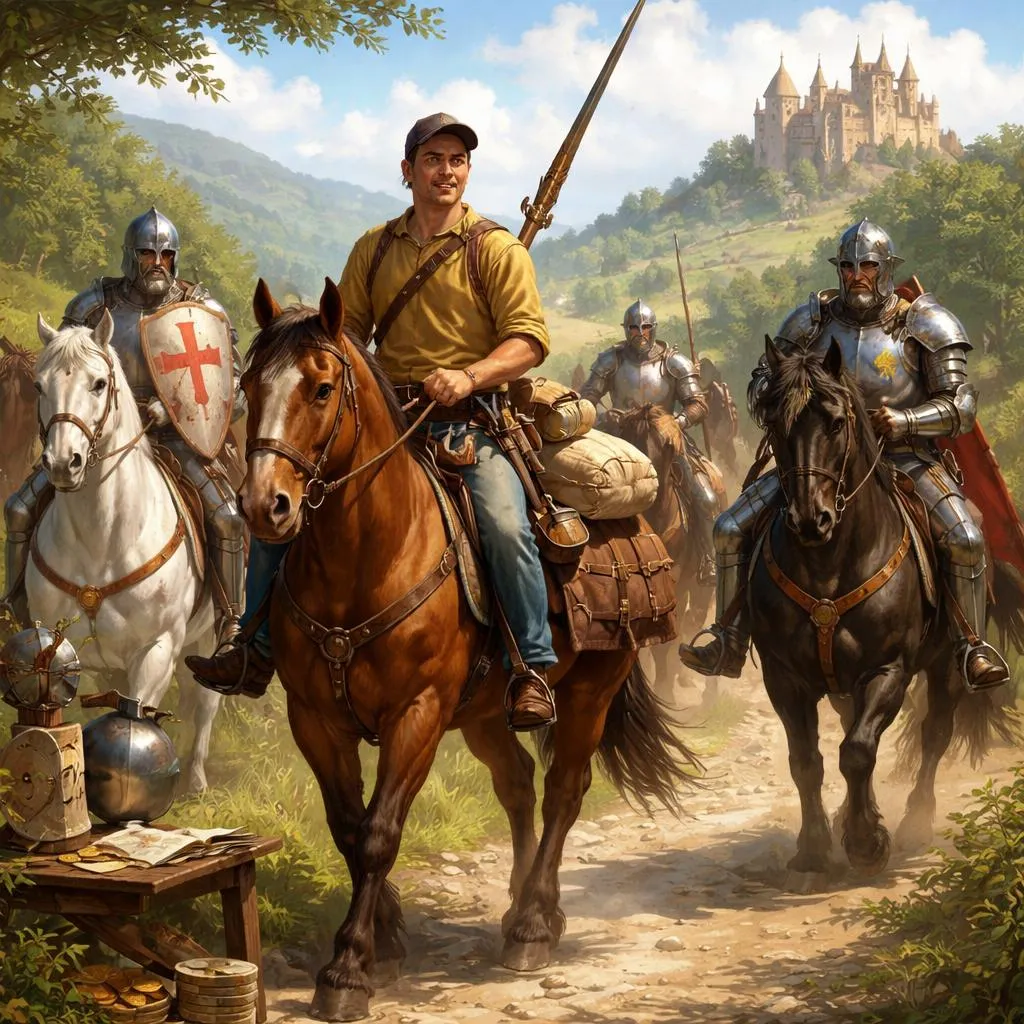

Sandy and I were on the road again, next morning, bright and early. It was so good to open up one’s lungs and take in whole luscious barrels-ful of the blessed God’s untainted, dew-fashioned, woodland-scented air once more, after suffocating body and mind for two days and nights in the moral and physical stenches of that intolerable old buzzard-roost! I mean, for me: of course the place was all right and agreeable enough for Sandy, for she had been used to high life all her days.
Poor girl, her jaws had had a wearisome rest now for a while, and I was expecting to get the consequences. I was right; but she had stood by me most helpfully in the castle, and had mightily supported and reinforced me with gigantic foolishnesses which were worth more for the occasion than wisdoms double their size; so I thought she had earned a right to work her mill for a while, if she wanted to, and I felt not a pang when she started it up:
“Now turn we unto Sir Marhaus that rode with the damsel of thirty winter of age southward—”
“Are you going to see if you can work up another half-stretch on the trail of the cowboys, Sandy?”
“Even so, fair my lord.”
“Go ahead, then. I won’t interrupt this time, if I can help it. Begin over again; start fair, and shake out all your reefs, and I will load my pipe and give good attention.”
“Now turn we unto Sir Marhaus that rode with the damsel of thirty winter of age southward. And so they came into a deep forest, and by fortune they were nighted, and rode along in a deep way, and at the last they came into a courtelage where abode the duke of South Marches, and there they asked harbour. And on the morn the duke sent unto Sir Marhaus, and bad him make him ready. And so Sir Marhaus arose and armed him, and there was a mass sung afore him, and he brake his fast, and so mounted on horseback in the court of the castle, there they should do the battle. So there was the duke already on horseback, clean armed, and his six sons by him, and every each had a spear in his hand, and so they encountered, whereas the duke and his two sons brake their spears upon him, but Sir Marhaus held up his spear and touched none of them. Then came the four sons by couples, and two of them brake their spears, and so did the other two. And all this while Sir Marhaus touched them not. Then Sir Marhaus ran to the duke, and smote him with his spear that horse and man fell to the earth. And so he served his sons. And then Sir Marhaus alight down, and bad the duke yield him or else he would slay him. And then some of his sons recovered, and would have set upon Sir Marhaus. Then Sir Marhaus said to the duke, Cease thy sons, or else I will do the uttermost to you all. When the duke saw he might not escape the death, he cried to his sons, and charged them to yield them to Sir Marhaus. And they kneeled all down and put the pommels of their swords to the knight, and so he received them. And then they holp up their father, and so by their common assent promised unto Sir Marhaus never to be foes unto King Arthur, and thereupon at Whitsuntide after, to come he and his sons, and put them in the king’s grace.*
[*Footnote: The story is borrowed, language and all, from the Morte d’Arthur.—M.T.]
“Even so standeth the history, fair Sir Boss. Now ye shall wit that that very duke and his six sons are they whom but few days past you also did overcome and send to Arthur’s court!”
“Why, Sandy, you can’t mean it!”
“An I speak not sooth, let it be the worse for me.”
“Well, well, well,—now who would ever have thought it? One whole duke and six dukelets; why, Sandy, it was an elegant haul. Knight-errantry is a most chuckle-headed trade, and it is tedious hard work, too, but I begin to see that there is money in it, after all, if you have luck. Not that I would ever engage in it as a business, for I wouldn’t. No sound and legitimate business can be established on a basis of speculation. A successful whirl in the knight-errantry line—now what is it when you blow away the nonsense and come down to the cold facts? It’s just a corner in pork, that’s all, and you can’t make anything else out of it. You’re rich—yes,—suddenly rich—for about a day, maybe a week; then somebody corners the market on you , and down goes your bucket-shop; ain’t that so, Sandy?”
“Whethersoever it be that my mind miscarrieth, bewraying simple language in such sort that the words do seem to come endlong and overthwart—”
“There’s no use in beating about the bush and trying to get around it that way, Sandy, it’s so, just as I say. I know it’s so. And, moreover, when you come right down to the bedrock, knight-errantry is worse than pork; for whatever happens, the pork’s left, and so somebody’s benefited anyway; but when the market breaks, in a knight-errantry whirl, and every knight in the pool passes in his checks, what have you got for assets? Just a rubbish-pile of battered corpses and a barrel or two of busted hardware. Can you call those assets? Give me pork, every time. Am I right?”
“Ah, peradventure my head being distraught by the manifold matters whereunto the confusions of these but late adventured haps and fortunings whereby not I alone nor you alone, but every each of us, meseemeth—”
“No, it’s not your head, Sandy. Your head’s all right, as far as it goes, but you don’t know business; that’s where the trouble is. It unfits you to argue about business, and you’re wrong to be always trying. However, that aside, it was a good haul, anyway, and will breed a handsome crop of reputation in Arthur’s court. And speaking of the cowboys, what a curious country this is for women and men that never get old. Now there’s Morgan le Fay, as fresh and young as a Vassar pullet, to all appearances, and here is this old duke of the South Marches still slashing away with sword and lance at his time of life, after raising such a family as he has raised. As I understand it, Sir Gawaine killed seven of his sons, and still he had six left for Sir Marhaus and me to take into camp. And then there was that damsel of sixty winter of age still excursioning around in her frosty bloom—How old are you, Sandy?”
It was the first time I ever struck a still place in her. The mill had shut down for repairs, or something.
Antecedentes e Introdução do Autor
Este trecho é extraído de uma história inspirada na Morte d’Arthur, uma famosa coleção de lendas arturianas compilada por Sir Thomas Malory no século XV. A obra de Malory é uma das fontes mais importantes para os contos do Rei Arthur, seus cavaleiros e as aventuras cavalheirescas que moldaram a literatura e a cultura ocidental. A Morte d’Arthur mistura história, mito e romance, apresentando contos de bravura, lealdade, honra e tragédia. A história aqui envolve Sir Marhaus, um cavaleiro da Távola Redonda, e retrata uma batalha cavalheiresca clássica e temas de honra e reconciliação.
Interpretação Detalhada e Significado
A passagem captura o espírito da cavalaria andante medieval — cavaleiros viajando, buscando aventura e se envolvendo em batalhas para defender a justiça e a lealdade. O encontro de Sir Marhaus com o Duque de South Marches e seus filhos é um exemplo vívido dos desafios que os cavaleiros enfrentavam: combate físico, testes de coragem e a busca pela paz através da força. A história também contrasta o idealismo da cavalaria com as duras realidades da vida, pois o narrador reflete sobre a natureza fugaz do sucesso e o "negócio" da cavalaria andante.
O diálogo entre o narrador e Sandy adiciona uma perspectiva moderna, um tanto humorística, sobre os contos antigos. Ele destaca a tensão entre os ideais românticos e as realidades práticas, um tema que ressoa com leitores de todas as idades. A menção de personagens como Morgana Le Fay e Sir Gawaine amarra este episódio ao mito arturiano maior, enriquecendo a tapeçaria de lendas.
Lições e Insights para Estudantes
-
Coragem e Honra: Os cavaleiros demonstram bravura em batalha e honra na vitória e na derrota. Os alunos podem aprender a importância de defender o que é certo, enfrentar desafios com bravura e tratar os outros com respeito, mesmo em conflitos.
-
Lealdade e Reconciliação: A história termina com o duque derrotado e seus filhos prometendo lealdade ao Rei Arthur, mostrando que a verdadeira força inclui a capacidade de perdoar e reconciliar. Isso ensina o valor de resolver disputas pacificamente e manter alianças.
-
Realidade vs. Idealismo: As reflexões do narrador lembram aos alunos que, embora os ideais sejam importantes, entender o lado prático da vida é igualmente crucial. Esse equilíbrio é fundamental para tomar decisões sábias na escola, nas amizades e nas futuras carreiras.
-
O Poder da Narrativa: A narrativa de Sandy, apesar de suas "tolices gigantescas", apoia e encoraja o narrador. Isso mostra como as histórias podem inspirar, confortar e nos ensinar, mesmo quando parecem fantasiosas.
Aplicando Essas Lições na Vida Diária
-
No Aprendizado: Abrace os desafios como os cavaleiros fazem, com coragem e determinação. Quando enfrentar assuntos difíceis, persista e procure ajuda, sabendo que o esforço leva ao crescimento.
-
Em Situações Sociais: Pratique a lealdade e a justiça nas amizades. Quando surgirem conflitos, busque a reconciliação e a compreensão em vez de hostilidade prolongada.
-
No Crescimento Pessoal: Equilibre sonhos com a realidade. Defina metas, mas esteja preparado para se adaptar e aprender com os contratempos, assim como a visão do narrador sobre o "negócio" da cavalaria andante.
-
Na Criatividade: Use a narrativa como uma ferramenta para se expressar e se conectar com os outros. Como Sandy, sua imaginação pode ser uma fonte de força e alegria.
Cultivando Traços Positivos da História
-
Bravura: Enfrente medos e desafios de frente, seja em falar em público, em exames ou em situações sociais.
-
Respeito: Honre as opiniões e origens dos outros, promovendo uma comunidade de apoio.
-
Sabedoria: Aprenda com sucessos e fracassos, entendendo que cada experiência contribui para o seu crescimento.
-
Imaginação: Mantenha sua criatividade viva; ela pode ajudar a resolver problemas e enriquecer sua vida.
Conclusão
Esta passagem de um conto inspirado em Artur oferece material rico para os alunos explorarem temas atemporais de coragem, honra, lealdade e o equilíbrio entre idealismo e realidade. Ao refletir sobre essas histórias, os jovens leitores podem obter insights valiosos que se aplicam não apenas à literatura, mas também à vida cotidiana, ajudando-os a se tornarem indivíduos atenciosos, corajosos e compassivos.
