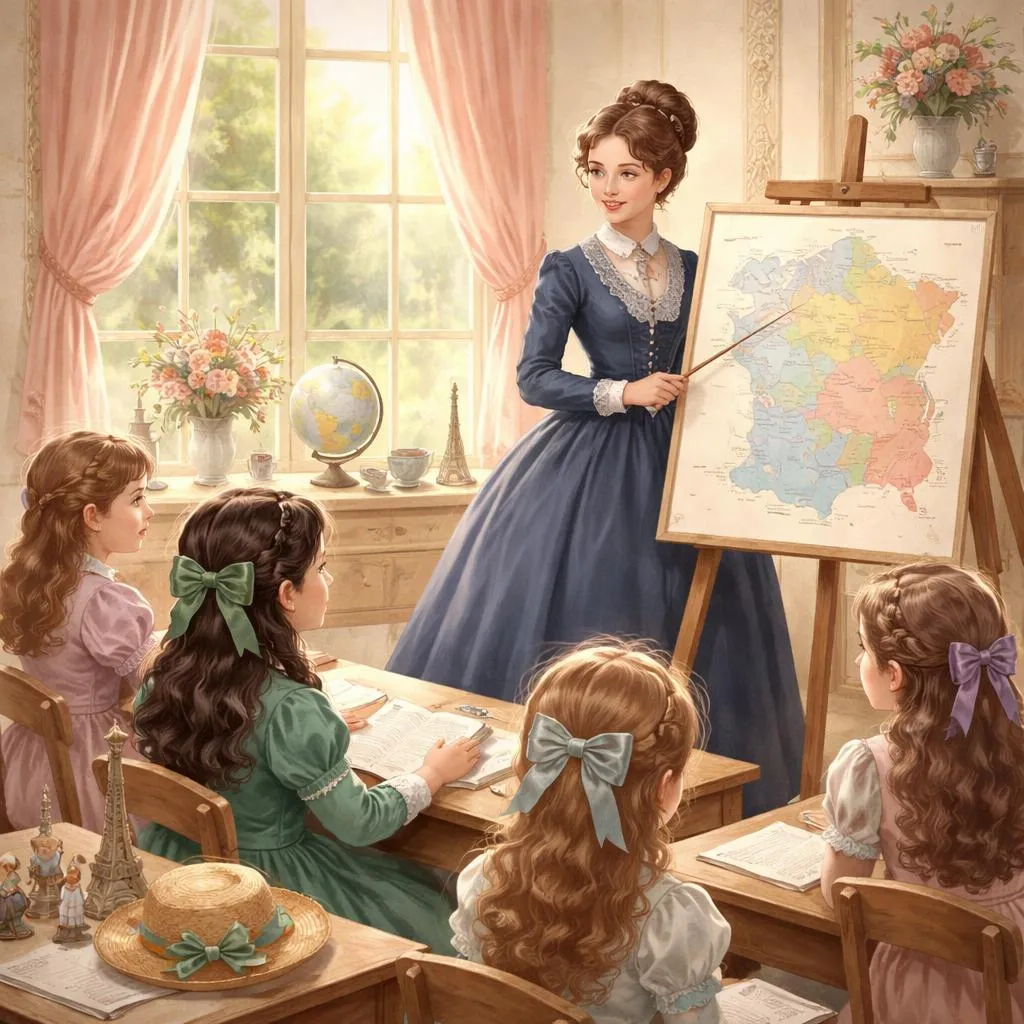

When Sara entered the schoolroom the next morning everybody looked at her with wide, interested eyes. By that time every pupil— from Lavinia Herbert, who was nearly thirteen and felt quite grown up, to Lottie Legh, who was only just four and the baby of the school— had heard a great deal about her. They knew very certainly that she was Miss Minchin’s show pupil and was considered a credit to the establishment. One or two of them had even caught a glimpse of her French maid, Mariette, who had arrived the evening before. Lavinia had managed to pass Sara’s room when the door was open, and had seen Mariette opening a box which had arrived late from some shop.
“It was full of petticoats with lace frills on them—frills and frills,” she whispered to her friend Jessie as she bent over her geography. “I saw her shaking them out. I heard Miss Minchin say to Miss Amelia that her clothes were so grand that they were ridiculous for a child. My mamma says that children should be dressed simply. She has got one of those petticoats on now. I saw it when she sat down.”
“She has silk stockings on!” whispered Jessie, bending over her geography also. “And what little feet! I never saw such little feet.”
“Oh,” sniffed Lavinia, spitefully, “that is the way her slippers are made. My mamma says that even big feet can be made to look small if you have a clever shoemaker. I don’t think she is pretty at all. Her eyes are such a queer color.”
“She isn’t pretty as other pretty people are,” said Jessie, stealing a glance across the room; “but she makes you want to look at her again. She has tremendously long eyelashes, but her eyes are almost green.”
Sara was sitting quietly in her seat, waiting to be told what to do. She had been placed near Miss Minchin’s desk. She was not abashed at all by the many pairs of eyes watching her. She was interested and looked back quietly at the children who looked at her. She wondered what they were thinking of, and if they liked Miss Minchin, and if they cared for their lessons, and if any of them had a papa at all like her own. She had had a long talk with Emily about her papa that morning.
“He is on the sea now, Emily,” she had said. “We must be very great friends to each other and tell each other things. Emily, look at me. You have the nicest eyes I ever saw—but I wish you could speak.”
She was a child full of imaginings and whimsical thoughts, and one of her fancies was that there would be a great deal of comfort in even pretending that Emily was alive and really heard and understood. After Mariette had dressed her in her dark-blue schoolroom frock and tied her hair with a dark-blue ribbon, she went to Emily, who sat in a chair of her own, and gave her a book.
“You can read that while I am downstairs,” she said; and, seeing Mariette looking at her curiously, she spoke to her with a serious little face.
“What I believe about dolls,” she said, “is that they can do things they will not let us know about. Perhaps, really, Emily can read and talk and walk, but she will only do it when people are out of the room. That is her secret. You see, if people knew that dolls could do things, they would make them work. So, perhaps, they have promised each other to keep it a secret. If you stay in the room, Emily will just sit there and stare; but if you go out, she will begin to read, perhaps, or go and look out of the window. Then if she heard either of us coming, she would just run back and jump into her chair and pretend she had been there all the time.”
“Comme elle est drole!” Mariette said to herself, and when she went downstairs she told the head housemaid about it. But she had already begun to like this odd little girl who had such an intelligent small face and such perfect manners. She had taken care of children before who were not so polite. Sara was a very fine little person, and had a gentle, appreciative way of saying, “If you please, Mariette,” “Thank you, Mariette,” which was very charming. Mariette told the head housemaid that she thanked her as if she was thanking a lady.
“Elle a l’air d’une princesse, cette petite,” she said. Indeed, she was very much pleased with her new little mistress and liked her place greatly.
After Sara had sat in her seat in the schoolroom for a few minutes, being looked at by the pupils, Miss Minchin rapped in a dignified manner upon her desk.
“Young ladies,” she said, “I wish to introduce you to your new companion.” All the little girls rose in their places, and Sara rose also. “I shall expect you all to be very agreeable to Miss Crewe; she has just come to us from a great distance—in fact, from India. As soon as lessons are over you must make each other’s acquaintance.”
The pupils bowed ceremoniously, and Sara made a little curtsy, and then they sat down and looked at each other again.
“Sara,” said Miss Minchin in her schoolroom manner, “come here to me.”
She had taken a book from the desk and was turning over its leaves. Sara went to her politely.
“As your papa has engaged a French maid for you,” she began, “I conclude that he wishes you to make a special study of the French language.”
Sara felt a little awkward.
“I think he engaged her,” she said, “because he—he thought I would like her, Miss Minchin.”
“I am afraid,” said Miss Minchin, with a slightly sour smile, “that you have been a very spoiled little girl and always imagine that things are done because you like them. My impression is that your papa wished you to learn French.”
If Sara had been older or less punctilious about being quite polite to people, she could have explained herself in a very few words. But, as it was, she felt a flush rising on her cheeks. Miss Minchin was a very severe and imposing person, and she seemed so absolutely sure that Sara knew nothing whatever of French that she felt as if it would be almost rude to correct her. The truth was that Sara could not remember the time when she had not seemed to know French. Her father had often spoken it to her when she had been a baby. Her mother had been a French woman, and Captain Crewe had loved her language, so it happened that Sara had always heard and been familiar with it.
“I—I have never really learned French, but—but—” she began, trying shyly to make herself clear.
One of Miss Minchin’s chief secret annoyances was that she did not speak French herself, and was desirous of concealing the irritating fact. She, therefore, had no intention of discussing the matter and laying herself open to innocent questioning by a new little pupil.
“That is enough,” she said with polite tartness. “If you have not learned, you must begin at once. The French master, Monsieur Dufarge, will be here in a few minutes. Take this book and look at it until he arrives.”
Sara’s cheeks felt warm. She went back to her seat and opened the book. She looked at the first page with a grave face. She knew it would be rude to smile, and she was very determined not to be rude. But it was very odd to find herself expected to study a page which told her that “le pere” meant “the father,” and “la mere” meant “the mother.”
Miss Minchin glanced toward her scrutinizingly.
“You look rather cross, Sara,” she said. “I am sorry you do not like the idea of learning French.”
“I am very fond of it,” answered Sara, thinking she would try again; “but—”
“You must not say `but’ when you are told to do things,” said Miss Minchin. “Look at your book again.”
And Sara did so, and did not smile, even when she found that “le fils” meant “the son,” and “le frere” meant “the brother.”
“When Monsieur Dufarge comes,” she thought, “I can make him understand.”
Monsieur Dufarge arrived very shortly afterward. He was a very nice, intelligent, middle-aged Frenchman, and he looked interested when his eyes fell upon Sara trying politely to seem absorbed in her little book of phrases.
“Is this a new pupil for me, madame?” he said to Miss Minchin. “I hope that is my good fortune.”
“Her papa—Captain Crewe—is very anxious that she should begin the language. But I am afraid she has a childish prejudice against it. She does not seem to wish to learn,” said Miss Minchin.
“I am sorry of that, mademoiselle,” he said kindly to Sara. “Perhaps, when we begin to study together, I may show you that it is a charming tongue.”
Little Sara rose in her seat. She was beginning to feel rather desperate, as if she were almost in disgrace. She looked up into Monsieur Dufarge’s face with her big, green-gray eyes, and they were quite innocently appealing. She knew that he would understand as soon as she spoke. She began to explain quite simply in pretty and fluent French. Madame had not understood. She had not learned French exactly—not out of books—but her papa and other people had always spoken it to her, and she had read it and written it as she had read and written English. Her papa loved it, and she loved it because he did. Her dear mamma, who had died when she was born, had been French. She would be glad to learn anything monsieur would teach her, but what she had tried to explain to madame was that she already knew the words in this book— and she held out the little book of phrases.
When she began to speak Miss Minchin started quite violently and sat staring at her over her eyeglasses, almost indignantly, until she had finished. Monsieur Dufarge began to smile, and his smile was one of great pleasure. To hear this pretty childish voice speaking his own language so simply and charmingly made him feel almost as if he were in his native land—which in dark, foggy days in London sometimes seemed worlds away. When she had finished, he took the phrase book from her, with a look almost affectionate. But he spoke to Miss Minchin.
“Ah, madame,” he said, “there is not much I can teach her. She has not learned French; she is French. Her accent is exquisite.”
“You ought to have told me,” exclaimed Miss Minchin, much mortified, turning to Sara.
“I—I tried,” said Sara. “I—I suppose I did not begin right.”
Miss Minchin knew she had tried, and that it had not been her fault that she was not allowed to explain. And when she saw that the pupils had been listening and that Lavinia and Jessie were giggling behind their French grammars, she felt infuriated.
“Silence, young ladies!” she said severely, rapping upon the desk. “Silence at once!”
And she began from that minute to feel rather a grudge against her show pupil.
Contexto e Introdução da Autora
Esta passagem é de A Princesinha, um amado romance infantil escrito por Frances Hodgson Burnett, publicado pela primeira vez em 1905. Burnett foi uma autora britânica-americana renomada por suas obras que frequentemente exploram temas de infância, resiliência e bondade. A Princesinha conta a história de Sara Crewe, uma jovem que enfrenta dificuldades com dignidade e graça após perder seu pai rico e cair na pobreza. O romance é celebrado por seu rico desenvolvimento de personagens e sua ênfase no poder da imaginação e da força interior.
Interpretação Detalhada e Significado da História
Neste trecho, vemos Sara entrando em um novo ambiente escolar, onde ela é admirada e invejada por seus colegas. A cena destaca o histórico único de Sara — sua riqueza, sua empregada francesa e seus modos refinados — que a diferenciam das outras meninas. No entanto, Sara permanece humilde e composta, mostrando uma maturidade além de sua idade. A interação com a Srta. Minchin, a diretora rigorosa, introduz um conflito: a incompreensão da Srta. Minchin sobre o conhecimento de francês de Sara simboliza o tema mais amplo de julgamento e preconceito que Sara enfrenta.
A conversa imaginativa de Sara com sua boneca Emily revela sua natureza terna e criativa. Este momento ilustra como Sara lida com a solidão e a incerteza, criando um mundo secreto de conforto e companheirismo. A chegada do Sr. Dufarge, o professor de francês, e o discurso fluente de Sara em francês enfatizam ainda mais sua inteligência e riqueza cultural, contrastando fortemente com a estreiteza de espírito da Srta. Minchin.
Lições e Insights para Crianças e Estudantes
-
Resiliência e Graça sob Pressão: A calma de Sara diante do escrutínio e da incompreensão ensina aos jovens leitores a importância de manter a dignidade e o respeito próprio, mesmo quando os outros julgam injustamente.
-
O Poder da Imaginação: A crença de Sara de que sua boneca Emily pode secretamente ganhar vida incentiva as crianças a usar sua imaginação como fonte de conforto e criatividade, especialmente em tempos difíceis.
-
Apreciação Cultural e Aprendizado de Idiomas: A fluência de Sara em francês, apesar das suposições da Srta. Minchin, destaca o valor da diversidade cultural e os benefícios de aprender novos idiomas. Incentiva os alunos a abraçar e respeitar diferentes culturas.
-
Bondade e Polidez: Os modos gentis de Sara, como agradecer a Mariette com respeito, mostram como a bondade e a polidez podem influenciar positivamente os relacionamentos e criar boa vontade.
Aplicando Essas Lições na Vida Diária
-
Na Escola: Os alunos podem aprender a enfrentar desafios e mal-entendidos com paciência e confiança, assim como Sara. Ao encontrar professores ou colegas difíceis, manter a compostura e a polidez pode ajudar a manter um ambiente positivo.
-
Em Ambientes Sociais: As interações respeitosas de Sara nos lembram de tratar todos com bondade, independentemente de seu status. Isso ajuda a construir amizades e a ganhar respeito.
-
No Aprendizado: Abraçar novos idiomas e culturas amplia horizontes e promove a empatia. Os alunos devem ser incentivados a explorar diferentes idiomas e tradições para se tornarem mais abertos.
-
No Crescimento Pessoal: Usar a imaginação e a criatividade como Sara faz pode ser uma maneira saudável de lidar com o estresse ou a solidão. Escrever histórias, desenhar ou jogar jogos imaginativos pode nutrir o bem-estar emocional.
Cultivando Traços Positivos da História
-
Empatia: Compreender os sentimentos de Sara ajuda os alunos a desenvolver empatia por outras pessoas que podem ser diferentes ou incompreendidas.
-
Confiança: A autoconfiança silenciosa de Sara inspira as crianças a acreditar em suas próprias habilidades, mesmo quando os outros duvidam delas.
-
Curiosidade: O interesse de Sara por seus novos arredores e sua vontade de aprender francês mostram a importância da curiosidade e do amor pelo aprendizado.
-
Gratidão: As expressões polidas de agradecimento de Sara ensinam o valor de apreciar os esforços dos outros.
Conclusão
A Princesinha é mais do que uma história sobre uma garota rica na escola; é uma lição atemporal sobre bondade, resiliência e a força do espírito humano. Ao estudar as experiências de Sara, os jovens leitores podem obter informações valiosas sobre como enfrentar os desafios da vida com coragem e graça, como apreciar a diversidade cultural e como nutrir sua imaginação e empatia. Essas lições são essenciais não apenas para o sucesso acadêmico, mas também para construir relacionamentos significativos e levar uma vida compassiva.
