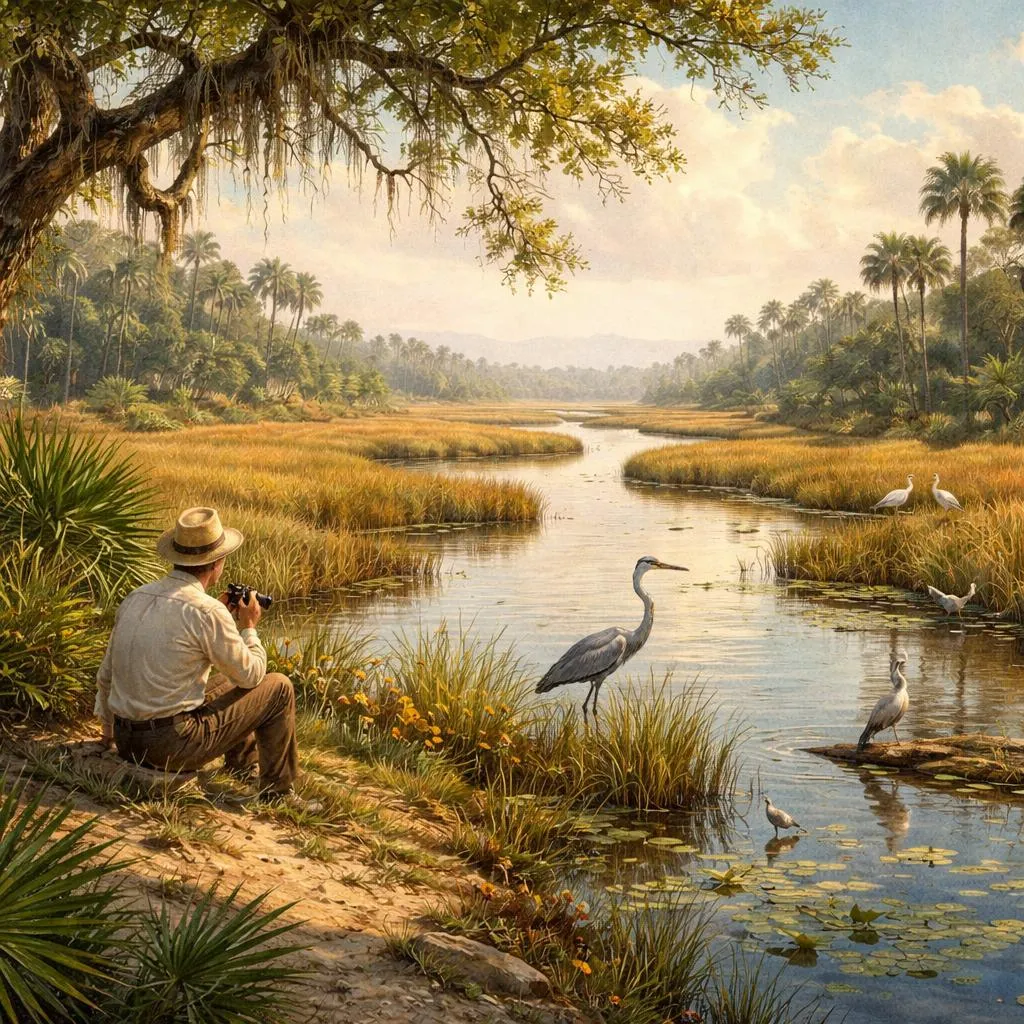

I am sitting upon the upland bank of a narrow winding creek. Before me is a sea of grass, brown and green of many shades. To the north themarsh is bounded by live-oak woods,—a line with numberlessindentations,—beyond which runs the Matanzas River, as I know by thepassing and repassing of sails behind the trees. Eastward aresand-hills, dazzling white in the sun, with a ragged green fringe alongtheir tops. Then comes a stretch of the open sea, and then, more to thesouth, St. Anastasia Island, with its tall black-and-white lighthouseand the cluster of lower buildings at its base. Small sailboats, and nowand then a tiny steamer, pass up and down the river to and from St.Augustine.
A delicious south wind is blowing (it is the 15th of February), and Isit in the shade of a cedar-tree and enjoy the air and the scene. Acontrast, this, to the frozen world I was living in, less than a weekago.
As I approached the creek, a single spotted sandpiper was teeteringalong the edge of the water, and the next moment a big blue heron rosejust beyond him and went flapping away to the middle of the marsh. Now,an hour afterward, he is still standing there, towering above the tallgrass. Once when I turned that way I saw, as I thought, a stake, andthen something moved upon it,—a bird of some kind. And what an enormousbeak! I raised my field-glass. It was the heron. His body was the post,and his head was the bird. Meanwhile, the sandpiper has stolen away, Iknow not when or where. He must have omitted the “tweet, tweet,” withwhich ordinarily he signalizes his flight. He is the first of his kindthat I have seen during my brief stay in these parts.
Now a multitude of crows pass over; fish crows, I think they must be,from their small size and their strange, ridiculous voices. And now asecond great blue heron comes in sight, and keeps on over the marsh andover the live-oak wood, on his way to the San Sebastian marshes, or somepoint still more remote. A fine show he makes, with his wide expanse ofwing, and his feet drawn up and standing out behind him. Next a marshhawk in brown plumage comes skimming over the grass. This way and thathe swerves in ever graceful lines. For one to whom ease and grace comeby nature, even the chase of meadow mice is an act of beauty, whileanother goes awkwardly though in pursuit of a goddess.
Several times I have noticed a kingfisher hovering above the grass (soit looks, but no doubt he is over an arm of the creek), striking the airwith quick strokes, and keeping his head pointed downward, after themanner of a tern. Then he disappeared while I was looking at somethingelse. Now I remark him sitting motionless upon the top of a post in themidst of the marsh.
A third blue heron appears, and he too flies over without stopping.Number One still keeps his place; through the glass I can see himdressing his feathers with his clumsy beak. The lively strain of awhite-eyed vireo, pertest of songsters, comes to me from somewhere on myright, and the soft chipping of myrtle warblers is all but incessant. Ilook up from my paper to see a turkey buzzard sailing majesticallynorthward. I watch him till he fades in the distance. Not once does heflap his wings, but sails and sails, going with the wind, yet turningagain and again to rise against it,—helping himself thus to itsadverse, uplifting pressure in the place of wing-strokes, perhaps,—andpassing onward all the while in beautiful circles. He, too, scavengerthough he is, has a genius for being graceful. One might almost bewilling to be a buzzard, to fly like that!
The kingfisher and the heron are still at their posts. An exquisiteyellow butterfly, of a sort strange to my Yankee eyes, flits past,followed by a red admiral. The marsh hawk is on the wing again, andwhile looking at him I descry a second hawk, too far away to be madeout. Now the air behind me is dark with crows,—a hundred or two, atleast, circling over the low cedars. Some motive they have for all theirclamor, but it passes my owlish wisdom to guess what it can be. A fourthblue heron appears, and drops into the grass out of sight.
Between my feet is a single blossom of the yellow oxalis, the onlyflower to be seen; and very pretty it is, each petal with an orange spotat the base.
Another buzzard, another marsh hawk, another yellow butterfly, and thena smaller one, darker, almost orange. It passes too quickly over thecreek and away. The marsh hawk comes nearer, and I see the strong yellowtinge of his plumage, especially underneath. He will grow handsomer ashe grows older. A pity the same could not be true of men. Behind me aresharp cries of titlarks. From the direction of the river come frequentreports of guns. Somebody is doing his best to be happy! All at once Iprick up my ears. From the grass just across the creek rises the brief,hurried song of a long-billed marsh wren. So he is in Florida, is he?Already I have heard confused noises which I feel sure are the work ofrails of some kind. No doubt there is abundant life concealed in thoseacres on acres of close grass.
The heron and the kingfisher are still quiet. Their morning hunt wassuccessful, and for to-day Fate cannot harm them. A buzzard, withnervous, rustling beats, goes directly above the low cedar under which Iam resting.
At last, after a siesta of two hours, the heron has changed his place. Ilooked up just in season to see him sweeping over the grass, into whichhe dropped the next instant. The tide is falling. The distant sand-hillsare winking in the heat, but the breeze is deliciously cool, the veryperfection of temperature, if a man is to sit still in the shade. It iseleven o’clock. I have a mile to go in the hot sun, and turn away. Butfirst I sweep the line once more with my glass. Yonder to the south aretwo more blue herons standing in the grass. Perhaps there are morestill. I sweep the line. Yes, far, far away I can see four heads in arow. Heads and necks rise above the grass. But so far away! Are theybirds, or only posts made alive by my imagination? I look again. Ibelieve I was deceived. They are nothing but stakes. See how in a rowthey stand. I smile at myself. Just then one of them moves, and anotheris pulled down suddenly into the grass. I smile again. “Ten great blueherons,” I say to myself.
All this has detained me, and meantime the kingfisher has taken wing andgone noisily up the creek. The marsh hawk appears once more. Akilldeer’s sharp, rasping note—a familiar sound in St. Augustine—comesfrom I know not where. A procession of more than twenty black vulturespasses over my head. I can see their feet drawn up under them. My own Imust use in plodding homeward.
Introdução e Apresentação do Autor
Esta narrativa vívida da natureza é uma observação detalhada de um ecossistema de pântano, capturando a beleza e a vida de um ambiente costeiro. O autor, cuja identidade não é especificada aqui, demonstra um olhar atento aos detalhes e uma profunda apreciação pela vida selvagem, particularmente pelas aves. Essa escrita descritiva é típica de escritores naturalistas que combinam observação científica com linguagem poética para dar vida à natureza para os leitores. Esse estilo incentiva os leitores, especialmente estudantes e jovens, a diminuir o ritmo e notar as pequenas maravilhas do mundo natural ao seu redor.
Interpretação Detalhada e Significado
A passagem fornece um instantâneo de um dia ensolarado e tranquilo em uma lagoa perto de St. Augustine, Flórida. A atenção cuidadosa do autor ao comportamento e à aparência das aves — as garças-azuis, os maçaricos, o martim-pescador, o gavião-do-banhado, o urubu-turco e outros — convida os leitores a apreciar a diversidade e a graça da vida selvagem. A narrativa também contrasta a cena quente e animada com a experiência recente do autor de uma paisagem de inverno congelada, enfatizando a renovação e a vibração da natureza em climas mais quentes.
A história não é apenas sobre pássaros, mas sobre a interconexão da vida e os ritmos silenciosos do mundo natural. Os movimentos, chamados e interações dos pássaros revelam um ecossistema complexo onde cada criatura desempenha um papel. As reflexões do autor sobre a beleza e a graça até mesmo de aves necrófagas como o urubu sugerem uma mensagem sobre encontrar valor e dignidade em todas as formas de vida.
Lições e Insights para Estudantes
-
Habilidades de Observação: As descrições detalhadas incentivam os alunos a desenvolver habilidades de observação cuidadosas. Notar pequenos detalhes — como as manchas laranja em uma pétala de flor ou o padrão de voo de um gavião — pode aprofundar a compreensão e a apreciação da natureza.
-
Paciência e Atenção Plena: O autor passa horas observando silenciosamente a lagoa, demonstrando paciência e atenção plena. Os alunos podem aprender a importância de diminuir o ritmo e estar presentes para realmente experimentar e aprender com seu ambiente.
-
Respeito pela Natureza: A narrativa promove o respeito pela vida selvagem e pelo meio ambiente. Compreender os papéis que os diferentes animais desempenham ajuda a construir um senso de responsabilidade pelo mundo natural.
-
Conexão com o Local: A conexão do autor com a lagoa e suas criaturas mostra como os lugares podem ter um significado especial. Os alunos podem ser incentivados a explorar e se conectar com seus ambientes locais.
Aplicações na Vida, Aprendizagem e Ambientes Sociais
-
Na Aprendizagem: Os alunos podem aplicar as técnicas de observação mostradas aqui aos estudos científicos, melhorando sua capacidade de registrar e interpretar dados. Esta história pode inspirar o diário da natureza ou estudos de campo.
-
Na Vida Social: O respeito por todas as criaturas, incluindo aquelas menos admiradas como os urubus, ensina empatia e aceitação da diversidade, traços valiosos nas relações sociais.
-
No Crescimento Pessoal: A paciência e a calma demonstradas podem ajudar os alunos a gerenciar o estresse e desenvolver práticas de atenção plena.
Cultivando Qualidades Positivas da História
-
Curiosidade e Admiração: Incentivar a curiosidade sobre o mundo natural pode levar à aprendizagem e descoberta ao longo da vida.
-
Paciência: Aprender a esperar e observar com atenção é uma habilidade que beneficia muitas áreas da vida.
-
Respeito e Empatia: Ver valor em todas as criaturas promove a bondade e a compreensão em relação aos outros.
-
Conexão com a Natureza: Passar tempo ao ar livre e observar a vida selvagem pode melhorar a saúde mental e promover a responsabilidade ambiental.
Conclusão
Esta passagem é um belo exemplo de escrita sobre a natureza que convida os jovens leitores a diminuir o ritmo, observar e apreciar o mundo vivo ao seu redor. Ela ensina lições valiosas sobre paciência, respeito e a beleza da vida em todas as suas formas. Ao se envolver com essas histórias, os alunos podem desenvolver habilidades e atitudes que enriquecem sua educação e vida pessoal, ajudando-os a se tornarem indivíduos atenciosos e carinhosos, conectados tanto à natureza quanto à comunidade.
