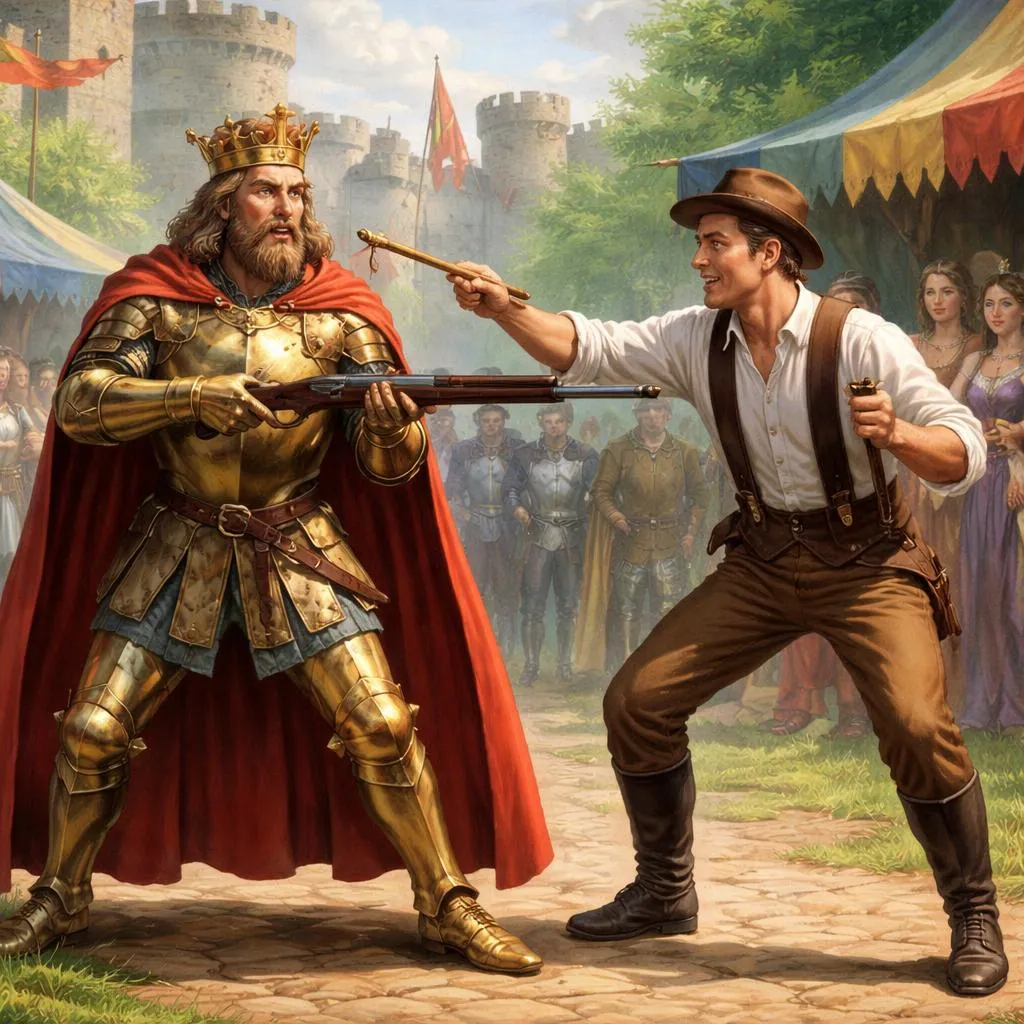

On the morning of the fourth day, when it was just sunrise, and we had been tramping an hour in the chill dawn, I came to a resolution: the king must be drilled; things could not go on so, he must be taken in hand and deliberately and conscientiously drilled, or we couldn’t ever venture to enter a dwelling; the very cats would know this masquerader for a humbug and no peasant. So I called a halt and said:
“Sire, as between clothes and countenance, you are all right, there is no discrepancy; but as between your clothes and your bearing, you are all wrong, there is a most noticeable discrepancy. Your soldierly stride, your lordly port—these will not do. You stand too straight, your looks are too high, too confident. The cares of a kingdom do not stoop the shoulders, they do not droop the chin, they do not depress the high level of the eye-glance, they do not put doubt and fear in the heart and hang out the signs of them in slouching body and unsure step. It is the sordid cares of the lowly born that do these things. You must learn the trick; you must imitate the trademarks of poverty, misery, oppression, insult, and the other several and common inhumanities that sap the manliness out of a man and make him a loyal and proper and approved subject and a satisfaction to his masters, or the very infants will know you for better than your disguise, and we shall go to pieces at the first hut we stop at. Pray try to walk like this.”
The king took careful note, and then tried an imitation.
“Pretty fair—pretty fair. Chin a little lower, please—there, very good. Eyes too high; pray don’t look at the horizon, look at the ground, ten steps in front of you. Ah—that is better, that is very good. Wait, please; you betray too much vigor, too much decision; you want more of a shamble. Look at me, please—this is what I mean.... Now you are getting it; that is the idea—at least, it sort of approaches it.... Yes, that is pretty fair. But! There is a great big something wanting, I don’t quite know what it is. Please walk thirty yards, so that I can get a perspective on the thing.... Now, then—your head’s right, speed’s right, shoulders right, eyes right, chin right, gait, carriage, general style right—everything’s right! And yet the fact remains, the aggregate’s wrong. The account don’t balance. Do it again, please.... Now I think I begin to see what it is. Yes, I’ve struck it. You see, the genuine spiritlessness is wanting; that’s what’s the trouble. It’s all amateur—mechanical details all right, almost to a hair; everything about the delusion perfect, except that it don’t delude.”
“What, then, must one do, to prevail?”
“Let me think... I can’t seem to quite get at it. In fact, there isn’t anything that can right the matter but practice. This is a good place for it: roots and stony ground to break up your stately gait, a region not liable to interruption, only one field and one hut in sight, and they so far away that nobody could see us from there. It will be well to move a little off the road and put in the whole day drilling you, sire.”
After the drill had gone on a little while, I said:
“Now, sire, imagine that we are at the door of the hut yonder, and the family are before us. Proceed, please—accost the head of the house.”
The king unconsciously straightened up like a monument, and said, with frozen austerity:
“Varlet, bring a seat; and serve to me what cheer ye have.”
“Ah, your grace, that is not well done.”
“In what lacketh it?”
“These people do not call each other varlets.”
“Nay, is that true?”
“Yes; only those above them call them so.”
“Then must I try again. I will call him villein.”
“No-no; for he may be a freeman.”
“Ah—so. Then peradventure I should call him goodman.”
“That would answer, your grace, but it would be still better if you said friend, or brother.”
“Brother!—to dirt like that?”
“Ah, but we are pretending to be dirt like that, too.”
“It is even true. I will say it. Brother, bring a seat, and thereto what cheer ye have, withal. Now ‘tis right.”
“Not quite, not wholly right. You have asked for one, not us —for one, not both; food for one, a seat for one.”
The king looked puzzled—he wasn’t a very heavy weight, intellectually. His head was an hour-glass; it could stow an idea, but it had to do it a grain at a time, not the whole idea at once.
“Would you have a seat also—and sit?”
“If I did not sit, the man would perceive that we were only pretending to be equals—and playing the deception pretty poorly, too.”
“It is well and truly said! How wonderful is truth, come it in whatsoever unexpected form it may! Yes, he must bring out seats and food for both, and in serving us present not ewer and napkin with more show of respect to the one than to the other.”
“And there is even yet a detail that needs correcting. He must bring nothing outside; we will go in—in among the dirt, and possibly other repulsive things,—and take the food with the household, and after the fashion of the house, and all on equal terms, except the man be of the serf class; and finally, there will be no ewer and no napkin, whether he be serf or free. Please walk again, my liege. There—it is better—it is the best yet; but not perfect. The shoulders have known no ignobler burden than iron mail, and they will not stoop.”
“Give me, then, the bag. I will learn the spirit that goeth with burdens that have not honor. It is the spirit that stoopeth the shoulders, I ween, and not the weight; for armor is heavy, yet it is a proud burden, and a man standeth straight in it.... Nay, but me no buts, offer me no objections. I will have the thing. Strap it upon my back.”
He was complete now with that knapsack on, and looked as little like a king as any man I had ever seen. But it was an obstinate pair of shoulders; they could not seem to learn the trick of stooping with any sort of deceptive naturalness. The drill went on, I prompting and correcting:
“Now, make believe you are in debt, and eaten up by relentless creditors; you are out of work—which is horse-shoeing, let us say—and can get none; and your wife is sick, your children are crying because they are hungry—”
And so on, and so on. I drilled him as representing in turn all sorts of people out of luck and suffering dire privations and misfortunes. But lord, it was only just words, words—they meant nothing in the world to him, I might just as well have whistled. Words realize nothing, vivify nothing to you, unless you have suffered in your own person the thing which the words try to describe. There are wise people who talk ever so knowingly and complacently about “the working classes,” and satisfy themselves that a day’s hard intellectual work is very much harder than a day’s hard manual toil, and is righteously entitled to much bigger pay. Why, they really think that, you know, because they know all about the one, but haven’t tried the other. But I know all about both; and so far as I am concerned, there isn’t money enough in the universe to hire me to swing a pickaxe thirty days, but I will do the hardest kind of intellectual work for just as near nothing as you can cipher it down—and I will be satisfied, too.
Intellectual “work” is misnamed; it is a pleasure, a dissipation, and is its own highest reward. The poorest paid architect, engineer, general, author, sculptor, painter, lecturer, advocate, legislator, actor, preacher, singer is constructively in heaven when he is at work; and as for the musician with the fiddle-bow in his hand who sits in the midst of a great orchestra with the ebbing and flowing tides of divine sound washing over him—why, certainly, he is at work, if you wish to call it that, but lord, it’s a sarcasm just the same. The law of work does seem utterly unfair—but there it is, and nothing can change it: the higher the pay in enjoyment the worker gets out of it, the higher shall be his pay in cash, also. And it’s also the very law of those transparent swindles, transmissible nobility and kingship.
Contexto e Introdução do Autor
Esta passagem é do romance clássico de Mark Twain, O Príncipe e o Mendigo, publicado pela primeira vez em 1881. Twain, um dos maiores escritores e humoristas da América, usou esta história para explorar temas de desigualdade social, identidade e empatia. O romance conta a história de dois meninos — um príncipe e o outro um mendigo pobre — que trocam de lugar e experimentam as vidas muito diferentes um do outro. O espírito aguçado e a observação social perspicaz de Twain tornam este livro uma crítica poderosa às distinções de classe e à injustiça.
Interpretação Detalhada e Significado
Neste trecho, o narrador está instruindo o príncipe sobre como imitar de forma convincente a postura e o comportamento de um plebeu pobre. A postura régia natural do príncipe o trai, então ele deve aprender a andar e se comportar como alguém sobrecarregado por dificuldades e pobreza. O exercício não é apenas sobre a aparência física, mas sobre incorporar o espírito de sofrimento e humildade que a pobreza impõe.
Esta cena destaca a dificuldade de realmente entender a experiência de outra pessoa sem vivê-la. O narrador enfatiza que apenas as palavras não podem transmitir a realidade da dificuldade; apenas a experiência vivida pode. Esta é uma lição profunda sobre empatia e os limites da compreensão superficial.
Além disso, a passagem critica os papéis sociais e a artificialidade das distinções de classe. O príncipe deve aprender a parecer oprimido para ser aceito pelo povo comum, mostrando como os julgamentos da sociedade são baseados em aparências e comportamentos externos moldados pelo status social.
Lições e Insights para Estudantes
-
Empatia Através da Experiência: A história ensina que a verdadeira empatia exige mais do que apenas imaginar a situação de outra pessoa; exige um esforço profundo para entender seus sentimentos e lutas. Os alunos podem aprender a ser mais compassivos ouvindo com atenção e tentando ver o mundo da perspectiva dos outros.
-
O Poder da Humildade: A tentativa do príncipe de se humilhar mostra a importância da humildade nas interações sociais. Reconhecer os próprios privilégios e limitações pode promover o respeito e a bondade para com os outros.
-
Pensamento Crítico Sobre os Papéis Sociais: O romance incentiva os leitores a questionar as estruturas e estereótipos sociais. Os alunos podem refletir sobre como as aparências e os rótulos sociais influenciam a forma como tratamos os outros e como eles podem desafiar julgamentos injustos.
-
O Valor da Prática e da Perseverança: Os repetidos esforços do príncipe para dominar o comportamento de um mendigo ilustram que aprender novas habilidades — sejam sociais, emocionais ou intelectuais — exige paciência e persistência.
Aplicação na Vida Diária
-
Na Escola: Os alunos podem aplicar a empatia apoiando os colegas que podem estar lutando ou se sentindo excluídos. Compreender diferentes origens pode melhorar o trabalho em equipe e a amizade.
-
Em Situações Sociais: Praticar a humildade e a bondade ajuda a construir relacionamentos mais fortes. Estar ciente das diferenças sociais sem julgamento promove a inclusão.
-
No Crescimento Pessoal: Abraçar desafios e praticar novos comportamentos, como o príncipe faz, pode ajudar os alunos a desenvolver resiliência e adaptabilidade.
Cultivando Qualidades Positivas da História
-
Empatia: Incentive os alunos a ler histórias diversas e a participar de atividades de dramatização para entender melhor as experiências dos outros.
-
Humildade: Ensine o valor de reconhecer os próprios pontos fortes e fracos e respeitar os outros, independentemente de seu status.
-
Perseverança: Destaque a importância da prática e do aprendizado com os erros, como o príncipe faz ao treinar para se encaixar em um novo papel social.
-
Consciência Crítica: Promova discussões sobre justiça, justiça social e o impacto dos estereótipos para desenvolver indivíduos atenciosos e socialmente conscientes.
Ao explorar O Príncipe e o Mendigo, os alunos não apenas apreciam uma história cativante, mas também adquirem valiosas lições de vida que os ajudam a se tornarem indivíduos empáticos, humildes e socialmente conscientes.
