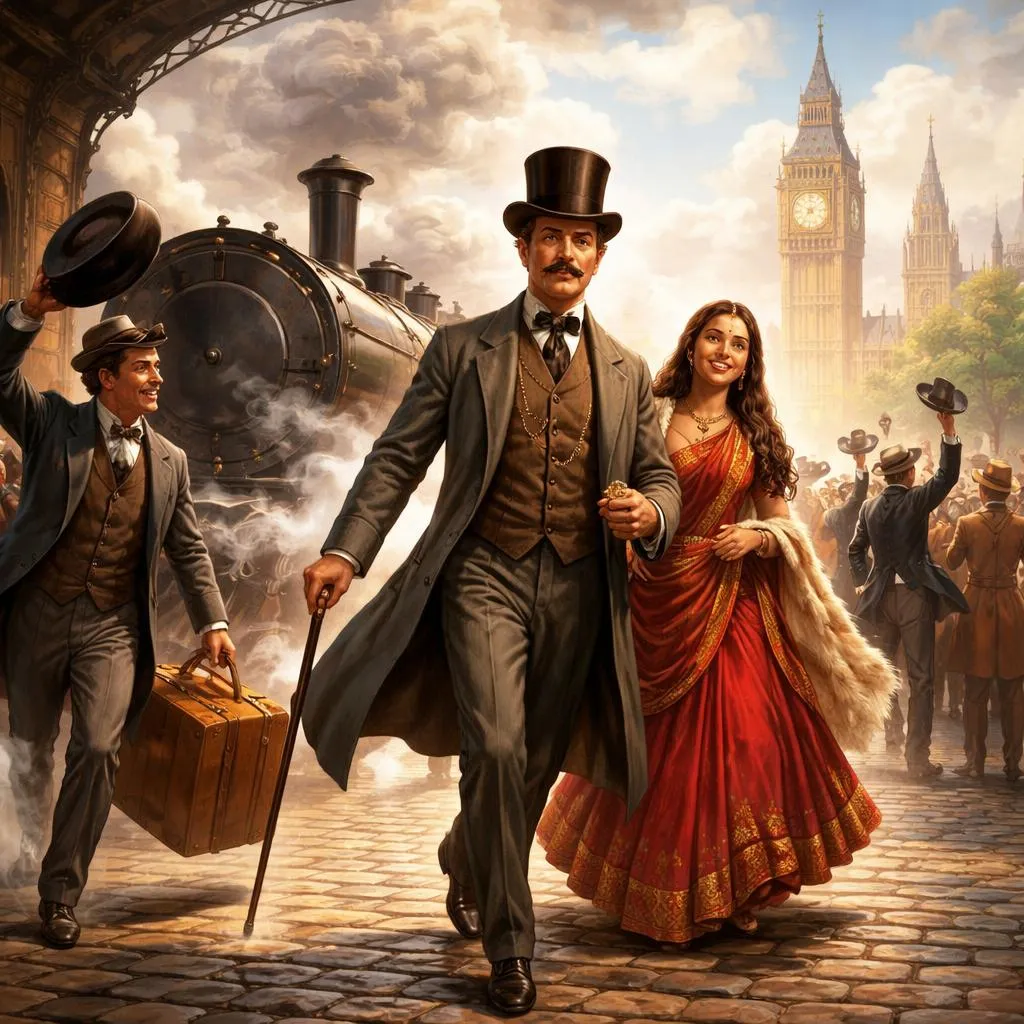

Phileas Fogg was in prison. He had been shut up in the Custom House, and he was to be transferred to London the next day.
Passepartout, when he saw his master arrested, would have fallen upon Fix had he not been held back by some policemen. Aouda was thunderstruck at the suddenness of an event which she could not understand. Passepartout explained to her how it was that the honest and courageous Fogg was arrested as a robber. The young woman's heart revolted against so heinous a charge, and when she saw that she could attempt to do nothing to save her protector, she wept bitterly.
As for Fix, he had arrested Mr. Fogg because it was his duty, whether Mr. Fogg were guilty or not.
The thought then struck Passepartout, that he was the cause of this new misfortune! Had he not concealed Fix's errand from his master? When Fix revealed his true character and purpose, why had he not told Mr. Fogg? If the latter had been warned, he would no doubt have given Fix proof of his innocence, and satisfied him of his mistake; at least, Fix would not have continued his journey at the expense and on the heels of his master, only to arrest him the moment he set foot on English soil. Passepartout wept till he was blind, and felt like blowing his brains out.
Aouda and he had remained, despite the cold, under the portico of the Custom House. Neither wished to leave the place; both were anxious to see Mr. Fogg again.
That gentleman was really ruined, and that at the moment when he was about to attain his end. This arrest was fatal. Having arrived at Liverpool at twenty minutes before twelve on the 21st of December, he had till a quarter before nine that evening to reach the Reform Club, that is, nine hours and a quarter; the journey from Liverpool to London was six hours.
If anyone, at this moment, had entered the Custom House, he would have found Mr. Fogg seated, motionless, calm, and without apparent anger, upon a wooden bench. He was not, it is true, resigned; but this last blow failed to force him into an outward betrayal of any emotion. Was he being devoured by one of those secret rages, all the more terrible because contained, and which only burst forth, with an irresistible force, at the last moment? No one could tell. There he sat, calmly waiting—for what? Did he still cherish hope? Did he still believe, now that the door of this prison was closed upon him, that he would succeed?
However that may have been, Mr. Fogg carefully put his watch upon the table, and observed its advancing hands. Not a word escaped his lips, but his look was singularly set and stern. The situation, in any event, was a terrible one, and might be thus stated: if Phileas Fogg was honest he was ruined; if he was a knave, he was caught.
Did escape occur to him? Did he examine to see if there were any practicable outlet from his prison? Did he think of escaping from it? Possibly; for once he walked slowly around the room. But the door was locked, and the window heavily barred with iron rods. He sat down again, and drew his journal from his pocket. On the line where these words were written, "21st December, Saturday, Liverpool," he added, "80th day, 11.40 a.m.," and waited.
The Custom House clock struck one. Mr. Fogg observed that his watch was two hours too fast.
Two hours! Admitting that he was at this moment taking an express train, he could reach London and the Reform Club by a quarter before nine, p.m. His forehead slightly wrinkled.
At thirty–three minutes past two he heard a singular noise outside, then a hasty opening of doors. Passepartout's voice was audible, and immediately after that of Fix. Phileas Fogg's eyes brightened for an instant.
The door swung open, and he saw Passepartout, Aouda, and Fix, who hurried towards him.
Fix was out of breath, and his hair was in disorder. He could not speak. "Sir," he stammered, "sir—forgive me—most—unfortunate resemblance—robber arrested three days ago—you are free!"
Phileas Fogg was free! He walked to the detective, looked him steadily in the face, and with the only rapid motion he had ever made in his life, or which he ever would make, drew back his arms, and with the precision of a machine knocked Fix down.
"Well hit!" cried Passepartout, "Parbleu! that's what you might call a good application of English fists!"
Fix, who found himself on the floor, did not utter a word. He had only received his deserts. Mr. Fogg, Aouda, and Passepartout left the Custom House without delay, got into a cab, and in a few moments descended at the station.
Phileas Fogg asked if there was an express train about to leave for London. It was forty minutes past two. The express train had left thirty–five minutes before. Phileas Fogg then ordered a special train.
There were several rapid locomotives on hand; but the railway arrangements did not permit the special train to leave until three o'clock.
At that hour Phileas Fogg, having stimulated the engineer by the offer of a generous reward, at last set out towards London with Aouda and his faithful servant.
It was necessary to make the journey in five hours and a half; and this would have been easy on a clear road throughout. But there were forced delays, and when Mr. Fogg stepped from the train at the terminus, all the clocks in London were striking ten minutes before nine.
Having made the tour of the world, he was behind–hand five minutes. He had lost the wager!
Introdução e Contexto do Autor
Esta história é um trecho de A Volta ao Mundo em Oitenta Dias, um romance de aventura clássico escrito pelo autor francês Jules Verne em 1873. Verne é frequentemente chamado de "Pai da Ficção Científica" por suas histórias imaginativas e inovadoras que combinam aventura com conhecimento científico e geográfico. Este romance em particular captura o espírito do século 19, uma época em que o mundo estava se tornando mais conectado por meio de ferrovias e navios a vapor, e as viagens estavam começando a encurtar as vastas distâncias entre os continentes.
Análise Detalhada da História e Significado
A história segue Phileas Fogg, um cavalheiro inglês calmo e metódico que aposta que pode dar a volta ao mundo em apenas oitenta dias. A passagem que você lê descreve um momento crítico em que Fogg é preso injustamente quando está prestes a completar sua jornada. Apesar desse contratempo, sua compostura e determinação brilham, mostrando sua resiliência diante da adversidade.
A prisão de Fogg é um ponto de virada que testa sua paciência, coragem e confiança em seus amigos. Seu criado, Passepartout, sente-se culpado por não ter avisado sobre as suspeitas do detetive Fix, e Aouda, uma jovem que eles resgataram durante suas viagens, demonstra profunda lealdade e preocupação por Fogg. A história destaca temas de justiça, perseverança e a importância da amizade e da confiança.
Lições e Insights para Estudantes e Jovens Leitores
-
Perseverança em Tempos Difíceis: A calma e a determinação de Fogg, mesmo quando injustamente acusado e preso, nos ensinam a importância de manter a compostura e o foco ao enfrentar desafios. A vida muitas vezes lança obstáculos inesperados, mas manter a mente clara nos ajuda a encontrar soluções.
-
O Valor da Lealdade e da Amizade: A devoção de Passepartout e Aouda a Fogg nos lembra que ter amigos solidários e estar ao lado uns dos outros em tempos difíceis é inestimável. Sua preocupação e ações demonstram como o trabalho em equipe e o cuidado podem ajudar a superar dificuldades.
-
Honestidade e Integridade: O caráter de Fogg é construído sobre honestidade e integridade. Mesmo quando acusado injustamente, ele não perde sua dignidade nem recorre à desonestidade. Isso mostra aos jovens leitores a importância de permanecer fiel aos seus valores.
-
O Poder do Gerenciamento do Tempo e do Planejamento: Todo o romance gira em torno da programação e do planejamento precisos de Fogg. Ensina aos alunos como é importante gerenciar o tempo com sabedoria e se preparar para atrasos inesperados, uma habilidade útil nos estudos e na vida diária.
Como Aplicar Essas Lições na Vida
-
Na Escola: Ao enfrentar exames ou projetos, os alunos podem aprender com a abordagem disciplinada de Fogg em relação ao planejamento e à perseverança. Mesmo que ocorram contratempos, manter a calma e o foco os ajudará a ter sucesso.
-
Em Situações Sociais: Assim como Passepartout e Aouda apoiam Fogg, construir amizades fortes baseadas na confiança e lealdade é essencial. Estar lá para os amigos e pedir ajuda quando necessário fortalece os relacionamentos.
-
No Crescimento Pessoal: A integridade de Fogg incentiva os jovens leitores a agir de forma honesta e responsável, mesmo quando pode ser mais fácil tomar atalhos. Isso constrói caráter e conquista respeito.
Cultivando Traços Positivos da História
-
Resiliência: Pratique manter a calma e pensar com clareza quando as coisas não saem como planejado. Tente ver os obstáculos como desafios a serem superados, em vez de motivos para desistir.
-
Empatia e Apoio: Aprenda a perceber quando amigos ou colegas de classe precisam de ajuda e ofereça seu apoio. Pequenos atos de bondade podem fazer uma grande diferença.
-
Responsabilidade: Assuma a responsabilidade por suas ações, como Passepartout percebe seu erro. Admitir erros e aprender com eles é um sinal de maturidade.
Conclusão
A Volta ao Mundo em Oitenta Dias é mais do que apenas uma aventura emocionante; é uma história repleta de valiosas lições de vida sobre coragem, amizade, honestidade e perseverança. Ao ler e refletir sobre personagens como Phileas Fogg, os alunos e jovens leitores podem se inspirar para enfrentar seus próprios desafios com confiança e integridade, preparando-os para o sucesso na escola, nos relacionamentos e além.
