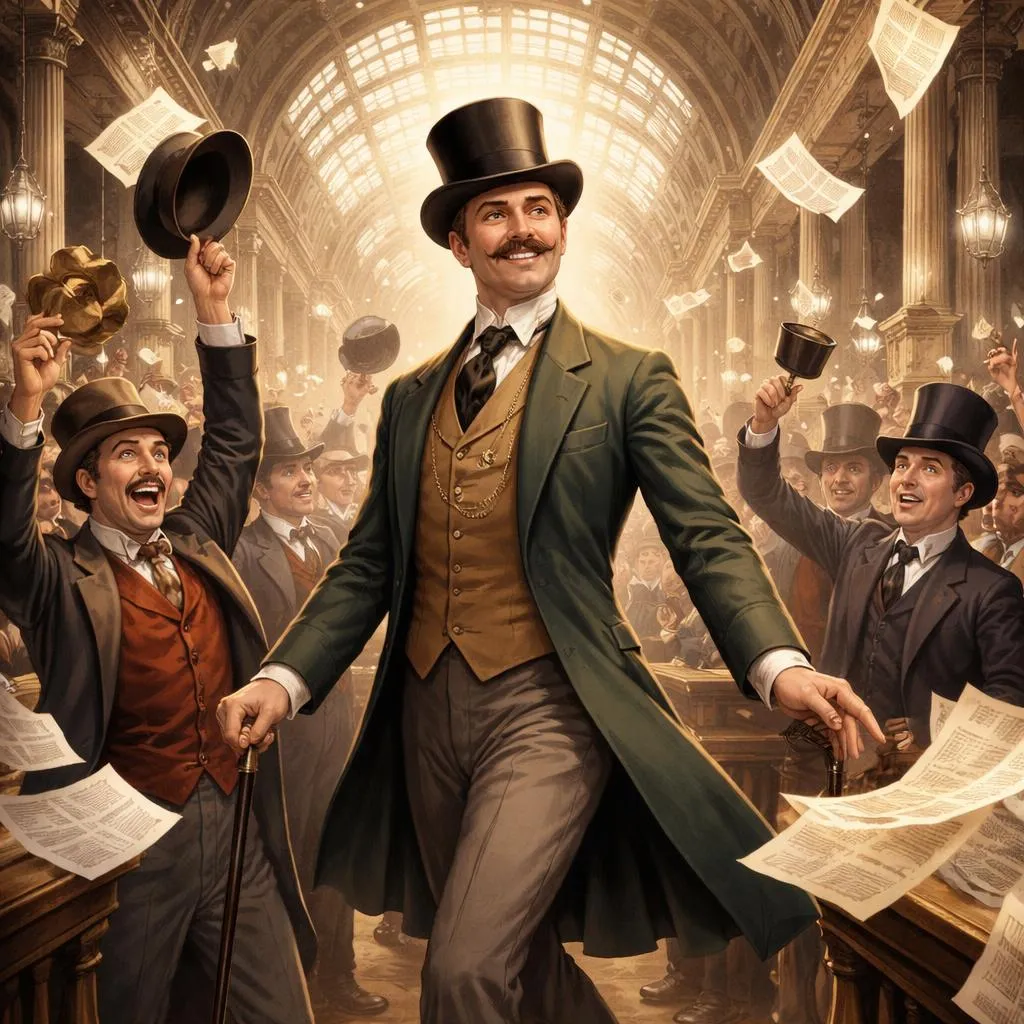

It is time to relate what a change took place in English public opinion when it transpired that the real bankrobber, a certain James Strand, had been arrested, on the 17th day of December, at Edinburgh. Three days before, Phileas Fogg had been a criminal, who was being desperately followed up by the police; now he was an honourable gentleman, mathematically pursuing his eccentric journey round the world.
The papers resumed their discussion about the wager; all those who had laid bets, for or against him, revived their interest, as if by magic; the "Phileas Fogg bonds" again became negotiable, and many new wagers were made. Phileas Fogg's name was once more at a premium on 'Change.
His five friends of the Reform Club passed these three days in a state of feverish suspense. Would Phileas Fogg, whom they had forgotten, reappear before their eyes! Where was he at this moment? The 17th of December, the day of James Strand's arrest, was the seventy–sixth since Phileas Fogg's departure, and no news of him had been received. Was he dead? Had he abandoned the effort, or was he continuing his journey along the route agreed upon? And would he appear on Saturday, the 21st of December, at a quarter before nine in the evening, on the threshold of the Reform Club saloon?
The anxiety in which, for three days, London society existed, cannot be described. Telegrams were sent to America and Asia for news of Phileas Fogg. Messengers were dispatched to the house in Saville Row morning and evening. No news. The police were ignorant what had become of the detective, Fix, who had so unfortunately followed up a false scent. Bets increased, nevertheless, in number and value. Phileas Fogg, like a racehorse, was drawing near his last turning–point. The bonds were quoted, no longer at a hundred below par, but at twenty, at ten, and at five; and paralytic old Lord Albemarle bet even in his favour.
A great crowd was collected in Pall Mall and the neighbouring streets on Saturday evening; it seemed like a multitude of brokers permanently established around the Reform Club. Circulation was impeded, and everywhere disputes, discussions, and financial transactions were going on. The police had great difficulty in keeping back the crowd, and as the hour when Phileas Fogg was due approached, the excitement rose to its highest pitch.
The five antagonists of Phileas Fogg had met in the great saloon of the club. John Sullivan and Samuel Fallentin, the bankers, Andrew Stuart, the engineer, Gauthier Ralph, the director of the Bank of England, and Thomas Flanagan, the brewer, one and all waited anxiously.
When the clock indicated twenty minutes past eight, Andrew Stuart got up, saying, "Gentlemen, in twenty minutes the time agreed upon between Mr. Fogg and ourselves will have expired."
"What time did the last train arrive from Liverpool?" asked Thomas Flanagan.
"At twenty–three minutes past seven," replied Gauthier Ralph; "and the next does not arrive till ten minutes after twelve."
"Well, gentlemen," resumed Andrew Stuart, "if Phileas Fogg had come in the 7:23 train, he would have got here by this time. We can, therefore, regard the bet as won."
"Wait; don't let us be too hasty," replied Samuel Fallentin. "You know that Mr. Fogg is very eccentric. His punctuality is well known; he never arrives too soon, or too late; and I should not be surprised if he appeared before us at the last minute."
"Why," said Andrew Stuart nervously, "if I should see him, I should not believe it was he."
"The fact is," resumed Thomas Flanagan, "Mr. Fogg's project was absurdly foolish. Whatever his punctuality, he could not prevent the delays which were certain to occur; and a delay of only two or three days would be fatal to his tour."
"Observe, too," added John Sullivan, "that we have received no intelligence from him, though there are telegraphic lines all along is route."
"He has lost, gentleman," said Andrew Stuart, "he has a hundred times lost! You know, besides, that the China the only steamer he could have taken from New York to get here in time arrived yesterday. I have seen a list of the passengers, and the name of Phileas Fogg is not among them. Even if we admit that fortune has favoured him, he can scarcely have reached America. I think he will be at least twenty days behind–hand, and that Lord Albemarle will lose a cool five thousand."
"It is clear," replied Gauthier Ralph; "and we have nothing to do but to present Mr. Fogg's cheque at Barings to–morrow."
At this moment, the hands of the club clock pointed to twenty minutes to nine.
"Five minutes more," said Andrew Stuart.
The five gentlemen looked at each other. Their anxiety was becoming intense; but, not wishing to betray it, they readily assented to Mr. Fallentin's proposal of a rubber.
"I wouldn't give up my four thousand of the bet," said Andrew Stuart, as he took his seat, "for three thousand nine hundred and ninety–nine."
The clock indicated eighteen minutes to nine.
The players took up their cards, but could not keep their eyes off the clock. Certainly, however secure they felt, minutes had never seemed so long to them!
"Seventeen minutes to nine," said Thomas Flanagan, as he cut the cards which Ralph handed to him.
Then there was a moment of silence. The great saloon was perfectly quiet; but the murmurs of the crowd outside were heard, with now and then a shrill cry. The pendulum beat the seconds, which each player eagerly counted, as he listened, with mathematical regularity.
"Sixteen minutes to nine!" said John Sullivan, in a voice which betrayed his emotion.
One minute more, and the wager would be won. Andrew Stuart and his partners suspended their game. They left their cards, and counted the seconds.
At the fortieth second, nothing. At the fiftieth, still nothing.
At the fifty–fifth, a loud cry was heard in the street, followed by applause, hurrahs, and some fierce growls.
The players rose from their seats.
At the fifty–seventh second the door of the saloon opened; and the pendulum had not beat the sixtieth second when Phileas Fogg appeared, followed by an excited crowd who had forced their way through the club doors, and in his calm voice, said, "Here I am, gentlemen!"
Contexto e Introdução do Autor
Esta passagem é do clássico romance de aventura A Volta ao Mundo em 80 Dias, de Júlio Verne, um autor francês conhecido por suas obras pioneiras em ficção científica e literatura de aventura. Escrito em 1873, este romance captura o espírito do século XIX — uma época de rápido progresso tecnológico e exploração global. A narrativa imaginativa e as descrições detalhadas de Verne tornaram suas obras atemporais, inspirando gerações de leitores a sonhar com lugares distantes e façanhas ousadas.
Interpretação Detalhada e Significado
A história gira em torno de Phileas Fogg, um cavalheiro inglês preciso e metódico que aposta que pode dar a volta ao mundo em apenas oitenta dias. Este trecho captura o clímax da história, onde a opinião pública oscila dramaticamente à medida que o destino de Fogg está em jogo. Inicialmente suspeito de um crime, a honra e a determinação de Fogg são restauradas quando o verdadeiro culpado é capturado. A tensão aumenta à medida que o relógio corre para o momento final da aposta, culminando no retorno triunfante de Fogg.
Esta cena destaca temas de perseverança, pontualidade e o triunfo da vontade humana contra probabilidades aparentemente impossíveis. Também reflete o fascínio da era vitoriana pelo progresso, pontualidade e o alcance crescente do Império Britânico. A história combina inteligentemente aventura com uma crítica sutil às normas sociais e ao valor atribuído às aparências e à reputação.
Lições e Inspirações para Estudantes
-
Perseverança e Determinação: A jornada de Phileas Fogg ensina a importância de manter o compromisso com os próprios objetivos, mesmo quando confrontado com contratempos e dúvidas. Os alunos podem aprender a persistir em seus estudos e desafios pessoais, adotando uma mentalidade semelhante.
-
Gerenciamento de Tempo e Pontualidade: A estrita adesão de Fogg à sua programação é um exemplo poderoso de como gerenciar o tempo de forma eficaz pode levar ao sucesso. Os jovens leitores podem refletir sobre como o planejamento e a pontualidade ajudam nos trabalhos escolares e nas responsabilidades diárias.
-
Pensamento Crítico e Julgamento: A flutuação da opinião pública sobre Fogg nos lembra de não tirar conclusões precipitadas com base em informações incompletas. Os alunos devem cultivar habilidades de pensamento crítico e evitar julgamentos apressados sobre os outros.
-
Coragem para Correr Riscos: A aposta de Fogg é ousada e arriscada, mas o impulsiona a explorar o mundo e crescer. Isso incentiva os alunos a sair de suas zonas de conforto e abraçar desafios que promovam a aprendizagem e a autodescoberta.
-
Resiliência Social e Emocional: Apesar da suspeita pública e da pressão da aposta, Fogg permanece calmo e composto. Isso ensina resiliência emocional e o valor de manter a compostura sob estresse.
Aplicando Essas Lições na Vida Diária
-
Na Aprendizagem: Os alunos podem definir metas e prazos claros para suas tarefas, assim como Fogg planejou sua jornada. Dividir grandes tarefas em etapas menores e manter uma programação pode melhorar o desempenho acadêmico.
-
Em Interações Sociais: Compreender a importância de não julgar os outros prematuramente ajuda a construir empatia e melhores relacionamentos. Os alunos podem praticar a escuta e a coleta de fatos antes de formar opiniões.
-
No Crescimento Pessoal: Correr riscos calculados, como participar de novos clubes ou experimentar novos hobbies, pode ampliar horizontes e construir confiança.
-
No Desenvolvimento do Caráter: Emular a calma e a determinação de Fogg pode ajudar os alunos a enfrentar exames, competições ou desafios pessoais com uma mente estável.
Cultivando Traços Positivos da História
Professores e pais podem incentivar as crianças a:
- Desenvolver um senso de responsabilidade, definindo metas pessoais.
- Praticar a pontualidade, criando rotinas diárias.
- Construir resiliência, discutindo histórias de superação de obstáculos.
- Promover a curiosidade sobre o mundo, por meio da leitura e da exploração.
- Apreciar o valor da amizade e do apoio, como visto nos companheiros de Fogg.
Em resumo, A Volta ao Mundo em 80 Dias não é apenas uma aventura emocionante; é uma rica fonte de lições de vida que inspiram os jovens leitores a sonhar grande, trabalhar duro e enfrentar os desafios da vida com coragem e integridade.
