
It seemed to me that this quaint lie was most simply and beautifully told; but then I had heard it only once, and that makes a difference; it was pleasant to the others when it was fresh, no doubt.
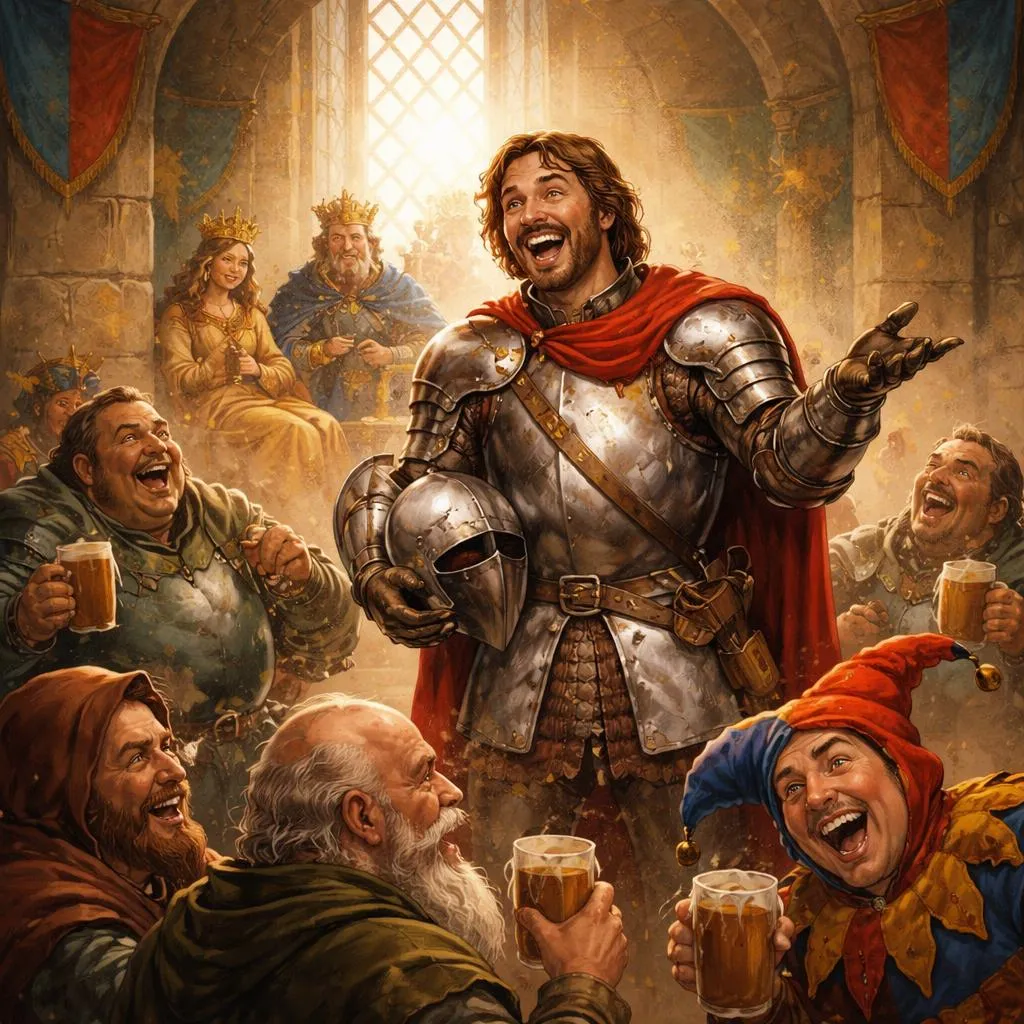
Sir Dinadan the Humorist was the first to awake, and he soon roused the rest with a practical joke of a sufficiently poor quality. He tied some metal mugs to a dog’s tail and turned him loose, and he tore around and around the place in a frenzy of fright, with all the other dogs bellowing after him and battering and crashing against everything that came in their way and making altogether a chaos of confusion and a most deafening din and turmoil; at which every man and woman of the multitude laughed till the tears flowed, and some fell out of their chairs and wallowed on the floor in ecstasy. It was just like so many children. Sir Dinadan was so proud of his exploit that he could not keep from telling over and over again, to weariness, how the immortal idea happened to occur to him; and as is the way with humorists of his breed, he was still laughing at it after everybody else had got through. He was so set up that he concluded to make a speech —of course a humorous speech. I think I never heard so many old played-out jokes strung together in my life. He was worse than the minstrels, worse than the clown in the circus. It seemed peculiarly sad to sit here, thirteen hundred years before I was born, and listen again to poor, flat, worm-eaten jokes that had given me the dry gripes when I was a boy thirteen hundred years afterwards. It about convinced me that there isn’t any such thing as a new joke possible. Everybody laughed at these antiquities —but then they always do; I had noticed that, centuries later. However, of course the scoffer didn’t laugh—I mean the boy. No, he scoffed; there wasn’t anything he wouldn’t scoff at. He said the most of Sir Dinadan’s jokes were rotten and the rest were petrified. I said “petrified” was good; as I believed, myself, that the only right way to classify the majestic ages of some of those jokes was by geologic periods. But that neat idea hit the boy in a blank place, for geology hadn’t been invented yet. However, I made a note of the remark, and calculated to educate the commonwealth up to it if I pulled through. It is no use to throw a good thing away merely because the market isn’t ripe yet.
Now Sir Kay arose and began to fire up on his history-mill with me for fuel. It was time for me to feel serious, and I did. Sir Kay told how he had encountered me in a far land of barbarians, who all wore the same ridiculous garb that I did—a garb that was a work of enchantment, and intended to make the wearer secure from hurt by human hands. However he had nullified the force of the enchantment by prayer, and had killed my thirteen knights in a three hours’ battle, and taken me prisoner, sparing my life in order that so strange a curiosity as I was might be exhibited to the wonder and admiration of the king and the court. He spoke of me all the time, in the blandest way, as “this prodigious giant,” and “this horrible sky-towering monster,” and “this tusked and taloned man-devouring ogre”, and everybody took in all this bosh in the naivest way, and never smiled or seemed to notice that there was any discrepancy between these watered statistics and me. He said that in trying to escape from him I sprang into the top of a tree two hundred cubits high at a single bound, but he dislodged me with a stone the size of a cow, which “all-to brast” the most of my bones, and then swore me to appear at Arthur’s court for sentence. He ended by condemning me to die at noon on the 21st; and was so little concerned about it that he stopped to yawn before he named the date.
I was in a dismal state by this time; indeed, I was hardly enough in my right mind to keep the run of a dispute that sprung up as to how I had better be killed, the possibility of the killing being doubted by some, because of the enchantment in my clothes. And yet it was nothing but an ordinary suit of fifteen-dollar slop-shops. Still, I was sane enough to notice this detail, to wit: many of the terms used in the most matter-of-fact way by this great assemblage of the first ladies and gentlemen in the land would have made a Comanche blush. Indelicacy is too mild a term to convey the idea. However, I had read “Tom Jones,” and “Roderick Random,” and other books of that kind, and knew that the highest and first ladies and gentlemen in England had remained little or no cleaner in their talk, and in the morals and conduct which such talk implies, clear up to a hundred years ago; in fact clear into our own nineteenth century—in which century, broadly speaking, the earliest samples of the real lady and real gentleman discoverable in English history—or in European history, for that matter—may be said to have made their appearance. Suppose Sir Walter, instead of putting the conversations into the mouths of his characters, had allowed the characters to speak for themselves? We should have had talk from Rebecca and Ivanhoe and the soft lady Rowena which would embarrass a tramp in our day. However, to the unconsciously indelicate all things are delicate. King Arthur’s people were not aware that they were indecent and I had presence of mind enough not to mention it.
They were so troubled about my enchanted clothes that they were mightily relieved, at last, when old Merlin swept the difficulty away for them with a common-sense hint. He asked them why they were so dull—why didn’t it occur to them to strip me. In half a minute I was as naked as a pair of tongs! And dear, dear, to think of it: I was the only embarrassed person there. Everybody discussed me; and did it as unconcernedly as if I had been a cabbage. Queen Guenever was as naively interested as the rest, and said she had never seen anybody with legs just like mine before. It was the only compliment I got—if it was a compliment.
Finally I was carried off in one direction, and my perilous clothes in another. I was shoved into a dark and narrow cell in a dungeon, with some scant remnants for dinner, some moldy straw for a bed, and no end of rats for company.
Contexto e Introdução do Autor
Esta passagem é do romance de Mark Twain, Um Ianque na Corte do Rei Arthur, publicado pela primeira vez em 1889. Twain, um dos maiores humoristas e críticos sociais da América, usa esta história para misturar fantasia, sátira e ficção histórica. O romance conta a história de um engenheiro americano do século 19 que é misteriosamente transportado no tempo para a era do Rei Arthur. Twain usa essa configuração imaginativa para explorar temas de progresso, tecnologia, justiça social e natureza humana.
Interpretação Detalhada e Significado
O trecho captura o choque humorístico e muitas vezes absurdo entre os mundos moderno e medieval. O protagonista, um homem do futuro, observa os cavaleiros e nobres da lenda arturiana com uma mistura de ironia e descrença. A brincadeira de Sir Dinadan e os contos exagerados contados por Sir Kay destacam o contraste entre os ideais cavalheirescos e a realidade muitas vezes ridícula por trás deles.
O estilo narrativo de Twain combina um tom divertido com comentários sociais aguçados. A "mentira curiosa" e as "velhas piadas gastas" simbolizam como as histórias e tradições podem se distorcer ou perder o significado com o tempo. As reflexões do protagonista sobre a linguagem e os costumes do passado revelam a crítica de Twain às pretensões sociais e à hipocrisia, tanto no cenário medieval quanto em seu próprio tempo.
A roupa encantada e o aprisionamento do protagonista ilustram a tensão entre superstição e razão, um tema recorrente no romance. O conselho prático do personagem Merlin para despir o protagonista para quebrar o encanto representa o triunfo do senso comum sobre a crença cega.
Lições e Insights para Estudantes
-
Pensamento Crítico e Ceticismo: A história incentiva os leitores a questionar verdades e tradições aceitas. Assim como o protagonista duvida dos contos dos cavaleiros e do poder dos encantamentos, os alunos devem aprender a pensar criticamente sobre as informações e não aceitar tudo como verdade.
-
Humor como Ferramenta para Reflexão: O uso do humor por Twain ajuda a expor as tolices humanas e as falhas sociais. Os alunos podem apreciar como o riso e a sátira podem ser maneiras poderosas de entender e criticar o mundo ao seu redor.
-
Compreensão do Contexto Histórico: O romance mistura lenda histórica com ideias modernas, mostrando como as perspectivas mudam com o tempo. Isso incentiva os alunos a explorar a história com a mente aberta e a reconhecer a influência da cultura e do tempo nas histórias e crenças.
-
Respeito pelo Conhecimento e Progresso: A formação do protagonista como engenheiro simboliza a importância da ciência e da tecnologia para o avanço da sociedade. Os alunos podem se inspirar a valorizar a educação e a inovação, respeitando as lições do passado.
-
Empatia e Mente Aberta: A experiência do protagonista como um estranho em um mundo estranho ensina a importância da empatia e da adaptabilidade. Os alunos podem aprender a apreciar diferentes culturas e pontos de vista, o que é vital na sociedade diversificada de hoje.
Aplicando o Espírito da História na Vida Diária
-
No Aprendizado: Abrace a curiosidade e questione as suposições. Aborde os estudos com um equilíbrio de ceticismo e abertura, assim como o protagonista navegando em um mundo desconhecido.
-
Em Interações Sociais: Use o humor com gentileza para aliviar tensões e construir conexões, mas seja atencioso com os sentimentos dos outros. Como as piadas de Sir Dinadan, o humor pode unir as pessoas quando usado com cuidado.
-
Ao Enfrentar Desafios: Aplique a razão e o senso comum para resolver problemas, como Merlin aconselha. Não tenha medo de eliminar complicações desnecessárias para encontrar soluções claras.
-
No Desenvolvimento do Caráter: Cultive a resiliência e a adaptabilidade. A jornada do protagonista mostra que situações inesperadas exigem coragem e flexibilidade.
Incentivando Valores Positivos
Os alunos podem aprender com a experiência do protagonista a desenvolver virtudes como honestidade, bravura e humildade. Reconhecer as falhas nos outros e em si mesmo com humor e graça ajuda a construir um caráter forte. O romance também promove o valor de defender o que é certo, questionar a injustiça e usar o conhecimento de forma responsável.
Ao ler e refletir sobre Um Ianque na Corte do Rei Arthur, os jovens leitores ganham não apenas entretenimento, mas também uma compreensão mais profunda da história, da sociedade e da natureza humana. Eles são convidados a pensar de forma independente, a apreciar o poder da narrativa e a levar adiante o espírito de investigação e bondade em suas próprias vidas.
