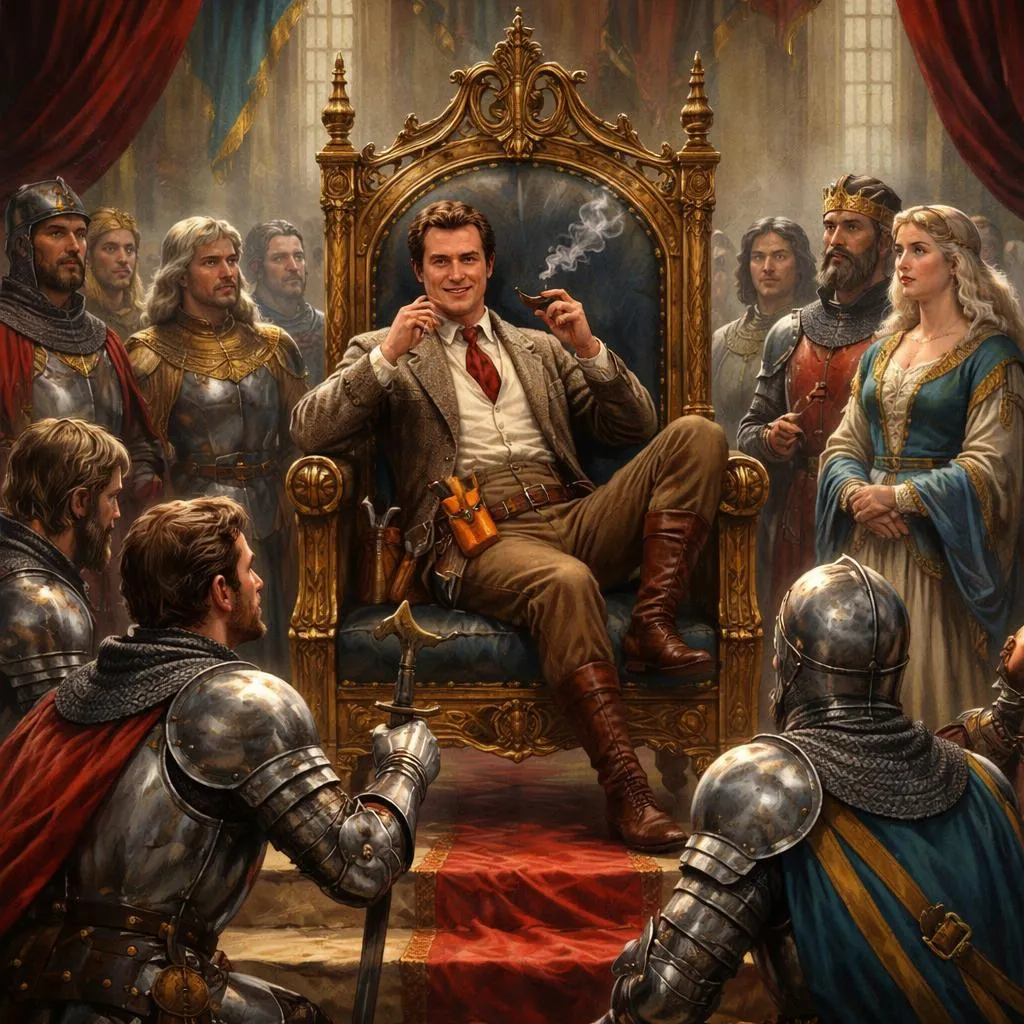

To be vested with enormous authority is a fine thing; but to have the on-looking world consent to it is a finer. The tower episode solidified my power, and made it impregnable. If any were perchance disposed to be jealous and critical before that, they experienced a change of heart, now. There was not any one in the kingdom who would have considered it good judgment to meddle with my matters.
I was fast getting adjusted to my situation and circumstances. For a time, I used to wake up, mornings, and smile at my “dream,” and listen for the Colt’s factory whistle; but that sort of thing played itself out, gradually, and at last I was fully able to realize that I was actually living in the sixth century, and in Arthur’s court, not a lunatic asylum. After that, I was just as much at home in that century as I could have been in any other; and as for preference, I wouldn’t have traded it for the twentieth. Look at the opportunities here for a man of knowledge, brains, pluck, and enterprise to sail in and grow up with the country. The grandest field that ever was; and all my own; not a competitor; not a man who wasn’t a baby to me in acquirements and capacities; whereas, what would I amount to in the twentieth century? I should be foreman of a factory, that is about all; and could drag a seine down street any day and catch a hundred better men than myself.
What a jump I had made! I couldn’t keep from thinking about it, and contemplating it, just as one does who has struck oil. There was nothing back of me that could approach it, unless it might be Joseph’s case; and Joseph’s only approached it, it didn’t equal it, quite. For it stands to reason that as Joseph’s splendid financial ingenuities advantaged nobody but the king, the general public must have regarded him with a good deal of disfavor, whereas I had done my entire public a kindness in sparing the sun, and was popular by reason of it.
I was no shadow of a king; I was the substance; the king himself was the shadow. My power was colossal; and it was not a mere name, as such things have generally been, it was the genuine article. I stood here, at the very spring and source of the second great period of the world’s history; and could see the trickling stream of that history gather and deepen and broaden, and roll its mighty tides down the far centuries; and I could note the upspringing of adventurers like myself in the shelter of its long array of thrones: De Montforts, Gavestons, Mortimers, Villierses; the war-making, campaign-directing wantons of France, and Charles the Second’s scepter-wielding drabs; but nowhere in the procession was my full-sized fellow visible. I was a Unique; and glad to know that that fact could not be dislodged or challenged for thirteen centuries and a half, for sure. Yes, in power I was equal to the king. At the same time there was another power that was a trifle stronger than both of us put together. That was the Church. I do not wish to disguise that fact. I couldn’t, if I wanted to. But never mind about that, now; it will show up, in its proper place, later on. It didn’t cause me any trouble in the beginning —at least any of consequence.
Well, it was a curious country, and full of interest. And the people! They were the quaintest and simplest and trustingest race; why, they were nothing but rabbits. It was pitiful for a person born in a wholesome free atmosphere to listen to their humble and hearty outpourings of loyalty toward their king and Church and nobility; as if they had any more occasion to love and honor king and Church and noble than a slave has to love and honor the lash, or a dog has to love and honor the stranger that kicks him! Why, dear me, any kind of royalty, howsoever modified, any kind of aristocracy, howsoever pruned, is rightly an insult; but if you are born and brought up under that sort of arrangement you probably never find it out for yourself, and don’t believe it when somebody else tells you. It is enough to make a body ashamed of his race to think of the sort of froth that has always occupied its thrones without shadow of right or reason, and the seventh-rate people that have always figured as its aristocracies—a company of monarchs and nobles who, as a rule, would have achieved only poverty and obscurity if left, like their betters, to their own exertions.
The most of King Arthur’s British nation were slaves, pure and simple, and bore that name, and wore the iron collar on their necks; and the rest were slaves in fact, but without the name; they imagined themselves men and freemen, and called themselves so. The truth was, the nation as a body was in the world for one object, and one only: to grovel before king and Church and noble; to slave for them, sweat blood for them, starve that they might be fed, work that they might play, drink misery to the dregs that they might be happy, go naked that they might wear silks and jewels, pay taxes that they might be spared from paying them, be familiar all their lives with the degrading language and postures of adulation that they might walk in pride and think themselves the gods of this world. And for all this, the thanks they got were cuffs and contempt; and so poor-spirited were they that they took even this sort of attention as an honor.
Inherited ideas are a curious thing, and interesting to observe and examine. I had mine, the king and his people had theirs. In both cases they flowed in ruts worn deep by time and habit, and the man who should have proposed to divert them by reason and argument would have had a long contract on his hands. For instance, those people had inherited the idea that all men without title and a long pedigree, whether they had great natural gifts and acquirements or hadn’t, were creatures of no more consideration than so many animals, bugs, insects; whereas I had inherited the idea that human daws who can consent to masquerade in the peacock-shams of inherited dignities and unearned titles, are of no good but to be laughed at. The way I was looked upon was odd, but it was natural. You know how the keeper and the public regard the elephant in the menagerie: well, that is the idea. They are full of admiration of his vast bulk and his prodigious strength; they speak with pride of the fact that he can do a hundred marvels which are far and away beyond their own powers; and they speak with the same pride of the fact that in his wrath he is able to drive a thousand men before him. But does that make him one of them ? No; the raggedest tramp in the pit would smile at the idea. He couldn’t comprehend it; couldn’t take it in; couldn’t in any remote way conceive of it. Well, to the king, the nobles, and all the nation, down to the very slaves and tramps, I was just that kind of an elephant, and nothing more. I was admired, also feared; but it was as an animal is admired and feared. The animal is not reverenced, neither was I; I was not even respected. I had no pedigree, no inherited title; so in the king’s and nobles’ eyes I was mere dirt; the people regarded me with wonder and awe, but there was no reverence mixed with it; through the force of inherited ideas they were not able to conceive of anything being entitled to that except pedigree and lordship. There you see the hand of that awful power, the Roman Catholic Church. In two or three little centuries it had converted a nation of men to a nation of worms. Before the day of the Church’s supremacy in the world, men were men, and held their heads up, and had a man’s pride and spirit and independence; and what of greatness and position a person got, he got mainly by achievement, not by birth. But then the Church came to the front, with an axe to grind; and she was wise, subtle, and knew more than one way to skin a cat—or a nation; she invented “divine right of kings,” and propped it all around, brick by brick, with the Beatitudes —wrenching them from their good purpose to make them fortify an evil one; she preached (to the commoner) humility, obedience to superiors, the beauty of self-sacrifice; she preached (to the commoner) meekness under insult; preached (still to the commoner, always to the commoner) patience, meanness of spirit, non-resistance under oppression; and she introduced heritable ranks and aristocracies, and taught all the Christian populations of the earth to bow down to them and worship them. Even down to my birth-century that poison was still in the blood of Christendom, and the best of English commoners was still content to see his inferiors impudently continuing to hold a number of positions, such as lordships and the throne, to which the grotesque laws of his country did not allow him to aspire; in fact, he was not merely contented with this strange condition of things, he was even able to persuade himself that he was proud of it. It seems to show that there isn’t anything you can’t stand, if you are only born and bred to it. Of course that taint, that reverence for rank and title, had been in our American blood, too—I know that; but when I left America it had disappeared—at least to all intents and purposes. The remnant of it was restricted to the dudes and dudesses. When a disease has worked its way down to that level, it may fairly be said to be out of the system.
But to return to my anomalous position in King Arthur’s kingdom. Here I was, a giant among pigmies, a man among children, a master intelligence among intellectual moles: by all rational measurement the one and only actually great man in that whole British world; and yet there and then, just as in the remote England of my birth-time, the sheep-witted earl who could claim long descent from a king’s leman, acquired at second-hand from the slums of London, was a better man than I was. Such a personage was fawned upon in Arthur’s realm and reverently looked up to by everybody, even though his dispositions were as mean as his intelligence, and his morals as base as his lineage. There were times when he could sit down in the king’s presence, but I couldn’t. I could have got a title easily enough, and that would have raised me a large step in everybody’s eyes; even in the king’s, the giver of it. But I didn’t ask for it; and I declined it when it was offered. I couldn’t have enjoyed such a thing with my notions; and it wouldn’t have been fair, anyway, because as far back as I could go, our tribe had always been short of the bar sinister. I couldn’t have felt really and satisfactorily fine and proud and set-up over any title except one that should come from the nation itself, the only legitimate source; and such a one I hoped to win; and in the course of years of honest and honorable endeavor, I did win it and did wear it with a high and clean pride. This title fell casually from the lips of a blacksmith, one day, in a village, was caught up as a happy thought and tossed from mouth to mouth with a laugh and an affirmative vote; in ten days it had swept the kingdom, and was become as familiar as the king’s name. I was never known by any other designation afterward, whether in the nation’s talk or in grave debate upon matters of state at the council-board of the sovereign. This title, translated into modern speech, would be THE BOSS. Elected by the nation. That suited me. And it was a pretty high title. There were very few THE’S, and I was one of them. If you spoke of the duke, or the earl, or the bishop, how could anybody tell which one you meant? But if you spoke of The King or The Queen or The Boss, it was different.
Well, I liked the king, and as king I respected him—respected the office; at least respected it as much as I was capable of respecting any unearned supremacy; but as MEN I looked down upon him and his nobles—privately. And he and they liked me, and respected my office; but as an animal, without birth or sham title, they looked down upon me—and were not particularly private about it, either. I didn’t charge for my opinion about them, and they didn’t charge for their opinion about me: the account was square, the books balanced, everybody was satisfied.
Contexto e Introdução do Autor
Esta passagem é de uma obra que explora a experiência de um homem moderno que se vê transportado para a época da corte do Rei Arthur, no século VI. O autor usa este cenário imaginativo para examinar temas de poder, hierarquia social e identidade pessoal. A história reflete sobre os contrastes entre o mundo medieval e a sociedade moderna, especialmente no que diz respeito à classe, autoridade e valor individual.
O autor, através de uma narrativa em primeira pessoa, oferece uma visão crítica e, por vezes, satírica das estruturas sociais rígidas do passado, particularmente a lealdade inquestionável aos reis, nobres e à Igreja. A voz narrativa é ponderada e reflexiva, convidando os leitores a questionar ideias herdadas sobre poder e respeito.
Interpretação Detalhada e Significado
O narrador descreve sua ascensão ao poder e aceitação na corte de Arthur, enfatizando que a verdadeira autoridade não vem apenas do título, mas do consentimento e reconhecimento do povo. Ele contrasta suas próprias habilidades e conhecimentos com os dos nobres e reis, apontando que muitos aristocratas devem seu status ao nascimento e não ao mérito.
A passagem critica o sistema social da época, que escravizava a maioria das pessoas, forçando-as à servidão e à lealdade cega. Também destaca como a Igreja reforçou esse sistema, promovendo a obediência, a humildade e a aceitação das hierarquias sociais como divinamente ordenadas. A recusa do narrador em aceitar um título nobre e, em vez disso, conquistar sua posição através do respeito do povo, demonstra seu compromisso com a meritocracia e a justiça.
Esta história incentiva os leitores a pensar criticamente sobre autoridade, justiça social e o valor da realização individual sobre o privilégio herdado. Também explora a solidão e os desafios de ser um indivíduo único em uma sociedade conformista.
Lições e Insights para Estudantes
-
Questionando a Autoridade e a Tradição: A história ensina os alunos a pensar criticamente sobre as normas sociais e as crenças herdadas. Só porque algo sempre foi feito de uma certa maneira não significa que seja justo ou correto.
-
Valor do Mérito e do Esforço: Enfatiza que o verdadeiro respeito e liderança vêm das ações, conhecimento e caráter de uma pessoa, e não do nascimento ou títulos.
-
Coragem para Ser Diferente: A experiência do narrador mostra a importância de manter-se firme em seus princípios, mesmo quando a sociedade o desaprova.
-
Compreendendo as Estruturas Sociais: Os alunos podem aprender sobre as hierarquias sociais históricas e o papel que instituições como a Igreja desempenharam na formação das sociedades.
-
Empatia pelos Outros: Ao descrever as vidas das pessoas comuns como escravos ou oprimidos, a história promove a empatia e a conscientização sobre a injustiça social.
Aplicações na Vida, Aprendizagem e Situações Sociais
-
Na Escola: Os alunos podem aplicar a lição de valorizar o mérito, concentrando-se em sua própria aprendizagem e habilidades, em vez de depender de rótulos ou comparações externas.
-
Em Interações Sociais: A história incentiva a tratar os outros com respeito, independentemente de seu status social ou origem, reconhecendo o valor inerente de cada pessoa.
-
No Crescimento Pessoal: Inspira os jovens leitores a desenvolver sua própria identidade e defender suas crenças, mesmo quando é difícil.
-
Na Liderança: O exemplo do narrador mostra que os bons líderes conquistam sua posição por meio do serviço e do respeito, e não por exigi-lo.
Como Cultivar Traços Positivos da História
-
Pensamento Crítico: Pratique questionar suposições e explorar diferentes pontos de vista.
-
Integridade: Seja honesto e fiel aos seus valores, mesmo sob pressão.
-
Respeito pelos Outros: Reconheça e aprecie a dignidade de cada pessoa.
-
Ambição Equilibrada com Humildade: Esforce-se para alcançar, mas permaneça humilde e consciente das contribuições dos outros.
-
Coragem: Desenvolva a coragem para enfrentar desafios e se destacar positivamente.
Ao refletir sobre esta história, os alunos podem obter uma compreensão mais profunda da história, da sociedade e de si mesmos, preparando-os para serem indivíduos ponderados, justos e corajosos em suas próprias vidas.
