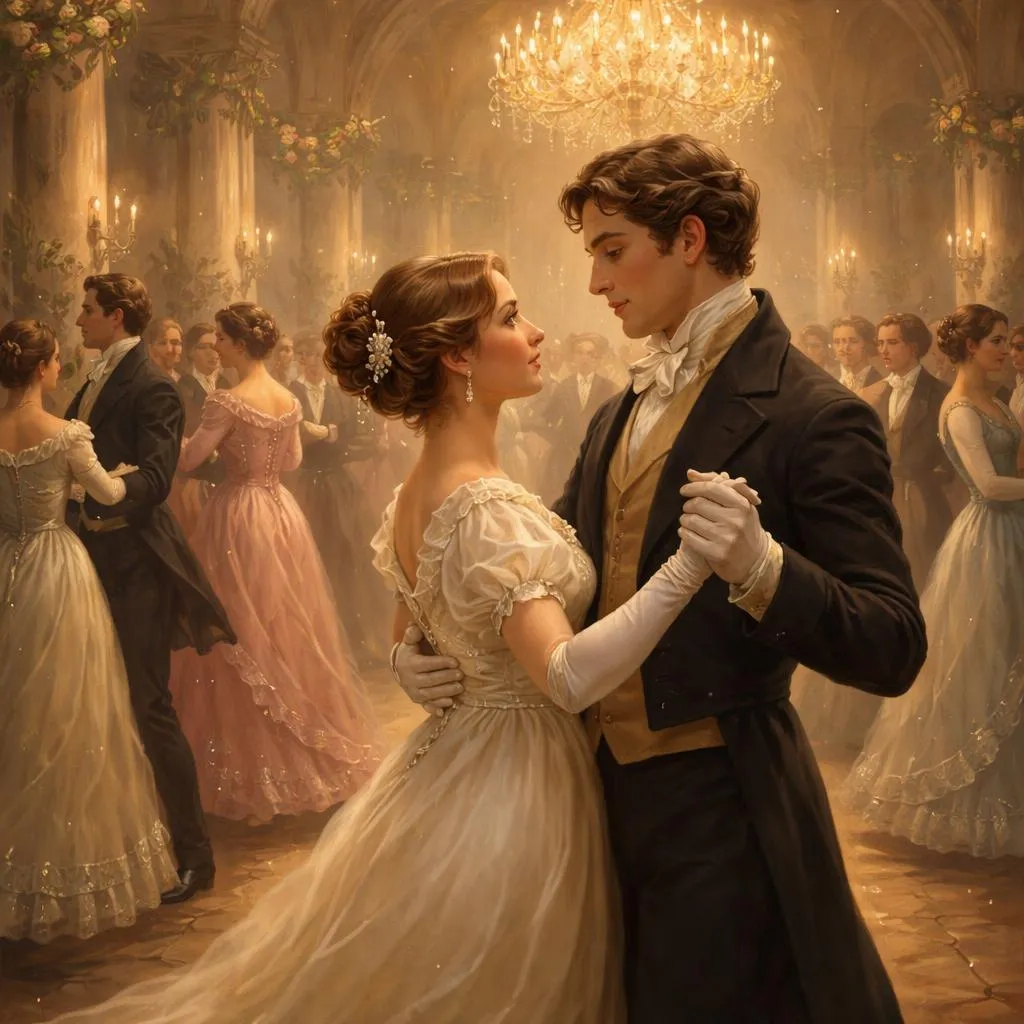

‘Now, Miss Grey,’ exclaimed Miss Murray, immediately I entered the schoolroom, after having taken off my outdoor garments, upon returning from my four weeks’ recreation, ‘Now—shut the door, and sit down, and I’ll tell you all about the ball.’
‘No—damn it, no!’ shouted Miss Matilda. ‘Hold your tongue, can’t ye? and let me tell her about my new mare—SUCH a splendour, Miss Grey! a fine blood mare—’
‘Do be quiet, Matilda; and let me tell my news first.’
‘No, no, Rosalie; you’ll be such a damned long time over it—she shall hear me first—I’ll be hanged if she doesn’t!’
‘I’m sorry to hear, Miss Matilda, that you’ve not got rid of that shocking habit yet.’
‘Well, I can’t help it: but I’ll never say a wicked word again, if you’ll only listen to me, and tell Rosalie to hold her confounded tongue.’
Rosalie remonstrated, and I thought I should have been torn in pieces between them; but Miss Matilda having the loudest voice, her sister at length gave in, and suffered her to tell her story first: so I was doomed to hear a long account of her splendid mare, its breeding and pedigree, its paces, its action, its spirit, &c., and of her own amazing skill and courage in riding it; concluding with an assertion that she could clear a five–barred gate ‘like winking,’ that papa said she might hunt the next time the hounds met, and mamma had ordered a bright scarlet hunting–habit for her.
‘Oh, Matilda! what stories you are telling!’ exclaimed her sister.
‘Well,’ answered she, no whit abashed, ‘I know I COULD clear a five–barred gate, if I tried, and papa WILL say I may hunt, and mamma WILL order the habit when I ask it.’
‘Well, now get along,’ replied Miss Murray; ‘and do, dear Matilda, try to be a little more lady–like. Miss Grey, I wish you would tell her not to use such shocking words; she will call her horse a mare: it is so inconceivably shocking! and then she uses such dreadful expressions in describing it: she must have learned it from the grooms. It nearly puts me into fits when she begins.’
‘I learned it from papa, you ass! and his jolly friends,’ said the young lady, vigorously cracking a hunting–whip, which she habitually carried in her hand. ‘I’m as good judge of horseflesh as the best of ‘m.’
‘Well, now get along, you shocking girl! I really shall take a fit if you go on in such a way. And now, Miss Grey, attend to me; I’m going to tell you about the ball. You must be dying to hear about it, I know. Oh, SUCH a ball! You never saw or heard, or read, or dreamt of anything like it in all your life. The decorations, the entertainment, the supper, the music were indescribable! and then the guests! There were two noblemen, three baronets, and five titled ladies, and other ladies and gentlemen innumerable. The ladies, of course, were of no consequence to me, except to put me in a good humour with myself, by showing how ugly and awkward most of them were; and the best, mamma told me,—the most transcendent beauties among them, were nothing to me. As for me, Miss Grey—I’m so SORRY you didn’t see me! I was CHARMING—wasn’t I, Matilda?’
‘Middling.’
‘No, but I really was—at least so mamma said—and Brown and Williamson. Brown said she was sure no gentleman could set eyes on me without falling in love that minute; and so I may be allowed to be a little vain. I know you think me a shocking, conceited, frivolous girl; but then, you know, I don’t attribute it ALL to my personal attractions: I give some praise to the hairdresser, and some to my exquisitely lovely dress—you must see it to–morrow— white gauze over pink satin—and so SWEETLY made! and a necklace and bracelet of beautiful, large pearls!’
‘I have no doubt you looked very charming: but should that delight you so very much?’
‘Oh, no!—not that alone: but, then, I was so much admired; and I made so MANY conquests in that one night—you’d be astonished to hear—’
‘But what good will they do you?’
‘What good! Think of any woman asking that!’
‘Well, I should think one conquest would be enough; and too much, unless the subjugation were mutual.’
‘Oh, but you know I never agree with you on those points. Now, wait a bit, and I’ll tell you my principal admirers—those who made themselves very conspicuous that night and after: for I’ve been to two parties since. Unfortunately the two noblemen, Lord G—– and Lord F—–, were married, or I might have condescended to be particularly gracious to THEM; as it was, I did not: though Lord F—–, who hates his wife, was evidently much struck with me. He asked me to dance with him twice—he is a charming dancer, by–the–by, and so am I: you can’t think how well I did—I was astonished at myself. My lord was very complimentary too—rather too much so in fact—and I thought proper to be a little haughty and repellent; but I had the pleasure of seeing his nasty, cross wife ready to perish with spite and vexation—’
‘Oh, Miss Murray! you don’t mean to say that such a thing could really give you pleasure? However cross or—’
‘Well, I know it’s very wrong;—but never mind! I mean to be good some time—only don’t preach now, there’s a good creature. I haven’t told you half yet. Let me see. Oh! I was going to tell you how many unmistakeable admirers I had:– Sir Thomas Ashby was one,—Sir Hugh Meltham and Sir Broadley Wilson are old codgers, only fit companions for papa and mamma. Sir Thomas is young, rich, and gay; but an ugly beast, nevertheless: however, mamma says I should not mind that after a few months’ acquaintance. Then, there was Henry Meltham, Sir Hugh’s younger son; rather good–looking, and a pleasant fellow to flirt with: but BEING a younger son, that is all he is good for; then there was young Mr. Green, rich enough, but of no family, and a great stupid fellow, a mere country booby! and then, our good rector, Mr. Hatfield: an HUMBLE admirer he ought to consider himself; but I fear he has forgotten to number humility among his stock of Christian virtues.’
‘Was Mr. Hatfield at the ball?’
‘Yes, to be sure. Did you think he was too good to go?’
‘I thought be might consider it unclerical.’
‘By no means. He did not profane his cloth by dancing; but it was with difficulty he could refrain, poor man: he looked as if he were dying to ask my hand just for ONE set; and—oh! by–the–by— he’s got a new curate: that seedy old fellow Mr. Bligh has got his long–wished–for living at last, and is gone.’
‘And what is the new one like?’
‘Oh, SUCH a beast! Weston his name is. I can give you his description in three words—an insensate, ugly, stupid blockhead. That’s four, but no matter—enough of HIM now.’
Then she returned to the ball, and gave me a further account of her deportment there, and at the several parties she had since attended; and further particulars respecting Sir Thomas Ashby and Messrs. Meltham, Green, and Hatfield, and the ineffaceable impression she had wrought upon each of them.
‘Well, which of the four do you like best?’ said I, suppressing my third or fourth yawn.
‘I detest them all!’ replied she, shaking her bright ringlets in vivacious scorn.
‘That means, I suppose, “I like them all”—but which most?’
‘No, I really detest them all; but Harry Meltham is the handsomest and most amusing, and Mr. Hatfield the cleverest, Sir Thomas the wickedest, and Mr. Green the most stupid. But the one I’m to have, I suppose, if I’m doomed to have any of them, is Sir Thomas Ashby.’
‘Surely not, if he’s so wicked, and if you dislike him?’
‘Oh, I don’t mind his being wicked: he’s all the better for that; and as for disliking him—I shouldn’t greatly object to being Lady Ashby of Ashby Park, if I must marry. But if I could be always young, I would be always single. I should like to enjoy myself thoroughly, and coquet with all the world, till I am on the verge of being called an old maid; and then, to escape the infamy of that, after having made ten thousand conquests, to break all their hearts save one, by marrying some high–born, rich, indulgent husband, whom, on the other hand, fifty ladies were dying to have.’
‘Well, as long as you entertain these views, keep single by all means, and never marry at all: not even to escape the infamy of old–maidenhood.’
Contexto e Introdução do Autor
Este trecho vem de um romance clássico do século XIX que explora temas de costumes sociais, juventude e as complexidades da vida aristocrática. A história se passa em uma época em que o status social, as aparências e a reputação eram de suma importância, especialmente para as jovens mulheres que navegavam na sociedade. A autora, conhecida por sua inteligência aguçada e observações perspicazes sobre a dinâmica social, frequentemente retratava os conflitos entre os desejos pessoais e as expectativas da sociedade. Suas obras são celebradas por suas caracterizações vívidas e comentários perspicazes sobre os papéis e limitações impostas às mulheres durante sua época.
Análise e Interpretação Detalhada
A passagem captura vividamente uma cena animada em que duas irmãs, Miss Murray e Miss Matilda, competem por atenção ao relatar suas experiências recentes. Miss Matilda se gaba de seu novo cavalo e de suas habilidades de equitação, enquanto Miss Murray domina a conversa com seu relato detalhado de um grande baile que frequentou. Seu diálogo revela muito sobre suas personalidades: Matilda é atrevida e rude, usando linguagem grosseira e exibindo sua proeza física, enquanto Rosalie (Miss Murray) está mais preocupada com o status social, as aparências e as conquistas românticas.
A história destaca temas como rivalidade, vaidade e as pressões sociais que as jovens mulheres enfrentam para se conformar a certos ideais de beleza e comportamento. A descrição detalhada do baile por Miss Murray, dos convidados e de seus admiradores, ressalta a importância dada aos encontros sociais como arenas para formar alianças, causar impressões e garantir casamentos vantajosos.
A atitude dos personagens em relação ao casamento e aos relacionamentos reflete as opções limitadas disponíveis para as mulheres na época. A visão cínica, mas estratégica, de Miss Murray sobre o amor e o casamento - como um jogo de conquista e ascensão social - contrasta com os ideais mais tradicionais ou românticos. Essa tensão convida os leitores a questionar os valores da sociedade retratada e a considerar os custos pessoais de tal estilo de vida.
Lições e Insights para Estudantes
-
Compreensão do Contexto Social: Esta história oferece uma janela para os costumes sociais e as expectativas de uma época passada. Os alunos podem aprender como o contexto histórico molda as ações dos personagens e as normas sociais.
-
Análise de Personagens: As personalidades contrastantes das irmãs incentivam os leitores a pensar criticamente sobre como a linguagem, o comportamento e as atitudes revelam traços e valores mais profundos.
-
Temas de Vaidade e Rivalidade: O diálogo mostra como a vaidade e a rivalidade entre irmãos podem afetar os relacionamentos e a autopercepção. Os alunos podem refletir sobre as consequências dessas características em suas próprias vidas.
-
Pensamento Crítico sobre os Papéis Sociais: A história leva os leitores a questionar os papéis atribuídos às mulheres e a importância dada à aparência e ao status social. Incentiva a reflexão sobre os papéis de gênero e as expectativas da sociedade, tanto historicamente quanto hoje.
Aplicação na Vida Diária e Aprendizagem
-
Habilidades Sociais: Ao examinar as interações dos personagens, os alunos podem aprender sobre comunicação respeitosa e o impacto das palavras e atitudes nos relacionamentos.
-
Autoconsciência e Humildade: A história serve como um lembrete para equilibrar a autoconfiança com a humildade e evitar a arrogância ou julgamentos superficiais.
-
Apreciação da História e da Literatura: A compreensão do contexto da história enriquece a apreciação dos alunos pela literatura como um reflexo da natureza humana e da sociedade.
-
Empatia e Perspectiva: Os alunos podem praticar a empatia considerando as pressões enfrentadas pelos personagens e como elas podem se relacionar com os desafios em seus próprios ambientes sociais.
Cultivando Comportamentos Positivos Inspirados pela História
-
Diálogo Respeitoso: Incentive os alunos a ouvir com paciência e respeitar os pontos de vista dos outros, evitando interrupções ou linguagem desdenhosa.
-
Autoestima Equilibrada: Promova um senso saudável de autoestima que não seja baseado apenas na aparência ou na aprovação externa.
-
Reflexão Crítica: Ensine os alunos a avaliar criticamente as normas sociais e a desenvolver seus próprios valores, em vez de seguir cegamente as tendências.
-
Consciência Social: Ajude os alunos a reconhecer a importância da bondade e dos relacionamentos genuínos em detrimento da popularidade ou status superficiais.
Ao se envolver com esta história e seus temas, os alunos podem desenvolver uma compreensão mais rica do comportamento humano, da dinâmica social e da importância da integridade pessoal na navegação em mundos sociais complexos.
