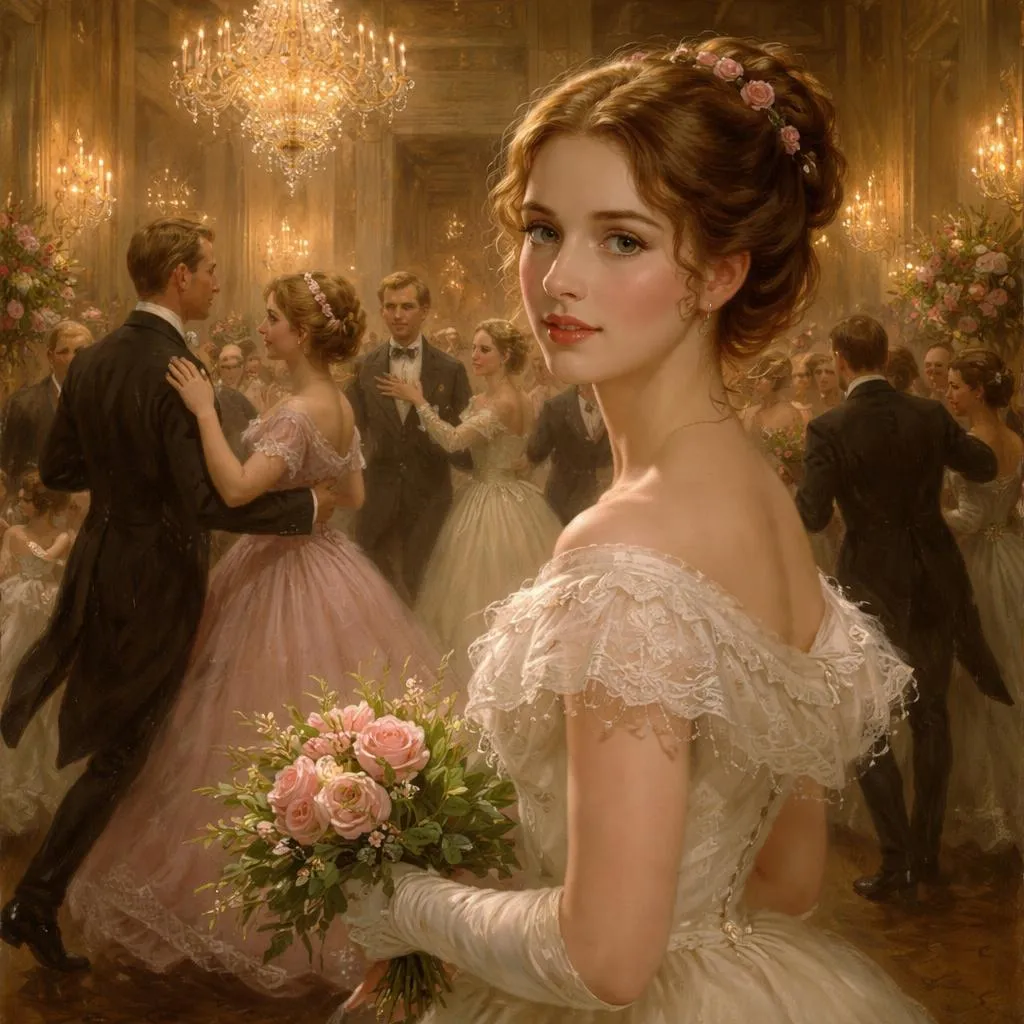

At eighteen, Miss Murray was to emerge from the quiet obscurity of the schoolroom into the full blaze of the fashionable world—as much of it, at least, as could be had out of London; for her papa could not be persuaded to leave his rural pleasures and pursuits, even for a few weeks’ residence in town. She was to make her debut on the third of January, at a magnificent ball, which her mamma proposed to give to all the nobility and choice gentry of O—– and its neighbourhood for twenty miles round. Of course, she looked forward to it with the wildest impatience, and the most extravagant anticipations of delight.
‘Miss Grey,’ said she, one evening, a month before the all–important day, as I was perusing a long and extremely interesting letter of my sister’s—which I had just glanced at in the morning to see that it contained no very bad news, and kept till now, unable before to find a quiet moment for reading it,—’Miss Grey, do put away that dull, stupid letter, and listen to me! I’m sure my talk must be far more amusing than that.’
She seated herself on the low stool at my feet; and I, suppressing a sigh of vexation, began to fold up the epistle.
‘You should tell the good people at home not to bore you with such long letters,’ said she; ‘and, above all, do bid them write on proper note–paper, and not on those great vulgar sheets. You should see the charming little lady–like notes mamma writes to her friends.’
‘The good people at home,’ replied I, ‘know very well that the longer their letters are, the better I like them. I should be very sorry to receive a charming little lady–like note from any of them; and I thought you were too much of a lady yourself, Miss Murray, to talk about the “vulgarity” of writing on a large sheet of paper.’
‘Well, I only said it to tease you. But now I want to talk about the ball; and to tell you that you positively must put off your holidays till it is over.’
‘Why so?—I shall not be present at the ball.’
‘No, but you will see the rooms decked out before it begins, and hear the music, and, above all, see me in my splendid new dress. I shall be so charming, you’ll be ready to worship me—you really must stay.’
‘I should like to see you very much; but I shall have many opportunities of seeing you equally charming, on the occasion of some of the numberless balls and parties that are to be, and I cannot disappoint my friends by postponing my return so long.’
‘Oh, never mind your friends! Tell them we won’t let you go.’
‘But, to say the truth, it would be a disappointment to myself: I long to see them as much as they to see me—perhaps more.’
‘Well, but it is such a short time.’
‘Nearly a fortnight by my computation; and, besides, I cannot bear the thoughts of a Christmas spent from home: and, moreover, my sister is going to be married.’
‘Is she—when?’
‘Not till next month; but I want to be there to assist her in making preparations, and to make the best of her company while we have her.’
‘Why didn’t you tell me before?’
‘I’ve only got the news in this letter, which you stigmatize as dull and stupid, and won’t let me read.’
‘To whom is she to be married?’
‘To Mr. Richardson, the vicar of a neighbouring parish.’
‘Is he rich?’
‘No; only comfortable.’
‘Is he handsome?’
‘No; only decent.’
‘Young?’
‘No; only middling.’
‘Oh, mercy! what a wretch! What sort of a house is it?’
‘A quiet little vicarage, with an ivy–clad porch, an old–fashioned garden, and—’
‘Oh, stop!—you’ll make me sick. How CAN she bear it?’
‘I expect she’ll not only be able to bear it, but to be very happy. You did not ask me if Mr. Richardson were a good, wise, or amiable man; I could have answered Yes, to all these questions—at least so Mary thinks, and I hope she will not find herself mistaken.’
‘But—miserable creature! how can she think of spending her life there, cooped up with that nasty old man; and no hope of change?’
‘He is not old: he’s only six or seven and thirty; and she herself is twenty–eight, and as sober as if she were fifty.’
‘Oh! that’s better then—they’re well matched; but do they call him the “worthy vicar”?’
‘I don’t know; but if they do, I believe he merits the epithet.’
‘Mercy, how shocking! and will she wear a white apron and make pies and puddings?’
‘I don’t know about the white apron, but I dare say she will make pies and puddings now and then; but that will be no great hardship, as she has done it before.’
‘And will she go about in a plain shawl, and a large straw bonnet, carrying tracts and bone soup to her husband’s poor parishioners?’
‘I’m not clear about that; but I dare say she will do her best to make them comfortable in body and mind, in accordance with our mother’s example.’
Contexto e Introdução do Autor
Este trecho é de um romance clássico do século 19 que explora temas de expectativas sociais, deveres familiares e crescimento pessoal. A história se concentra na Srta. Murray, uma jovem mulher se preparando para entrar na sociedade através de um baile de debutantes — um evento significativo que marca a introdução de uma jovem à elite social. A narrativa captura o contraste entre a empolgação da vida social e as realidades mais silenciosas e fundamentadas da família e da responsabilidade pessoal.
A autora, uma figura proeminente na literatura vitoriana, frequentemente escrevia sobre a vida de mulheres navegando pelos rígidos códigos sociais de sua época. Suas obras são conhecidas por observações agudas sobre o caráter e a sociedade, misturando humor com reflexões sérias sobre a natureza humana e as restrições sociais.
Interpretação Detalhada e Significado
Esta passagem destaca a tensão entre a antecipação juvenil e a responsabilidade madura. A Srta. Murray espera ansiosamente seu baile de debutantes, simbolizando sua entrada no mundo da moda. No entanto, através do diálogo com a Srta. Grey, vislumbramos as realidades práticas por trás de tais eventos — laços familiares, sacrifícios pessoais e as expectativas colocadas sobre as mulheres.
A conversa sobre o próximo casamento da irmã da Srta. Murray com um vigário modesto introduz temas de classe social e felicidade pessoal. A escolha da irmã contrasta fortemente com o glamouroso baile de debutantes, sugerindo diferentes caminhos que as mulheres daquela época poderiam tomar. A discussão sobre o caráter e o estilo de vida do vigário desafia julgamentos superficiais, enfatizando virtudes como bondade, sabedoria e contentamento em vez de riqueza ou aparência.
Lições e Insights para Estudantes
-
Compreendendo as Expectativas Sociais: A história oferece uma janela para os costumes sociais históricos, ajudando os alunos a apreciar como os papéis e expectativas sociais moldam as escolhas individuais. Reconhecer essas influências incentiva a empatia e o pensamento crítico sobre as normas sociais atuais.
-
Equilibrando Ambição e Dever: A empolgação da Srta. Murray com o baile contrasta com a vida mais tranquila e responsável de sua irmã. Os alunos podem aprender sobre como equilibrar os sonhos pessoais com as obrigações familiares e a importância de apoiar os entes queridos.
-
Julgando o Caráter Além das Aparências: O diálogo sobre o Sr. Richardson ensina o valor de olhar além dos traços superficiais, como riqueza ou aparência, para avaliar o verdadeiro caráter de alguém — uma lição essencial no desenvolvimento de relacionamentos significativos.
-
Apreciação de Diferentes Caminhos de Vida: A história mostra que a felicidade e a realização vêm de muitas formas, seja através do sucesso social ou de uma vida simples e virtuosa. Isso amplia as perspectivas dos alunos sobre sucesso e contentamento.
Aplicando o Espírito da História na Vida Diária
-
Na Escola: Os alunos podem aprender a respeitar diferentes origens e escolhas entre seus colegas, promovendo um ambiente inclusivo. Eles também podem refletir sobre o equilíbrio entre metas acadêmicas e vida familiar e social.
-
Em Ambientes Sociais: A história incentiva a bondade e a mente aberta, lembrando os alunos de não julgar os outros apressadamente com base na aparência ou no status social.
-
No Crescimento Pessoal: Abraçar tanto a ambição quanto a responsabilidade pode ajudar os alunos a desenvolver maturidade. Eles podem aspirar a realizações pessoais, permanecendo ao mesmo tempo fundamentados e atenciosos com os outros.
Cultivando Valores Positivos da História
-
Empatia e Compreensão: Ao ver diferentes perspectivas dentro da história, os alunos podem praticar a empatia, compreendendo os desafios e alegrias que os outros enfrentam.
-
Respeito pela Tradição e Mudança: A narrativa mostra respeito pela família e pela tradição, mas também sugere a possibilidade de escolha pessoal e felicidade além das expectativas sociais.
-
Sabedoria no Julgamento: Incentivar os alunos a olhar mais profundamente do que as impressões superficiais promove a sabedoria e uma melhor tomada de decisões em amizades e relacionamentos futuros.
-
Gratidão e Contentamento: A aceitação da irmã de uma vida modesta, mas feliz, convida à reflexão sobre a gratidão pelo que se tem e a encontrar alegria nas coisas simples.
Conclusão
Esta história é mais do que um conto de um baile de debutantes; é uma rica exploração da vida social, dos laços familiares e dos valores pessoais. Para os jovens leitores, oferece lições atemporais sobre caráter, empatia e as diversas maneiras pelas quais as pessoas encontram a felicidade. Ao se envolver com esses temas, os alunos podem desenvolver uma compreensão mais profunda de si mesmos e do mundo ao seu redor, preparando-os para vidas atenciosas e compassivas.
