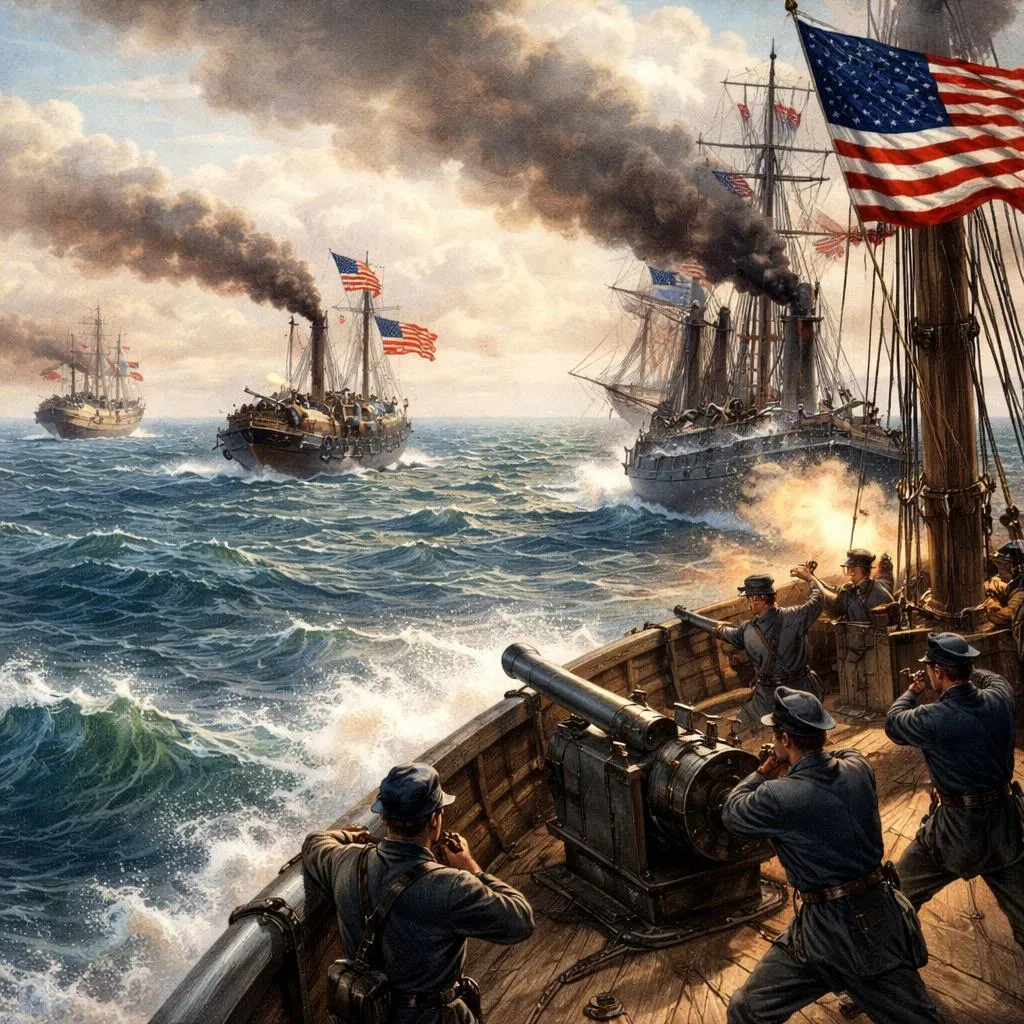

Captain Breaker had been in the main rigging with his night-glass, watching the movements of the chase; but he recognized the voice of Christy when he shouted to French to pick up the quarter-boat of the schooner, as he could no longer make out the Tallahatchie in the fog.
“Good-morning, Mr. Passford,” said he, as he met Christy when he descended from the rail. “I am glad to see you again.”
“Good-morning, Captain Breaker,” replied the lieutenant, as he took the offered hand of the commander. “I hope all is well on board, sir.”
“Entirely well, and your messenger came on board in good time, so that we were in position to get the first sight of the Trafalgar when she showed herself off Sand Island Lighthouse,” replied the captain, as he led the way to his cabin. “Mr. Ballard, keep a sharp lookout for the chase,” he added to the acting executive officer.
“Will you allow me to put on my uniform, Captain?” asked Christy. “I don’t feel quite at home on board the ship in the rigout I have worn all night.”
“Certainly; for I do not wish you to show yourself to the ship’s company while you look so little like a naval officer,” replied the captain, as he went to take another look at the darkness ahead.
The lieutenant hastened to his stateroom, and in a very short time he had washed off the smut from his face and hands, and dressed himself in his uniform, so that he looked like quite another person, Graines had gone to his room in the steerage for the same purpose, for neither of them desired to show himself as he had appeared before Captain Sullendine.
Christy hurried to the deck as soon as he had made the change, and met the commander on the quarter-deck. Lookouts were stationed aloft and on the top-gallant forecastle, and all hands were in a state of healthy excitement in view of the stirring event which was likely to transpire before the lapse of many hours; and doubtless some of the men were moved by the prospect of prize-money, not only from the proceeds of the sale of the steamer they were chasing, but from the full freight of cotton on board of the schooner, the deck load of which had been noted by some of the crew.
The schooner which had come so close aboard of the Bellevite was a mystery to all, from the captain down to the humblest seaman; but the American ensign over the Confederate flag had been observed by a few, and this settled her status. Not more than half of the seamen were aware that an expedition had left the ship at ten o’clock the evening before, and they had had no opportunity to notice the absence of the executive officer during the night; and even yet all hands had not been called, for the regular watch was enough to get the ship under way.
The commander conducted the executive officer to his own cabin, again reminding Mr. Ballard to keep a sharp lookout for the chase. Christy felt like himself again in his neat uniform, and his vigorous and well knit, as well as graceful form, did more to show off the dress than the dress did to adorn his person.
“I am very glad to see you again, Christy,” said Captain Breaker, seating himself and pointing to an arm-chair for the lieutenant, while he came down from the stately dignity of the commander of a man-of-war to the familiarity with which he treated his chief officer when they were alone. “I had no doubt that you would give a good account of yourself, as you always do. You were going on the enemy’s territory, and you were in peril all the time. Now you come off in a schooner, which appears to be loaded with cotton, and how or where you picked her up is a mystery to me;” and the commander indulged in a laugh at the oddity of the young officer’s reappearance. “Your messenger reported that the Trafalgar would sail at three o’clock in the morning, and I judge that she left at about that hour.”
“Within ten minutes of it, and probably made an arrangement with the commandant of the fort to that effect,” added Christy. “But they do not call her the Trafalgar now; though Weeks was not aware of the fact when I sent him on board. She is now the Tallahatchie, though I noticed that some in the vicinity of the fort still called her by her old name.”
“Never mind the name; she will answer our purpose as well under one appellation as another. When I asked your messenger about you and the other six men of your party, he was unable to give me any information in regard to your movements; and he could not tell me how you had ascertained the hour at which the steamer was to sail,” continued the captain.
“Graines and myself separated from the party as soon as we landed on the point; and we had obtained our information before we joined them again on the shore of Mobile Bay, sir. At the same time we had learned all about the West Wind”—
“The what?” interposed the commander.
“I mean the schooner West Wind, the one from which we came on board of the Bellevite, which was to be towed out by the Tallahatchie, and which was towed out by her till we on board of her cast off the towline.”
“Perhaps you had better narrate the events of your expedition seriatim, for all you say in this disconnected manner only thickens the mystery,” said the commander: and he knew that his officer had an excellent command of the English language, and could make a verbal report in a very attractive and telling style, though perhaps his fatherly interest in the young man had something to do with the matter.
Christy began his narrative with the departure from the ship, passing lightly over the minor details till he came to the meeting with the deserters from the West Wind, bivouacking in the hollow. He described the drinking bout which followed, in which he and Graines had pretended to join, stating the information he had obtained from them. He rehearsed a portion of Captain Sullendine’s speech, adding that most of his auditors were the seamen from the Bellevite, though he had sent four of them back to the ship before he reached the shore.
He detailed his interview with the master of the West Wind, explaining how he had shipped the new crew with him. The scenes in the cabin were described in full; in fact, every incident of any importance which had transpired during the night was related. The commander was deeply interested, and listened without comment to the narrative up to the moment when the narrator had come on board of the Bellevite. He was not sparing in his praise of the engineer, and separated what he had said and done as far as he could from his own words and actions.
The commander then questioned him in regard to the armament of the Tallahatchie, and he repeated the meagre information he had obtained from Bokes. Some conversation concerning Armstrong guns followed; but both of them were well posted in regard to this long-range piece. Christy read the satisfaction with which the captain heard his statements on his face.
A knock at the door of the cabin disturbed the conference, and the lieutenant was directed to open the door. The shaking and straining of the ship had for some time indicated that Paul Vapoor was fully alive to the importance of getting the Bellevite’s best speed out of her on the present occasion; and he did not intrust the duty to his subordinates. Christy opened the cabin door, and Midshipman Walters asked for the commander, and was admitted.
“Mr. Ballard directs me to inform you, sir, that we are gaining on the chase,” said the young officer. “The fog has lifted again, and we can make her out very clearly. The Holyoke has abandoned the chase, and appears to be headed for the schooner that came to on the starboard of the ship.”
“Tell Mr. Ballard to keep the ship as she is, headed for the Tallahatchie,” replied Captain Breaker.
“The Tallahatchie, sir?” queried the midshipman.
“Formerly the Trafalgar,” added the commander.
The young officer touched his cap and retired.
“This Captain Sullendine is still secured in his stateroom on board of the West Wind, is he?” asked the captain, rising from his arm-chair.
“He was when I left the schooner, sir,” replied Christy. “French, the captain of the forecastle, is in charge of the vessel, with orders to anchor her a couple of miles to the eastward of the lighthouse. I have already commended French to your attention, Captain, as a faithful and reliable man, and I think he deserves promotion.”
“Your recommendation will go a great way to procure it for him," added the commander with a significant smile.
“He is a thorough seaman, has been the mate of a large coaster, and would have become master of her if his patriotic duty had not led him to ship in the navy.”
“He is a resolute and brave fellow in action, as I have had occasion to observe, and I shall remember him. When you are writing to your father it would be well for you to mention him; and the thing will be done at your request if not at mine.”
“It certainly would not be done without your indorsement, for my father will not indulge in any favoritism aside from real merit," protested the lieutenant, with some warmth.
“You are quite right, Christy. We must go on deck now,” added Captain Breaker, as he moved towards the door. “You have been up all night, my boy; it will be some hours before we come within reach of the chase, and you can turn in and get a little sleep before anything stirring takes place on board.”
The excitement which had animated the young officer during the night had subsided with the rendering of his report, and the responsibility of a command no longer rested upon him, and for the first time since he embarked in the whaleboat, he began to feel tired and sleepy. He went on deck with the commander, and took a survey, first of the chase, then of the Holyoke, and finally of the West Wind.
Captain Breaker thought the Tallahatchie was about five miles distant. Seen through the glass, for the fog had all blown away, and the daylight had begun to obscure the stars, the steamer seemed to be doing her best. The Holyoke was headed to the eastward, evidently intending to chase the West Wind, for she could not yet make out her flags, indicating that she was already a prize. She need not have troubled herself to pursue the schooner if she had known the facts in regard to her, for she was entitled to a share of the prize as a member of the blockading fleet at the time of her capture. But she could prevent her from being retaken by any boat expedition sent from the shore, as her lonely position where the Bellevite had been for several days might tempt some enterprising Confederate officer to do.
Although the last heaving of the log showed twenty knots, it was a quiet time of the deck of the Bellevite, and all the excitement on board was confined to the engine and fire rooms. With sundry gapes Christy had taken in the situation, and then he concluded to avail himself of the commander’s permission to retire to his stateroom, where he was soon in a sound slumber.
Just before, Captain Breaker had retired to his cabin, where he had a chart of the Gulf of Mexico spread out on his table. Assuming the point where the Tallahatchie had changed her course to the south-west, he drew a line in that direction, and realized that the chase could not go clear of the Passes of the Mississippi River; and she was likely to sight some Federal steamer in that locality.
As the daylight increased the weather improved so far as the fog was concerned and it promised to be a clear day, for the stars had not been obscured at any time during the night. The only alternative the commander could see for the chase, as he studied the chart, was to go to the southward before he could sight the Pass à l’Outre. He was so confident that this must be his course, that he decided to take advantage of the situation, and he went on deck at once, where he ordered the officer of the deck to make the course south south-west.
Contexto e Introdução do Autor
Este trecho vem de uma história clássica de aventura naval que captura a tensão e a emoção das batalhas marítimas durante a era dos navios a vapor e das escunas à vela. A história se passa no contexto da Guerra Civil Americana, uma época em que os bloqueios navais e as expedições ousadas eram cruciais para o esforço de guerra. O autor, cujo estilo narrativo detalhado e descrições vívidas dão vida ao mundo marítimo, era conhecido por sua capacidade de combinar precisão histórica com uma narrativa emocionante. Suas obras frequentemente destacam temas de bravura, lealdade e pensamento estratégico, tornando-as favoritas duradouras entre jovens leitores e entusiastas da história.
Análise Detalhada da História e Significado
A passagem se concentra no Capitão Breaker e no Tenente Christy enquanto se envolvem em uma perseguição naval de alto risco envolvendo a escuna Tallahatchie (anteriormente Trafalgar) e outros navios. A narrativa se desenrola com uma mistura de suspense, estratégia e interação de personagens, ilustrando as complexidades da guerra naval e a importância da liderança e da tomada de decisões rápidas.
Vários elementos-chave se destacam nesta história:
-
Liderança e Responsabilidade: O Capitão Breaker exemplifica uma liderança calma e decisiva, equilibrando a necessidade de vigilância com o cuidado por sua tripulação. A transformação do Tenente Christy de uma figura cansada e disfarçada em um oficial confiante em uniforme simboliza a restauração da ordem e da autoridade.
-
Coragem e Recurso: A infiltração ousada de Christy em território inimigo e sua capacidade de reunir informações cruciais demonstram coragem e engenhosidade, qualidades essenciais para o sucesso em situações desafiadoras.
-
Trabalho em Equipe e Confiança: As interações entre oficiais e membros da tripulação refletem a importância da confiança e da cooperação para alcançar objetivos comuns, especialmente em ambientes perigosos.
-
Contexto Histórico: A história fornece informações sobre as operações navais durante a Guerra Civil, como bloqueios, incentivos de dinheiro de prêmio e o uso de navios a vapor e à vela.
Lições e Inspirações para Estudantes
Os alunos podem aprender muito com esta história, não apenas sobre história, mas também sobre caráter e valores:
-
Resiliência na Adversidade: A perseverança de Christy, apesar do perigo e da fadiga, ensina o valor da resiliência e da determinação ao enfrentar desafios.
-
O Poder da Preparação: O planejamento cuidadoso e a prontidão da tripulação do Capitão Breaker destacam como a preparação e a atenção aos detalhes levam ao sucesso.
-
Integridade e Mérito: A recomendação de promoção baseada no mérito, e não no favoritismo, ressalta a importância da justiça e de ganhar respeito por meio de trabalho duro e capacidade.
-
Pensamento Estratégico: O uso de mapas pelo comandante e a antecipação dos movimentos do inimigo incentivam o pensamento crítico e as habilidades de planejamento.
Aplicando o Espírito da História na Vida Cotidiana
-
No Aprendizado: Os alunos podem emular a curiosidade e a dedicação de Christy, preparando-se minuciosamente para seus estudos e sendo corajosos ao abordar assuntos difíceis.
-
Em Situações Sociais: A ênfase da história na confiança e no trabalho em equipe pode inspirar os alunos a construir relacionamentos fortes e de apoio com colegas e professores.
-
No Crescimento Pessoal: Os temas de coragem e integridade incentivam os jovens a defender o que é certo e a agir com responsabilidade, mesmo sob pressão.
-
Na Liderança: Seja em projetos escolares ou atividades comunitárias, os alunos podem praticar a liderança sendo calmos, justos e incentivando a cooperação entre os membros do grupo.
Cultivando Qualidades Positivas da História
-
Bravura: Enfrentar medos e entrar em novos papéis com confiança, como Christy, pode ajudar os alunos a crescer em autoconfiança.
-
Disciplina: Manter o foco e a compostura, como mostrado pelos oficiais, é fundamental para atingir metas.
-
Empatia e Apoio: Reconhecer e valorizar as contribuições dos outros, como o Capitão Breaker faz com French, promove um ambiente positivo e inclusivo.
-
Adaptabilidade: Estar pronto para mudar os planos e responder a novas informações, assim como a tripulação ajusta seu curso, é uma habilidade essencial para a vida.
Conclusão
Esta história de aventura naval é mais do que um conto emocionante de perseguições marítimas e estratégia em tempo de guerra; é uma rica fonte de lições sobre coragem, liderança e integridade. Ao explorar seus personagens e temas, os alunos podem se inspirar para enfrentar seus próprios desafios com determinação e justiça. A história incentiva os jovens leitores a desenvolver qualidades que lhes serão úteis na escola, nas amizades e nas carreiras futuras, tornando-a uma adição valiosa a qualquer currículo educacional.
