
Captain Breaker watched the Tallahatchie with the most earnest attention; and it was not five minutes after he had given out the new course before she changed her direction, though not to the south, but enough to carry her clear of the Passes of the Mississippi. Paul Vapoor was still crowding the engine to the utmost that could be done with safety, and he spent no little of his time in the fire room, personally directing the men in the work of feeding the furnaces.
It was evident to the commander that his ship was gaining on the Tallahatchie, at least a knot an hour, as he estimated it, and the chase could not now be more than four miles distant. This was within the range of her Armstrong gun, if it was of the calibre reported by Bokes, whose information was mere hearsay, and was open to many doubts.
“She is changing her course again, Captain Breaker,” said Mr. Ballard, who had been observing the chase with the best glass on board.
“Probably she has discovered a man-of-war in the distance,” added the captain.
“I cannot make out anything to the westward of her,” said Mr. Ballard, who had directed his glass that way.
“She knows very well that she is liable to encounter a Federal ship on the course she is running. How does she head now?”
“As nearly south as I can make it out.”
“Then we have made something on her by going to the south south-west in good season; and I am sorry I did not do it sooner,” replied the commander, as he went into a fine calculation, estimating sundry angles, and figuring on the gain he was confident he had already made.
“I think she is headed due south now, Captain,” said Mr. Ballard.
“So I should say, and we are headed a little too much to the westward. Make the course south by west half west, Mr. Ballard.”
This course was given to the quartermaster conning the wheel. For another hour the two steamers kept on the course taken, at the end of which time the captain believed they were within three miles of each other; and the appearance, as viewed by skilful and experienced officers, verified his estimate of the relative speed of both—that the Bellevite was gaining about a knot an hour on the chase.
They had hardly agreed upon the situation before a cloud of smoke was seen to rise from the waist of the Tallahatchie, followed by the report of a heavy gun. The projectile struck the water at least a quarter of a mile ahead of the Bellevite, at which the watch on deck gave a half-suppressed cheer.
“They must have better gunners than that indicates on board of that steamer, for she has been fitted out as a cruiser,” said the commander with a quiet smile.
Twenty minutes later another puff of smoke, followed by a second report, excited the attention of an officer on the deck of the loyal ship. The shot struck the water only a little less ahead of the ship than the former, and the crew gave a more vigorous cheer: but it was observed that it hit the sea a little on the starboard bow, so that if it had been better aimed it would not have reached the ship.
“She is wasting her ammunition,” said the captain. “She seems to be jesting, or else she is trying to frighten us.”
“I think it is some thing worse than that, Captain Breaker,” replied Mr. Ballard.
“What could be worse?”
“I am inclined to the opinion that she cannot swing the gun around so as to make it bear on an object so far astern of her as this ship is at the present moment.” said the lieutenant.
“He has an all sufficient remedy for that,” added the captain. “He can swing his ship’s head around so his gun will bear on us.”
“But that would cause him to lose a quarter of a mile or more of his advantage; and she seems to be more inclined to run away from the Bellevite than to fight her,” suggested the lieutenant.
“Call all hands, Mr. Ballard,” said the commander; and in a few minutes all the officers and seamen were at their stations.
The call awoke Christy from his slumber, which the report of the gun and the cheering of the men had failed to do. But he understood the summons, and thought the action was about to begin. He adjusted his dress and hastened to the quarter deck, where he reported in due form to the captain. Mr. Ballard was relieved of his duties as acting executive officer, and went to his proper station to take command of his division. Christy took a careful survey of the situation, and saw that the Bellevite had gained at least two knots on the chase. The Holyoke and the West Wind were no longer in sight, though the fog seemed to be still hanging about the entrance to Mobile Bay.
“The Tallahatchie has fired two shots at us, Mr. Passford; but she wasted her ammunition,” said the commander. “I am inclined to agree with Mr. Ballard that she cannot swing her Armstrong gun so as to cover the Bellevite.”
“She has stopped her screw, sir!” exclaimed the first lieutenant, who was looking at the chase through the best glass.
“Make the course west, Mr. Passford!” said the captain with energy.
“Quartermaster, make it west!” shouted Christy.
“West, sir!” repeated the quartermaster, as he caused the helmsmen to heave over the wheel.
Directing his glass to the chase again, Christy saw the Tallahatchie swing around so that she was broadside to the Bellevite. Almost at the same moment the smoke rose from her deck, and the sound of the gun reached the ears of the officers and crew. The shot passed with a mighty whiz between the fore and main mast of the ship, cutting away one of the fore topsail braces, but doing no other damage. The seamen cheered as they had before. The Tallahatchie started her screw as soon as she had discharged her gun, and resumed her former course, the Bellevite doing the same.
If the loyal ship had not promptly altered her course, the projectile would have raked her, and must have inflicted much greater injury in the spars and rigging. But both vessels promptly resumed their former relative positions, though the Tallahatchie had lost some of her advantage by coming to, while her pursuer had only made a small circuit without stopping her engine for a moment.
“If she does that again, Mr. Passford, we must be ready to return her fire,” said the captain. “Have the pivot gun ready, and aim for her Armstrong, which seems to be sufficiently prominent on her deck to make a good target.”
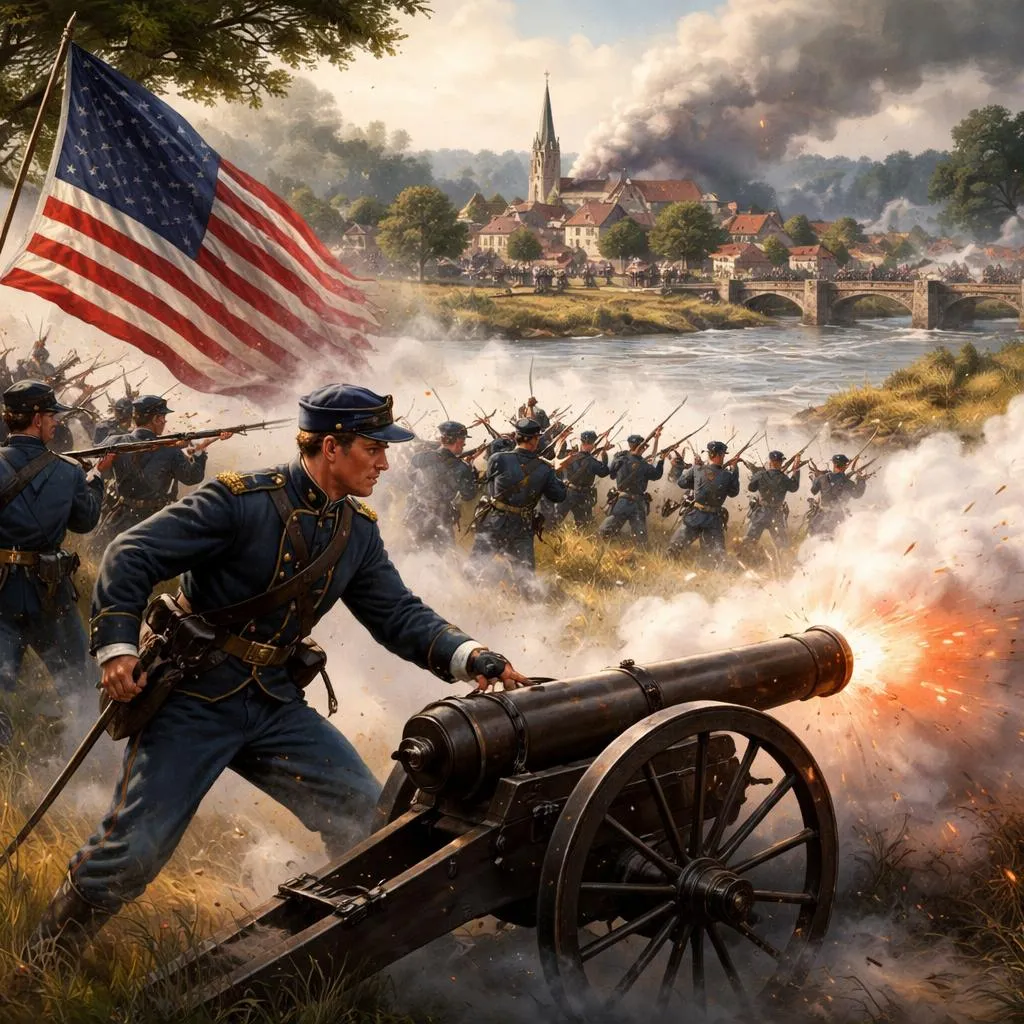
Christy hastened forward, and gave the order to Mr. Ballard, in whose division the great Parrot was included. The signal was promptly given for manning the gun, and seventeen men immediately sprang to their stations. The men were armed with cutlasses, muskets, battle-axes, pistols, and pikes, which were so disposed as to be in readiness for boarding the enemy, or repelling boarders.
“A solid shot, and aim at the pivot gun of the enemy,” said Christy in a low tone to the second lieutenant, who had the reputation of being an expert in the handling of guns of the largest calibre.
There were two captains to the pivot gun, one on each side, stationed nearest to the base of the breech. Seventeen men were required to work the pivot gun, whose duties were defined in the names applied to them, the powderman being the odd one. The first and second captains were numbers one and two; the odd numbers being on the right, and the even on the left of the piece: number three was the first loader, four the first sponger, five the second loader, six the second sponger, seven the first shellman, eight the second shellman, nine the first handspikeman, ten the second handspikeman, eleven the first train tackleman, twelve the second train tackleman (the last two at the breech, next to the captains), thirteen first side tackleman, fourteen second side tackleman, fifteen first port tackleman, sixteen second port tackleman.
The gun crew had been frequently drilled in the management of the piece, and the men were entirely at home in their stations. Other hands had been trained in serving the gun, so that the places of any disabled in action could be replaced. The service at the Parrot was not all that was required of the men forming the gun crew, for each was also a first or second boarder, a pumpman, or something else, and to each number one or two weapons were assigned, as musket and pike, sword and pistol, battle-axe. When the order to board the enemy was given, every man knew his station and his proper officer.
“Silence, men!” commanded the second lieutenant, “Cast loose and provide!”
These orders were repeated by the first captain of the gun. It is his duty to see the piece cleared and cast loose, and everything made ready for action. He and the second captain “provide” themselves with waist belts and primers, and the first with some other implements. But the handling of one of these great guns is about as technical as a surgical operation would be, and it would be quite impossible for the uninitiated to understand it, though it is every-day work to the ordinary man-of-war’s-man.
Prompted by the executive officer, who had been further instructed by the captain, all the series of steps had been taken which put the piece in readiness to be discharged, and all that remained to be done was to adjust the aim, which is done by the first captain. At this time the distance between the two ships had been considerably reduced. The captain and the first lieutenant were closely watching the chase with glasses.
The crew of the Tallahatchie could be seen at work at the long gun, and another shot from it was momentarily expected. The instant the bow of the enemy began to swerve to port, the captain of the Bellevite gave the order to put the helm to starboard. Almost at the same instant the enemy stopped her screw, swung round and fired her long gun. The projectile crashed through the bulwarks between the foremast and top-gallant forecastle, wounding two men with the splinters which flew in every direction.
Dr. Linscott and his mates had established themselves in the cockpit, to which the wounded are conveyed, in action, for treatment. The two men who had been injured by the splinters were not disabled, and they were ordered to report to the surgeon. Before the enemy could resume her course, the captain of the pivot gun had caught his aim, and discharged the Parrot. All hands watched for the result of the shot, and the glasses of the captain and the first lieutenant were directed to the chase.
She was near enough now to be observed with the naked eye with tolerable accuracy, and a shout went up from the men at the pivot gun, in which the rest of the crew on deck joined, as they saw that the shot had struck the midship gun of the enemy, or very near it; and this was the point where old Blumenhoff, the captain of the gun, had been directed to aim. He was a German, but he had served for twenty-one years in the British navy, and had won a brilliant reputation in his present position.
It could not be immediately determined whether or not the Armstrong had been disabled. The Tallahatchie had swung round again and resumed her flight; but her commander must have realized by this time that he was getting the worst of it. Paul Vapoor had not left his post in the engine and fire room, to ascertain how the battle was going, but still plied all his energies in driving the Bellevite to the utmost speed she could possibly attain. The log was frequently heaved, and the last result had been sent down to him by Midshipman Walters, and it was twenty-one knots.
During the next hour the long gun of the enemy was not again discharged, and the officers of the loyal ship were assured that it had been rendered useless by Blumenhoff’s only shot.
Contexto e Introdução do Autor
Esta emocionante cena de perseguição naval é de um romance clássico de aventura marítima, um gênero popular no século 19 que cativou a imaginação dos jovens leitores com contos de coragem, estratégia e os perigos do mar. A história provavelmente vem de um autor experiente em vida náutica, possivelmente alguém que serviu na marinha ou passou muito tempo a bordo de navios. Tais autores visavam trazer realismo e ação emocionante para seus leitores, pintando imagens vívidas de guerra naval e os desafios enfrentados pelos marinheiros.
A narrativa se concentra no Capitão Breaker e seu navio, o Bellevite, enquanto eles perseguem o Tallahatchie, um navio a vapor equipado como um cruzador. A história destaca o pensamento estratégico, a liderança e a bravura necessárias em combates navais, bem como o conhecimento técnico necessário para operar armas complexas e gerenciar um navio sob pressão.
Interpretação Detalhada e Significado
A passagem ilustra uma perseguição naval tensa e cheia de suspense, enfatizando temas de vigilância, tomada de decisão rápida e trabalho em equipe. As observações e cálculos cuidadosos do Capitão Breaker mostram a importância da inteligência e da antecipação para superar um oponente. A prontidão da tripulação em responder aos comandos, sua disciplina no manejo das armas e sua coragem diante do perigo refletem valores de lealdade e dever.
A descrição detalhada da equipe da arma de pivô e seus papéis educa os leitores sobre a complexidade da guerra naval e a importância da contribuição de cada indivíduo para o esforço coletivo. A história retrata não apenas os desafios físicos da batalha, mas também a acuidade mental e a coordenação necessárias para ter sucesso.
Lições e Insights para Estudantes
-
Pensamento Estratégico e Resolução de Problemas: A capacidade do Capitão Breaker de analisar a situação, prever os movimentos do inimigo e ajustar suas táticas ensina aos alunos o valor do pensamento crítico e da adaptabilidade em situações desafiadoras.
-
Trabalho em Equipe e Liderança: A história destaca como cada membro da tripulação, de oficiais a artilheiros, desempenha um papel vital. A liderança eficaz motiva e organiza a equipe, enquanto a habilidade e a cooperação de cada indivíduo contribuem para o sucesso. Esta é uma lição valiosa para projetos em grupo e interações sociais.
-
Coragem e Responsabilidade: Os marinheiros enfrentam o perigo com bravura, cumprindo seus deveres apesar dos riscos. Isso incentiva os alunos a enfrentar seus próprios desafios com coragem e um senso de responsabilidade.
-
Conhecimento Técnico e Preparação: Compreender a operação das armas do navio e a importância dos exercícios mostra que a preparação e o aprendizado de habilidades técnicas são cruciais para um desempenho eficaz. Os alunos podem relacionar isso à importância de estudar e praticar habilidades na escola e na vida.
Aplicando o Espírito da História na Vida Diária
-
No Aprendizado: Como a tripulação se preparando e praticando seus papéis, os alunos devem se preparar completamente para exames e projetos, entendendo que o conhecimento e a prática levam à confiança e ao sucesso.
-
Em Situações Sociais: Liderança e trabalho em equipe da história podem inspirar os alunos a serem amigos solidários e membros responsáveis do grupo, ajudando os outros e trabalhando juntos para alcançar objetivos comuns.
-
Na Superação de Desafios: A coragem demonstrada pelo Capitão Breaker e sua tripulação pode motivar os alunos a enfrentar dificuldades — sejam acadêmicas, pessoais ou sociais — com determinação e calma.
Cultivando Valores Positivos da História
-
Disciplina: A resposta disciplinada da tripulação aos comandos ensina a importância do autocontrole e de cumprir as responsabilidades.
-
Respeito pelos Papéis: Reconhecer que cada papel importa incentiva o respeito pelas contribuições dos outros, promovendo a empatia e a cooperação.
-
Paciência Estratégica: O planejamento cuidadoso do capitão antes de enfrentar o inimigo mostra que a paciência e a ação ponderada geralmente levam a melhores resultados do que decisões precipitadas.
Conclusão
Esta aventura naval não apenas diverte com sua ação vívida e suspense, mas também oferece ricas lições de liderança, trabalho em equipe, coragem e pensamento estratégico. Ao refletir sobre a história, os alunos podem se inspirar para desenvolver essas qualidades em suas próprias vidas — seja na escola, nas amizades ou em carreiras futuras. O conto nos lembra que o sucesso muitas vezes depende da preparação, cooperação e da bravura para enfrentar os desafios de frente.
