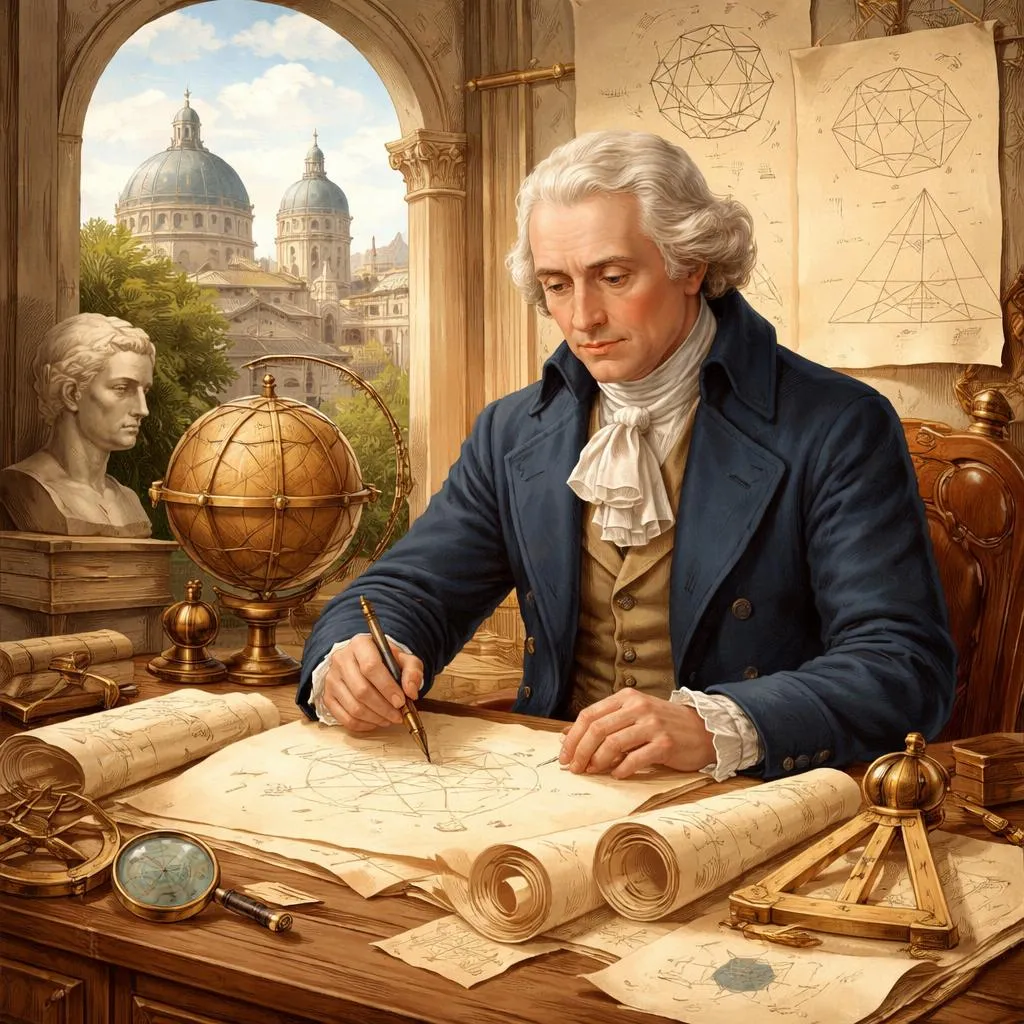

Gaspard Monge was born at Beaune on May 10, 1746, and died at Paris on July 28, 1818. He was the son of a small pedlar, and was educated in the schools of the Oratorians, in one of which he subsequently became an usher. A plan of Beaune which he had made fell into the hands of an officer who recommended the military authorities to admit him to their training school at Mézières. His birth, however, precluded his receiving a commission in the army, but his attendance at an annexe of the school where surveying and drawing were taught was tolerated, though he was told that he was not sufficiently well born to be allowed to attempt problems which required calculation. At last his opportunity came. A plan of a fortress having to be drawn from the data supplied by certain observations, he did it by a geometrical construction. At first the officer in charge refused to receive it, because etiquette required that not less than a certain time should be used in making such drawings, but the superiority of the method over that then taught was so obvious that it was accepted; and in 1768 Monge was made professor, on the understanding that the results of his descriptive geometry were to be a military secret confined to officers above a certain rank.
In 1780 he was appointed to a chair in mathematics in Paris, and this with some provincial appointments which he held gave him a comfortable income. The earliest paper of any special importance which he communicated to the French Academy was one in 1781, in which he discussed the lines of curvature drawn on a surface. These had been first considered by Euler in 1760, and defined as those normal sections whose curvature was a maximum or a minimum. Monge treated them as the locus of those points on the surface at which successive normals intersect, and thus obtained the general differential equation. He applied his results to the central quadrics in 1795. In 1786 he published his well-known work on statics.
Monge eagerly embraced the doctrines of the revolution. In 1792 he became minister of the marine, and assisted the committee of public safety in utilizing science for the defence of the republic. When the Terrorists obtained power he was denounced, and escaped the guillotine only by a hasty flight. On his return in 1794 he was made a professor at the short-lived Normal school, where he gave lectures on descriptive geometry; the notes of these were published under the regulation above alluded to. In 1796 he went to Italy on the roving commission which was sent with orders to compel the various Italian towns to offer pictures, sculpture, or other works of art that they might possess, as a present or in lieu of contributions to the French republic for removal to Paris. In 1798 he accepted a mission to Rome, and after executing it joined Napoleon in Egypt. Thence after the naval and military victories of England he escaped to France.
Monge then settled down at Paris, and was made professor at the Polytechnic school, where he gave lectures on descriptive geometry; these were published in 1800 in the form of a textbook entitled Géométrie descriptive . This work contains propositions on the form and relative position of geometrical figures deduced by the use of transversals. The theory of perspective is considered; this includes the art of representing in two dimensions geometrical objects which are of three dimensions, a problem which Monge usually solved by the aid of two diagrams, one being the plan and the other the elevation. Monge also discussed the question as to whether, if in solving a problem certain subsidiary quantities introduced to facilitate the solution become imaginary, the validity of the solution is thereby impaired, and he shewed that the result would not be affected. On the restoration he was deprived of his offices and honours, a degradation which preyed on his mind and which he did not long survive.
Most of his miscellaneous papers are embodied in his works, Application de l'algèbre à la géométrie , published in 1805, and Application de l'analyse à la géométrie , the fourth edition of which, published in 1819, was revised by him just before his death. It contains among other results his solution of a partial differential equation of the second order.
Antecedentes e Introdução do Autor
Gaspard Monge foi um notável matemático e cientista francês nascido em 1746 em Beaune, França. Vindo de uma origem humilde como filho de um pequeno vendedor ambulante, a história de vida de Monge é uma história de determinação e brilhantismo intelectual superando barreiras sociais. Apesar dos obstáculos iniciais devido ao seu status de nascimento, ele perseguiu a educação com paixão e rapidamente se destacou nos campos da geometria e da matemática. Seu trabalho lançou as bases para a geometria descritiva, um ramo da matemática que nos ajuda a representar objetos tridimensionais em duas dimensões — uma habilidade crucial em engenharia, arquitetura e arte.
Monge viveu um período turbulento na história francesa, incluindo a Revolução Francesa. Ele não foi apenas um cientista, mas também um servidor público que usou seu conhecimento para apoiar o governo revolucionário. Sua carreira incluiu funções como professor, ministro e conselheiro científico de Napoleão. Suas contribuições para a matemática e a ciência estavam profundamente interligadas com as mudanças sociais e políticas de seu tempo.
Interpretação Detalhada e Significado
A história de Gaspard Monge não é um conto fictício, mas uma narrativa da vida real de perseverança, inovação e o poder da educação. Seu desenvolvimento da geometria descritiva foi uma descoberta em como visualizamos e resolvemos problemas espaciais. Este método permite que formas tridimensionais complexas sejam compreendidas através de desenhos bidimensionais, o que é fundamental em muitos campos hoje.
O trabalho de Monge sobre linhas de curvatura, estática e equações diferenciais também avançou significativamente a compreensão matemática. Sua abordagem combinou visão teórica com aplicação prática, mostrando como a matemática abstrata pode resolver problemas do mundo real. Além disso, seu papel durante a Revolução Francesa destaca como a ciência e a política podem se cruzar, às vezes com grande risco pessoal.
Lições e Insights para Estudantes
Os alunos que leem sobre Monge podem aprender várias lições valiosas:
-
Superando Obstáculos: A vida inicial de Monge nos ensina que a origem ou o status social não determinam o potencial de alguém. Com dedicação e trabalho árduo, qualquer pessoa pode alcançar a grandeza.
-
A Importância da Educação: O sucesso de Monge foi construído sobre seu profundo conhecimento e aprendizado contínuo. Isso incentiva os alunos a valorizar sua educação e se esforçar para entender os assuntos profundamente.
-
Inovação e Criatividade: Os novos métodos de Monge em geometria mostram como o pensamento criativo pode levar a avanços. Os alunos devem ser incentivados a pensar fora da caixa e abordar os problemas de novos ângulos.
-
Ciência e Sociedade: O envolvimento de Monge na política nos lembra que a ciência não está isolada do mundo. O conhecimento pode ser usado para servir à sociedade e contribuir para causas importantes.
Aplicações Práticas na Vida Diária
-
No Aprendizado: A geometria descritiva de Monge pode inspirar os alunos a melhorar suas habilidades de raciocínio espacial, úteis em disciplinas como matemática, física e arte.
-
Na Resolução de Problemas: Seu exemplo incentiva os alunos a serem pacientes e persistentes ao enfrentar problemas difíceis, sabendo que soluções inovadoras geralmente exigem tempo e esforço.
-
Na Interação Social: Compreender a coragem de Monge diante do perigo político pode inspirar os alunos a defender suas crenças e contribuir positivamente para suas comunidades.
Cultivando Qualidades Positivas
Para incorporar o espírito de Monge, os alunos podem:
-
Desenvolver curiosidade e amor pelo aprendizado, explorando assuntos além da sala de aula.
-
Praticar a resiliência, vendo os fracassos como oportunidades de aprendizado.
-
Abraçar a criatividade, experimentando novas ideias e abordagens.
-
Reconhecer o valor de contribuir para a sociedade, seja através da ciência, arte ou ação social.
Conclusão
A vida e o trabalho de Gaspard Monge oferecem uma rica fonte de inspiração para jovens aprendizes. Sua jornada, de uma origem modesta a se tornar um pioneiro em matemática e uma figura-chave na história, mostra o poder da educação, inovação e coragem. Ao estudar sua história, os alunos podem obter não apenas conhecimento, mas também a motivação para perseguir seus próprios objetivos com determinação e integridade.
